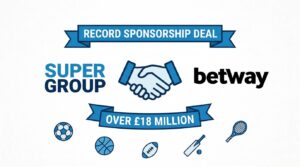
Super Group, the parent company behind the Betway brand, has committed to what is understood to be its largest sponsorship investment to date, with a deal valued at over £18 million spanning multiple major sports. The agreement marks a significant escalation in the operator’s strategy to embed its brand across high-visibility sporting properties. While specific details of the partner organisations remain closely held, the scale of the commitment signals a clear pivot toward deeper market penetration through sports marketing.
What This Record Sponsorship Means for Betway’s Market Position
A deal of this magnitude doesn’t arrive in isolation. It reflects both the competitive pressure facing online gambling operators and the premium now attached to sports sponsorship inventory. Here’s what stands out:
- At over £18 million, this is Super Group’s single largest sponsorship outlay, surpassing previous Betway agreements in football, horse racing, and esports
- The multi-sport scope suggests a portfolio approach to brand exposure rather than concentration in one discipline
- Timing matters: the deal arrives as regulatory scrutiny of gambling sponsorships intensifies across several European markets
- For rival operators, the benchmark has shifted — matching this level of investment will be necessary to compete for equivalent visibility
- The investment underscores Super Group’s confidence in sponsorship ROI despite ongoing debates about the effectiveness of logo placement versus digital-first marketing
Why Super Group Is Doubling Down on Sports Visibility
Betway has long positioned itself as a premium sportsbook brand, and its sponsorship history reflects that ambition. Partnerships with Premier League clubs, major horse racing events, and esports tournaments have given the brand consistent exposure in markets where customer acquisition costs continue to climb. But this latest deal represents something qualitatively different.
Rather than securing a single jersey front or stadium naming right, the reported structure spans multiple sports. That diversification is deliberate. It hedges against the risk of any one sport tightening its rules around gambling partnerships (a distinction regulators have been slow to enforce uniformly across jurisdictions). It also broadens the demographic reach, capturing audiences that a single-sport deal simply cannot.
The question nobody at Super Group is answering publicly: how much of this spend is offensive — chasing growth — and how much is defensive, protecting market share against aggressive competitors like Flutter Entertainment and Entain?
The Regulatory Backdrop Complicating Gambling Sponsorships
This deal lands at a moment when the relationship between sports and gambling brands is under sustained political pressure. The UK’s Gambling Act review, concluded in 2023, stopped short of a blanket ban on shirt sponsorships but introduced tighter voluntary codes. Italy and Spain have already imposed significant restrictions. And Belgium’s advertising rules have made large-scale sports sponsorships increasingly difficult for operators to execute.
Still, the UK market — where Betway operates as one of the more recognised online sportsbook brands — remains comparatively permissive. That window may not stay open indefinitely. Operators are aware that the current regulatory posture could shift within a single parliamentary cycle, which arguably makes locking in long-term sponsorship agreements now a form of strategic insurance.
How This Compares to Competitor Spending
| Operator | Notable Sponsorship | Estimated Annual Value |
|---|---|---|
| Betway (Super Group) | Multi-sport portfolio deal | £18m+ (total deal value) |
| Bet365 | Stoke City, various racing partnerships | Not publicly disclosed |
| Flutter (Paddy Power/Betfair) | Multiple Premier League and Serie A deals | Estimated £30m+ across brands annually |
| Entain (Ladbrokes/Coral) | Horse racing, football, rugby league | Estimated £20m+ annually across portfolio |
Even against the largest operators, Super Group’s single-deal commitment stands out. Flutter’s total may be higher, but it is spread across multiple brands and dozens of individual contracts. Concentrating over £18 million into one structured agreement carries different risk — and different upside.
Strategic Psychology Behind Large-Scale Brand Sponsorship
Beyond the financials, there’s a behavioural dimension worth examining. Sports sponsorship operates on principles closely aligned with neuro-linguistic programming concepts around anchoring and repeated association. When a consumer sees a brand logo during a moment of excitement — a last-minute goal, a photo finish, a championship-clinching play — the emotional state becomes linked to the brand at a subconscious level. This is not speculation; it is the foundational logic behind decades of sports marketing research.
Betway’s multi-sport approach amplifies this effect. By appearing across different sporting contexts, the brand creates multiple anchoring points. A football fan and a horse racing enthusiast may never overlap in their viewing habits, yet both encounter the same brand during peak emotional engagement. The cumulative effect builds what marketers call “ambient familiarity” — the sense that a brand belongs in the sporting landscape, even if the viewer has never placed a bet.
There’s also a framing effect at work. Associating with premium sporting events frames Betway as a premium product. Consumers unconsciously transfer the prestige of the event to the sponsor. And in a market where trust and perceived legitimacy differentiate operators, that transfer carries real commercial weight. The investment isn’t just buying eyeballs. It’s buying context.
What makes this particularly effective is repetition without monotony. Each sport provides a fresh visual and emotional environment, preventing the brand fatigue that can set in with single-property sponsorships. The brain processes each encounter as partially novel, which sustains attention in ways that static billboard placement cannot.
Frequently Asked Questions
What is the value of Betway’s new sponsorship deal?
The deal is reported to be worth over £18 million, making it the largest single sponsorship investment in Super Group’s history across its portfolio of brands.
Which sports does the sponsorship cover?
The agreement spans multiple major sports, though the specific properties and disciplines involved have not been fully disclosed. Betway has historically maintained partnerships in football, horse racing, and esports.
Could regulatory changes affect this deal?
Potentially, yes. While the UK has not banned gambling sponsorships outright, the political trajectory across Europe suggests tighter restrictions could emerge. Operators entering long-term agreements now may be attempting to secure visibility before any future prohibitions take effect — though contract protections in such scenarios remain a matter of private negotiation.
How does this compare to what other gambling companies spend on sponsorship?
It places Super Group in the upper tier of individual deal commitments, though conglomerates like Flutter Entertainment likely spend more in aggregate across their multiple brands and markets.



