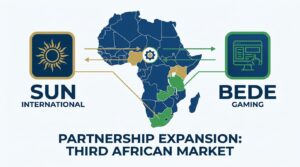
Sun International, one of Africa’s most prominent casino and hospitality operators, has extended its technology partnership with Bede Gaming into a third African jurisdiction. The deal deepens a relationship that has already delivered online gaming platforms across two markets, signalling Sun International’s accelerating digital ambitions on the continent. While specific jurisdictions were not named in the initial disclosure, the expansion underscores how established land-based operators in Africa are increasingly treating digital infrastructure as a strategic priority rather than a secondary channel.
What This Deal Signals for Africa’s Digital Gaming Landscape
The partnership between Sun International and Bede Gaming is not new, but its geographic widening carries implications that go beyond a single contract renewal. Here’s what matters most from a business and regulatory standpoint:
- Platform consistency across borders: By deploying Bede’s technology in a third market, Sun International gains operational uniformity, reducing the complexity of managing multiple vendor relationships across jurisdictions with differing regulatory frameworks.
- Regulatory confidence: Expanding into another licensed jurisdiction suggests that Bede’s platform has met compliance thresholds in markets where licensing requirements are still maturing — a non-trivial achievement in African regulatory environments.
- The deal reinforces a broader trend: legacy hospitality and gaming brands in Africa are no longer experimenting with digital. They are scaling it.
- Competitive positioning: Sun International operates over 30 properties across southern Africa. A unified digital layer across three jurisdictions arguably gives the group a structural edge over competitors still assembling their online strategies piecemeal.
Why Bede Gaming Keeps Winning These Contracts
Bede Gaming, a UK-headquartered platform provider, has built its reputation on flexibility and regulatory adaptability. The company’s technology stack supports both retail and online gaming operations, which makes it particularly suited to operators like Sun International’s multi-property gaming network that need to bridge physical and digital experiences.
What separates Bede from larger platform competitors is its willingness to configure deeply for individual market requirements. African jurisdictions, in particular, present a patchwork of licensing conditions, tax structures, and responsible gambling mandates. A one-size-fits-all platform rarely survives first contact with that reality. Bede’s modular architecture, at least on paper, allows operators to adapt without rebuilding.
Still, the question lingers: can a mid-sized UK supplier sustain this kind of bespoke delivery as it scales across more African markets simultaneously?
Africa’s Online Gaming Market: Growth With Guardrails
The continent’s regulated online gambling sector has been expanding steadily, driven by mobile penetration rates that outpace desktop adoption by a wide margin. South Africa, Nigeria, Kenya, and Ghana have all seen significant regulatory activity in recent years, though the pace and rigour of enforcement vary considerably (a distinction regulators have been slow to harmonise across borders).
For operators like Sun International, the opportunity is substantial but layered with complexity. Each new jurisdiction requires not just a technology deployment but a full compliance apparatus: local partnerships, responsible gambling tools calibrated to regional norms, and payment integrations that reflect how consumers in each market actually transact.
The table below offers a snapshot of key factors shaping digital gaming expansion in selected African markets:
| Factor | South Africa | Nigeria | Kenya |
|---|---|---|---|
| Regulatory maturity | Established but evolving; remote gambling bill under review | State-level licensing with federal oversight gaps | Centralised licensing via BCLB |
| Mobile penetration | High (~95%) | Very high; mobile-first market | High; M-Pesa integration critical |
| Tax environment | Operator and player-level taxation | Varies by state | 20% excise tax on stakes (revised from earlier rates) |
| Key challenge | Pending legislative clarity on online gambling | Fragmented regulation across 36 states | Public and political pressure on gambling advertising |
The Strategic Calculus Behind Platform Partnerships
Choosing a technology partner in regulated gaming is, in practice, choosing a long-term operating philosophy. The platform dictates how quickly an operator can launch in new markets, how efficiently it can respond to regulatory changes, and how seamlessly it can integrate third-party content from game studios and payment providers.
Sun International’s decision to deepen rather than diversify its supplier relationship with Bede Gaming’s platform technology suggests the operator values continuity and proven integration over the theoretical benefits of multi-vendor competition. That calculus makes sense when the cost of switching platforms mid-expansion is measured not just in money but in regulatory re-certification timelines and operational disruption.
And yet, vendor concentration carries its own risks. If Bede encounters capacity constraints or regulatory pushback in any single jurisdiction, the ripple effects could touch all three markets simultaneously.
How Operators Can Frame Digital Expansion as Organisational Capability
Beyond the contractual mechanics, this partnership illustrates something that gaming executives across Africa are increasingly recognising: digital expansion is not merely a technology procurement exercise. It demands a shift in how organisations perceive their own capabilities and communicate internally about change.
Drawing from principles of organisational communication and behavioural framing, operators that succeed in multi-jurisdiction digital rollouts tend to share certain traits. They anchor their teams around outcome-based language rather than process-driven directives. Instead of framing a new market launch as “deploying a platform,” high-performing organisations describe it as “building a new customer relationship channel” — a reframe that aligns technical teams, compliance officers, and commercial leaders around a shared mental model. This kind of internal alignment, where every stakeholder understands not just what is being built but why it matters to the end user, reduces friction during execution. Sun International’s ability to replicate its Bede deployment across three jurisdictions likely reflects not just technical compatibility but organisational readiness: teams that have learned from prior launches, internalised the regulatory nuances, and developed a shared vocabulary for what success looks like in each market. Operators that treat each new jurisdiction as an isolated IT project, rather than an extension of institutional knowledge, tend to stumble on the softer challenges — stakeholder buy-in, local team empowerment, and adaptive decision-making under regulatory ambiguity.
Frequently Asked Questions
What does Bede Gaming provide to Sun International?
Bede Gaming supplies the online gaming platform technology that powers Sun International’s digital operations, handling everything from player account management to regulatory compliance tooling and third-party content integration.
How many African jurisdictions does this partnership now cover?
Three. The latest expansion marks the third African market where Sun International has deployed Bede’s platform, though the specific jurisdictions have not all been publicly identified in the initial announcement.
Why is this expansion significant?
It reflects a broader strategic commitment by one of Africa’s largest land-based gaming operators to build a unified digital presence across multiple regulated markets — a move that few competitors have executed at this scale on the continent.
Is online gambling legal across Africa?
Legality varies significantly by country and, in some cases, by state or province within a country. Several major markets have established licensing frameworks, but regulatory harmonisation across the continent remains limited.