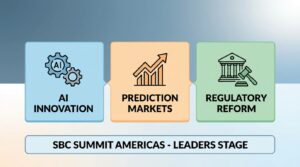
The Leaders Stage at SBC Summit Americas is shaping up as a focal point for senior-level discourse on the forces redefining the North American gambling and sports betting landscape. Scheduled to bring together C-suite executives, regulators, and technology leaders, the programme zeroes in on three converging themes: artificial intelligence integration, the rapid emergence of prediction markets, and the unfinished business of regulatory reform across U.S. and Latin American jurisdictions. The event positions itself not as a trade show sideshow but as a working forum where policy meets product strategy.
What the Leaders Stage Agenda Signals for the Industry
Before diving into the specifics, it’s worth framing why this particular lineup matters. The topics selected for the Leaders Stage reflect pressure points that boardrooms and state capitals are grappling with simultaneously. Here’s what stands out:
- AI is no longer theoretical. Operators are deploying machine learning for customer segmentation, responsible gambling triggers, and fraud detection — and regulators want to understand the guardrails.
- Prediction markets have moved from niche curiosity to mainstream controversy, with platforms like Kalshi and Polymarket forcing a conversation about where sports betting ends and financial speculation begins (a distinction regulators have been slow to enforce).
- Regulatory fragmentation persists. With more than 30 U.S. states now live with some form of legal sports wagering, the patchwork of compliance requirements continues to raise costs and slow market entry.
- Latin American markets, particularly Brazil and Mexico, are entering a critical phase of regulatory maturation that could reshape operator strategies across the hemisphere.
- The convergence of media, gaming, and technology capital is accelerating M&A activity and partnership structures that didn’t exist three years ago
AI on the Floor: From Buzzword to Balance Sheet
Artificial intelligence has saturated conference agendas across industries. What distinguishes its treatment at the SBC Summit Americas Leaders Stage is the emphasis on operational deployment rather than aspirational roadmaps. Sessions are expected to explore how AI-driven tools are already affecting customer lifetime value calculations, real-time odds compilation, and the detection of problem gambling behaviours before they escalate.
Still, the regulatory dimension looms large. State gaming commissions have yet to establish uniform standards for algorithmic transparency in betting platforms. That gap creates both risk and opportunity. Operators who can demonstrate responsible AI governance may find themselves with a competitive edge when licensing decisions come down to trust.
One tension worth watching: the use of generative AI in marketing personalisation versus the tightening of advertising standards in states like New York and Massachusetts. The tools are getting sharper. The rules are not keeping pace.
Prediction Markets and the Blurring of Categories
Few topics have generated as much regulatory heat in the past twelve months as prediction markets. The Commodity Futures Trading Commission’s evolving stance on event contracts, combined with court rulings that have alternately enabled and constrained platforms, has left the sector in a state of productive uncertainty.
For traditional sportsbook operators, prediction markets represent both a threat and a template. They attract a younger, digitally native demographic that views wagering through the lens of information markets rather than entertainment. And while the regulatory classification of these products remains contested, their growth trajectory is difficult to ignore.
The Leaders Stage is expected to feature direct exchanges between prediction market advocates and sportsbook executives. Whether those conversations produce alignment or sharpen the divide will say a great deal about where capital flows next.
Why This Matters Beyond the Conference Hall
Prediction markets sit at the intersection of gambling regulation, financial oversight, and First Amendment considerations. The outcome of current regulatory deliberations could determine whether these platforms operate under gaming commissions, financial regulators, or some hybrid framework that doesn’t yet exist. That ambiguity is precisely what makes the discussion urgent.
Regulatory Reform: Unfinished and Uneven
Six years after the Supreme Court struck down PASPA, the U.S. sports betting regulatory environment remains remarkably fragmented. Tax rates vary from 6.75% in Iowa to 51% in New York. Licensing timelines differ by months. And the question of federal oversight, once thought inevitable, has largely stalled in Congress.
| Jurisdiction | Tax Rate | Status |
|---|---|---|
| New York | 51% | Live, mobile |
| Iowa | 6.75% | Live, mobile and retail |
| Brazil | Under finalisation | Regulatory framework enacted 2023, implementation ongoing |
| Mexico | Varies by state | Federal and state licensing coexist |
Latin America adds another layer. Brazil’s regulated market is expected to be fully operational in 2025, but enforcement against unlicensed operators remains inconsistent. Mexico’s dual federal-state licensing model creates its own complexity for operators seeking scale.
Reframing Industry Dialogue Through Strategic Framing
Beyond the policy substance, the Leaders Stage programming reflects a broader shift in how the gambling industry communicates with itself. The framing of sessions around decision-making under uncertainty, stakeholder alignment, and adaptive strategy borrows from disciplines outside gaming. This is deliberate. As the industry matures, its leadership conversations increasingly mirror those in fintech, healthcare, and regulated technology sectors.
Effective leaders in this space are learning to hold multiple frames simultaneously: compliance as competitive advantage, technology as both enabler and liability, and market expansion as a function of political timing rather than pure demand. The ability to reframe challenges, to see regulatory friction not as an obstacle but as a filter that rewards prepared operators, separates those who scale from those who stall.
This kind of strategic reframing also applies to how companies communicate with regulators. Operators who approach licensing hearings with data-driven narratives about consumer protection outcomes, rather than revenue projections alone, tend to build more durable relationships with oversight bodies. The language matters. And at a summit designed for leaders, the subtext of every panel is as instructive as the headline topic.
Frequently Asked Questions
What is the SBC Summit Americas Leaders Stage?
It’s a dedicated programming track within the broader SBC Summit Americas event, designed for C-suite executives and senior decision-makers to engage with the most pressing strategic and regulatory issues facing the gambling and sports betting industry in the Americas.
Why are prediction markets a major topic this year?
Because their regulatory status remains unresolved. Recent CFTC actions and court decisions have created uncertainty about how these platforms should be classified and overseen, which directly affects both traditional operators and new market entrants.
How does AI factor into gambling regulation?
AI tools are already deployed across the industry for fraud detection, responsible gambling, and personalisation. But regulatory frameworks haven’t caught up, and the Leaders Stage sessions are expected to address that gap head-on. The stakes are higher than most operators publicly acknowledge.
Is Latin American regulation discussed at the summit?
Yes. Brazil and Mexico feature prominently, given that both markets are at inflection points in their regulatory development — Brazil with its newly enacted framework and Mexico with its layered licensing model.



