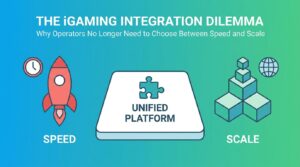
For years, online casino operators expanding into regulated international markets have faced a frustrating technical trade-off when building their game libraries. Either deploy a fast, lightweight API that limits portfolio size, or adopt a heavier aggregation platform that delivers breadth at the cost of performance and integration complexity. This binary choice has quietly shaped how Tier-1 operators source content, constrained marketing teams, and slowed time-to-market across jurisdictions. A new generation of integration solutions is now challenging that assumption, and the implications for competitive positioning are significant.
What’s Actually Changing in iGaming Content Integration
Before unpacking the strategic takeaways, it’s worth grounding the discussion in the core problem. The global iGaming market demands massive game catalogs to retain players and compete across demographics. But the technical infrastructure connecting operators to game providers has historically imposed a penalty: you get speed or you get scale. Not both. That constraint is no longer inevitable, and operators who recognise this shift early stand to gain a measurable edge in player engagement and operational efficiency.
- Operators have historically been forced into a trade-off between lightweight, fast-deploying APIs (limited game selection) and heavier aggregation platforms (broader catalogs but slower, more complex integrations)
- This compromise directly impacts marketing effectiveness, since a narrow game portfolio limits audience targeting and retention strategies
- Emerging integration architectures are collapsing this trade-off, enabling both speed-to-market and extensive content libraries through a single technical layer
- For decision-makers in regulated markets, the ability to onboard new providers without re-engineering existing infrastructure translates to faster geographic expansion
- The competitive window is narrowing: operators still locked into legacy integration models risk falling behind on content diversity, which increasingly drives player lifetime value
The Hidden Cost of the Old Model
Consider what the traditional approach actually looks like in practice. An operator entering a newly regulated European or Latin American market needs to offer hundreds, sometimes thousands, of slot titles, table games, and live dealer products from dozens of providers. Each provider has its own API specifications, certification requirements, and data formats. Under the old model, the operator’s tech team either builds bespoke integrations one by one (slow, expensive, hard to maintain) or relies on an aggregator that bundles everything together but introduces latency, dependency, and often unfavourable revenue-sharing terms.
The financial drag is real. Engineering hours spent on integration work are hours not spent on product differentiation. And the marketing team? They’re left promoting whatever games happen to be technically available, rather than curating a catalog that matches player preferences in each target market.
One detail that often gets overlooked: compliance certification timelines vary by jurisdiction. An integration architecture that can’t modularly swap providers in and out based on regulatory approval status creates bottlenecks that delay launches by weeks or months. That’s revenue left on the table (a distinction finance teams tend to notice before anyone else does).
How Modern Aggregation Bridges the Gap
The newer approach treats integration as a platform problem rather than a point-to-point wiring exercise. Instead of choosing between a thin API and a heavy aggregator, operators can now access unified integration layers that maintain low latency while supporting thousands of game titles across multiple providers. The technical architecture typically involves a single API endpoint that normalises data from all connected studios, handles wallet transactions, and manages regulatory compliance per jurisdiction.
This matters because it decouples two things that were previously tangled together: the speed of deployment and the depth of the content library. Operators can go live in a new market with a core set of certified games, then expand the catalog incrementally as additional providers clear regulatory review. No re-integration required.
Several B2B platforms in the iGaming software and aggregation space have been building toward this model, though adoption varies widely depending on operator size, technical maturity, and the specific regulatory environments they target.
Why Content Breadth Is Now a Retention Lever
There’s a broader strategic point here that goes beyond infrastructure. Player expectations have shifted. The average online casino user in 2024 encounters thousands of titles across competing platforms. Stickiness increasingly depends on whether an operator can surface the right game to the right player at the right moment. That requires not just a large catalog but a diverse one, spanning providers, game mechanics, volatility profiles, and regional preferences.
Yet breadth alone isn’t enough. Without intelligent recommendation engines and personalisation layers sitting on top of the content library, a 5,000-game catalog performs no better than a 500-game one. The integration layer, in other words, is necessary but not sufficient. What remains less clear is how quickly operators will invest in the data infrastructure needed to actually exploit these larger libraries.
Reframing the Decision for Operators and Stakeholders
The framing matters here. This isn’t simply a technology upgrade story. It’s a strategic repositioning question. Operators evaluating their content integration stack should be asking three things:
| Question | Why It Matters |
|---|---|
| Can we add a new game provider without engineering involvement? | Directly affects speed-to-market and operational cost per new jurisdiction |
| Does our current integration model limit our game catalog below competitive thresholds? | Impacts player acquisition cost and retention metrics |
| Are we paying aggregator margins that erode our unit economics? | Revenue-sharing structures vary significantly; some legacy models take 15–30% of GGR from aggregated content, which compounds at scale |
Not every operator will answer these the same way. A niche brand targeting a single regulated market with a curated portfolio has different needs than a multi-brand group operating across fifteen jurisdictions. But the direction of travel is consistent: the operators gaining ground are the ones treating content integration as a strategic capability, not an IT procurement exercise.
Frequently Asked Questions
What is a game aggregation platform in iGaming?
A game aggregation platform connects online casino operators to multiple game providers through a single integration point, reducing the need to build and maintain separate technical connections for each studio. It typically handles game delivery, wallet transactions, and regulatory compliance across jurisdictions.
Why do operators face a trade-off between API speed and catalog size?
Lightweight APIs are designed for quick deployment but often support a limited number of providers. Heavier aggregation solutions offer broader catalogs but introduce latency and complexity. Newer platforms are working to eliminate this compromise, though results depend on the specific architecture and operator requirements.
How does content integration affect regulatory compliance?
Each jurisdiction certifies games and providers independently. A modular integration architecture allows operators to activate or deactivate specific providers per market without disrupting the broader platform, which is critical for maintaining compliance during expansion.
Is a larger game catalog always better for player retention?
Not automatically. Catalog size only translates to retention when paired with effective personalisation and recommendation systems. A massive library without intelligent curation can overwhelm players rather than engage them.