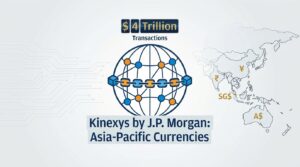
J.P. Morgan’s blockchain-based settlement platform, Kinexys, has crossed $4 trillion in cumulative transaction volume, a milestone that underscores the accelerating institutional appetite for on-chain payment infrastructure. Alongside the volume benchmark, the bank announced the addition of five Asia-Pacific currencies: the Australian dollar, Hong Kong dollar, Japanese yen, Chinese renminbi, and Singapore dollar. The expansion brings 24/7 settlement capability to some of the world’s busiest trade corridors, a move with significant implications for cross-border treasury operations across the region.
What the $4 Trillion Milestone Signals for Institutional Blockchain Adoption
Before parsing the strategic details, it helps to frame the scale of what Kinexys has achieved and what it means for the broader financial services landscape. The platform, which evolved from J.P. Morgan’s earlier Onyx initiative, now handles real-time value transfer at a volume that dwarfs most blockchain networks outside of stablecoin settlement. Here are the key takeaways:
- Cumulative transaction volume reaching $4 trillion positions Kinexys as arguably the most commercially significant permissioned blockchain in global banking, not just a proof of concept.
- Adding five APAC currencies extends round-the-clock settlement to corridors that collectively account for trillions in annual trade flows between Asia, Europe, and North America.
- The 24/7 settlement model directly challenges the constraints of legacy correspondent banking, where cut-off times and time-zone mismatches routinely delay cross-border payments by one to three business days.
- For corporate treasurers operating across multiple Asian markets, the ability to move liquidity in real time across currencies like the renminbi and yen could reshape working capital strategies.
- Competitors in the institutional blockchain space, including Fnality and Partior, will face pressure to match this geographic and currency breadth.
Why Asia-Pacific, and Why Now
The choice of currencies is deliberate. Australia, Hong Kong, Japan, China, and Singapore represent not just large economies but critical nodes in global supply chain finance. Japan alone accounts for roughly $700 billion in annual goods trade. Singapore functions as a hub for Southeast Asian capital flows. And the renminbi’s inclusion (a distinction regulators in multiple jurisdictions have been slow to facilitate for blockchain platforms) signals that J.P. Morgan has navigated the complex compliance landscape required to settle China-linked transactions on distributed ledger infrastructure.
Still, the real competitive edge here isn’t the currencies themselves. It’s the always-on settlement window. Traditional foreign exchange settlement operates within banking hours, creating friction for companies managing liquidity across time zones. Kinexys digital payments eliminate that gap by enabling atomic settlement at any hour, reducing both counterparty risk and the need for pre-funded nostro accounts.
How Kinexys Fits Into the Broader Institutional DLT Landscape
J.P. Morgan isn’t operating in isolation. Several bank-backed blockchain ventures are pursuing similar goals. Partior, backed by DBS, Standard Chartered, and Temasek, targets multi-currency clearing. Fnality, a consortium of major global banks, is building tokenized central bank money settlement. But none have publicly reported transaction volumes at the scale Kinexys has now disclosed.
That gap matters.
Volume is the clearest proxy for institutional trust in a settlement platform. When a network processes $4 trillion, it has moved well past pilot-stage validation into operational dependency. Corporate clients aren’t experimenting; they’re routing real treasury flows through the system. Which raises a harder question: at what point does a bank-operated blockchain become systemically important infrastructure, and what regulatory framework applies?
Comparative Snapshot: Institutional Blockchain Settlement Platforms
| Platform | Backing | Currency Coverage | Reported Volume |
|---|---|---|---|
| Kinexys (J.P. Morgan) | J.P. Morgan | USD, EUR, GBP, AUD, HKD, JPY, CNY, SGD | $4 trillion cumulative |
| Partior | DBS, Standard Chartered, Temasek | USD, SGD, EUR (expanding) | Not publicly disclosed at comparable scale |
| Fnality | Consortium of 17+ banks | GBP, USD, EUR (planned) | Early-stage settlement; limited public data |
Reframing Treasury Operations Through Real-Time Settlement
For CFOs and treasury teams, the practical implications of 24/7 multi-currency settlement extend beyond speed. Consider the cost of maintaining pre-funded accounts in multiple jurisdictions simply to ensure liquidity is available when a payment window opens. These trapped balances represent capital that could otherwise be deployed. By enabling just-in-time funding across eight currencies, Kinexys reduces the structural drag on working capital that has long been accepted as a cost of doing international business.
And while the technology is blockchain-based, the value proposition is fundamentally about removing friction from existing financial plumbing. Corporates don’t need to understand distributed ledger mechanics to benefit from faster, cheaper, and more predictable settlement. In practice, the blockchain layer is invisible to most end users. What they see is money arriving when it should.
Frequently Asked Questions
What is Kinexys?
Kinexys is J.P. Morgan’s institutional blockchain platform for real-time payments and settlement. It evolved from the bank’s earlier Onyx blockchain initiative and supports multi-currency, 24/7 transaction processing for corporate and institutional clients.
Which currencies does Kinexys now support?
The platform supports the US dollar, euro, British pound, Australian dollar, Hong Kong dollar, Japanese yen, Chinese renminbi, and Singapore dollar. The five APAC currencies were the most recent additions.
How does this differ from public blockchain payment networks?
Kinexys operates as a permissioned network, meaning only vetted institutional participants can transact on it. Unlike public chains, it offers regulatory compliance by design and integrates directly with J.P. Morgan’s existing banking infrastructure. The trade-off is decentralization, but for institutional use cases, that’s rarely the priority.
Does the $4 trillion figure represent daily volume?
No. The $4 trillion is a cumulative figure representing total transaction value processed since the platform’s inception. Daily volumes have not been separately disclosed, though the trajectory suggests significant and growing throughput.
What Comes Next for Bank-Operated Blockchains
The expansion into Asia-Pacific currencies positions Kinexys to capture a larger share of intraday liquidity management flows in the region. But scale brings scrutiny. Regulators in multiple jurisdictions are still developing frameworks for how bank-operated blockchain infrastructure should be supervised, particularly when it begins to function as de facto market infrastructure rather than a proprietary service.
Whether Kinexys eventually interoperates with competing platforms or central bank digital currency initiatives remains an open question. For now, J.P. Morgan has built something that works at scale, settles around the clock, and spans the currencies that matter most to global commerce. The rest of the industry is watching to see whether that lead compounds or gets shared.