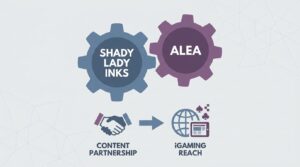
Shady Lady, a growing name in the iGaming content space, has signed a content partnership with Alea, a deal that positions both companies to expand their footprint across regulated markets. The agreement will see Alea’s portfolio of casino and gaming content integrated into Shady Lady’s platform ecosystem. While financial terms of the arrangement remain undisclosed, the partnership signals a broader trend of mid-tier operators and content providers consolidating their offerings through strategic alliances rather than organic development alone.
What the Shady Lady–Alea Deal Means for the Market
Partnerships like this one rarely happen in isolation. They tend to reflect shifting commercial pressures, regulatory fragmentation, and the rising cost of content exclusivity. Here’s what stands out from this particular agreement:
- Content diversification without heavy capex: Shady Lady gains access to Alea’s library without the overhead of building equivalent content in-house, a model increasingly favoured by operators navigating tight margins.
- Regulated market alignment: Both parties have signalled a focus on jurisdictions where compliance requirements are tightening, making pre-vetted content partnerships more attractive than ad hoc licensing.
- The deal arguably strengthens Alea’s distribution network at a time when visibility across multiple operator platforms matters more than ever for content studios.
- Speed to market: Rather than a multi-quarter integration cycle, content partnerships of this nature typically allow deployment within weeks, giving Shady Lady a near-term competitive edge in player engagement metrics.
Why Content Alliances Are Reshaping iGaming Distribution
The iGaming sector has, over the past eighteen months, seen a noticeable acceleration in content partnership announcements. The logic is straightforward but worth unpacking. Operators face a dual squeeze: players demand fresh, varied content libraries, while regulators in markets like the UK, Ontario, and parts of Latin America impose increasingly granular compliance requirements on every title offered. Building all of that internally is expensive and slow.
Alea, which has been steadily expanding its portfolio of casino gaming solutions, brings a catalogue that has already cleared compliance hurdles in several regulated territories. For Shady Lady, that translates into reduced time-to-market and lower regulatory risk. And while the partnership is bilateral, the real beneficiary may be the end player, who sees a richer content selection without knowing or caring about the commercial plumbing behind it.
Still, not every content deal delivers on its promise. Integration quality, promotional support, and data-sharing arrangements all determine whether a partnership moves the needle or simply adds volume without engagement.
Strategic Positioning in a Crowded Landscape
What makes this deal worth watching is less the individual brands and more the pattern it fits into. Mid-tier operators and studios are increasingly choosing targeted partnerships over platform-wide aggregation deals. The economics favour it: rather than paying aggregator margins, direct partnerships allow both sides to retain more value per transaction.
That shift matters because it changes the competitive dynamics for aggregators themselves. If enough studios and operators bypass the middleman, the aggregation layer either needs to offer more (better analytics, faster integration, compliance-as-a-service) or risk becoming a commodity.
Shady Lady’s move suggests the company is betting on curated content relationships rather than breadth for its own sake. Whether that bet pays off depends on execution.
How NLP-Driven Player Engagement Amplifies Content Partnerships
Beyond the commercial mechanics, there is a less visible dimension to deals like this one: how operators frame and deliver content to players matters as much as the content itself. Neuro-linguistic programming principles, when applied to player communication and interface design, can significantly influence engagement rates with newly integrated game libraries.
Consider the language used in lobby placements, push notifications, and promotional banners. Operators that anchor new content launches with sensory-rich language (“experience the atmosphere of a live table” rather than “new game available”) tap into representational systems that resonate more deeply with different player segments. Visual players respond to vivid imagery cues; kinaesthetic players engage more when copy evokes tactile or emotional experiences. The framing effect, well-documented in behavioural economics, applies directly here: how a new game is positioned within a lobby can alter click-through rates by double-digit percentages.
Rapport-building techniques drawn from NLP also inform CRM strategies around content launches. Mirroring a player’s historical preferences in recommendation language (not just in algorithmic selection, but in the actual words used to describe why a game was suggested) creates a sense of personalisation that generic “recommended for you” labels cannot match. Operators who invest in this layer of communication design tend to see higher retention on newly onboarded content, which directly impacts the ROI of partnerships like the Shady Lady–Alea agreement.
Reframing is another tool. When a player has lapsed or shown declining session times, presenting a new content partner’s games as a “fresh chapter” rather than simply “new additions” subtly shifts the player’s internal narrative. It moves the mental model from passive consumption to active exploration. These are small linguistic choices, but at scale, they compound.
Frequently Asked Questions
What does the Shady Lady and Alea partnership involve?
The partnership integrates Alea’s casino and gaming content into Shady Lady’s platform, giving Shady Lady access to a broader content library without developing it internally. Specific financial terms have not been made public.
Which markets will this partnership target?
Both companies have indicated a focus on regulated jurisdictions, though the exact market rollout has not been confirmed. Compliance-ready content is a central feature of the arrangement.
Why are direct content partnerships becoming more common in iGaming?
Operators and studios increasingly prefer direct deals because they reduce aggregator margins, allow tighter integration, and give both parties more control over data and promotional strategy. The trend reflects broader margin pressure across the sector.
How quickly can players expect to see new content from this deal?
Content partnerships of this type typically deploy within weeks rather than months, though the exact timeline depends on technical integration and regulatory approvals in each target market.