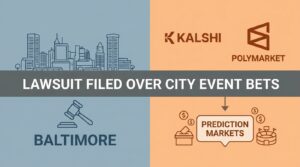
The City of Baltimore has launched separate legal actions against prediction market platforms Kalshi and Polymarket, alleging that both companies facilitated wagering on events tied directly to the city’s welfare. The lawsuits mark one of the first instances of a U.S. municipality taking direct legal action against prediction market operators, raising pointed questions about where the line sits between speculative forecasting and exploitation. Filed in Maryland courts, the complaints argue that these platforms profited from bets placed on outcomes that carried real consequences for Baltimore residents.
What Baltimore’s Legal Challenge Signals for Prediction Markets
The city’s decision to pursue litigation rather than rely solely on federal regulators reflects a growing frustration among local governments with the pace of oversight in the prediction market space. Here are the core strategic implications:
- Municipal legal action sets precedent: Baltimore’s suits could open the door for other cities to challenge prediction market operators directly, bypassing slower federal regulatory channels.
- Reputational risk for platforms: Both Kalshi and Polymarket now face public association with what Baltimore frames as exploitative gambling on civic harm.
- The cases test whether prediction markets can be held liable for the social externalities of contracts they list, not just their regulatory compliance at the federal level.
- Regulatory fragmentation deepens: With state and local governments stepping in independently, prediction market operators face an increasingly unpredictable patchwork of legal exposure across jurisdictions.
The Core Allegations Against Kalshi and Polymarket
Baltimore’s complaints center on the claim that both platforms allowed users to place wagers on events with direct ties to the city’s public safety and infrastructure. While the full details of every contract at issue have not been publicly enumerated, the city argues that such markets effectively turned Baltimore’s challenges into spectacle, with outside speculators standing to profit from negative outcomes affecting real communities.
Kalshi, which operates as a CFTC-regulated exchange, has previously positioned itself as a legitimate financial marketplace distinct from traditional gambling platforms. Polymarket, by contrast, operates with a different structure and has faced its own regulatory scrutiny in the past (a distinction that may matter less than either platform hopes, given the nature of Baltimore’s claims).
What makes these lawsuits unusual is the plaintiff. Municipalities rarely engage prediction market operators in court. Baltimore’s legal team appears to be arguing not just on regulatory grounds but on a theory of harm rooted in the city’s sovereign interest in protecting its residents from being treated as data points in someone else’s speculative portfolio.
Why Local Governments Are Losing Patience
Federal oversight of prediction markets has been, at best, uneven. The CFTC approved Kalshi’s event contracts after a protracted legal battle in 2023, but that approval did not resolve questions about which specific events should be eligible for trading. And while federal regulators debate scope, cities like Baltimore are left watching contracts appear on platforms that reference their own crises.
This dynamic has created a vacuum. Local officials see platforms listing contracts that touch on municipal outcomes, yet they have had no formal seat at the regulatory table where those listings get approved or denied. Baltimore’s lawsuits are, in part, an assertion of standing: a claim that cities deserve a voice when their names and fates become tradeable instruments.
Still, the legal path forward is anything but clear. Prediction market operators will likely argue federal preemption, contending that CFTC oversight supersedes state or municipal authority. Whether Maryland courts agree could shape the regulatory landscape for years.
Prediction Markets and the Ethics of Civic Speculation
Beyond the courtroom, Baltimore’s action forces a broader reckoning. Prediction markets have been championed by economists and technologists as tools for aggregating information, improving forecasting accuracy, and even informing policy. That framing works well in the abstract. It becomes harder to sustain when the “information” being aggregated involves whether a specific city will experience a spike in violent crime or a collapse in public services.
The tension here is not purely legal. It is about what kind of markets a society is willing to tolerate. Proponents of platforms like Polymarket argue that restricting contract types undermines the informational value of prediction markets. Critics counter that some outcomes should simply not be commodified, regardless of the data they might yield.
Arguably, both positions contain merit. But Baltimore’s lawsuits suggest that the theoretical debate has collided with political reality. Elected officials answerable to constituents are unlikely to accept the argument that betting on their city’s misfortune is a net social good because it produces better forecasts.
How This Could Reshape Platform Strategy
If Baltimore’s suits survive early motions to dismiss, prediction market operators will need to reassess how they select and list event contracts. The calculus changes when a municipality can sue over a listed market, not just when a federal regulator objects.
Several operational shifts could follow:
- Platforms may implement geographic sensitivity reviews before listing contracts tied to specific cities or regions
- Legal reserves and compliance costs could rise substantially, particularly for smaller or less capitalized operators
- Industry groups may push for clearer federal preemption language to shield platforms from municipal litigation
- Some platforms might voluntarily delist certain categories of civic-outcome contracts to reduce exposure
That last point matters more than it might seem. Voluntary restraint, if it emerges, would signal that the industry recognizes a boundary the law has not yet fully drawn.
Frequently Asked Questions
What are prediction markets?
Prediction markets are platforms where participants buy and sell contracts based on the outcome of future events. Prices reflect the market’s collective estimate of an event’s probability, and they have been used to forecast elections, economic indicators, and other measurable outcomes.
Has a city ever sued a prediction market platform before?
Baltimore’s lawsuits against Kalshi and Polymarket appear to be among the first cases where a U.S. municipality has directly sued prediction market operators. The legal theory, rooted in harm to the city’s interests, is largely untested.
Could these lawsuits shut down prediction markets?
Not likely on their own. But they could force platforms to change which contracts they offer and how they evaluate the civic implications of listed markets. The broader effect depends on whether other cities follow Baltimore’s lead and how courts rule on questions of federal preemption.
Are prediction markets legal in the United States?
Some are. Kalshi operates under CFTC regulation, which grants it legal authority to offer certain event-based contracts. Polymarket’s regulatory status is more complex and has been subject to prior enforcement action. Legality varies by platform, contract type, and jurisdiction.