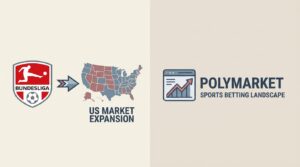
Germany’s top-flight football league is sharpening its focus on American audiences ahead of what promises to be a pivotal year for soccer in the United States, while prediction market platform Polymarket has quietly expanded its footprint into sports-related event contracts. The convergence of these two developments signals a broader shift in how European sports properties and decentralized platforms are competing for attention in the world’s most lucrative media market. With the 2026 FIFA World Cup set to be co-hosted by the US, the timing is anything but accidental.
What the Bundesliga’s US Push Actually Means for the Business of Soccer
Before unpacking the strategic layers, here’s what matters most for industry stakeholders watching this space:
- Market timing is deliberate: The Bundesliga’s intensified US outreach aligns with a surge in American soccer engagement driven by MLS expansion, Apple TV’s broadcast deal, and World Cup anticipation
- Polymarket’s entry into sports event contracts introduces a new category of fan engagement that sits outside traditional sportsbook models
- Revenue diversification: European leagues increasingly view the US not just as a broadcast rights market but as a direct-to-consumer opportunity spanning merchandise, content, and digital experiences
- The competitive landscape among European leagues for American eyeballs has never been tighter, with the Premier League, La Liga, and Serie A all running parallel strategies
- Regulatory complexity: Polymarket’s sports-adjacent offerings raise questions about where prediction markets end and sports betting begins, a distinction regulators have been slow to enforce
A League Looking West
The Bundesliga’s international broadcasting strategy has historically lagged behind the Premier League’s global dominance. That gap is narrowing. Under the leadership of the DFL (Deutsche Fußball Liga), the league has invested in English-language content production, pre-season tours to US cities, and partnerships with American media platforms designed to build a fanbase that extends well beyond the German diaspora.
What makes 2025 different is context.
The United States is roughly 14 months away from hosting World Cup matches across 16 venues. Youth participation in soccer has climbed steadily, and MLS clubs are drawing record attendance figures. For a league like the Bundesliga, which features several players with US national team ties and a reputation for developing young talent, the window to embed itself in the American sports consciousness is open now. Whether it stays open depends on execution.
How European Leagues Stack Up in the US Market
| League | US Broadcast Partner | Estimated US Viewership (2024) | Key US-Linked Players |
|---|---|---|---|
| Premier League | NBC / Peacock | ~1.5 million avg. per match window | Multiple USMNT regulars |
| La Liga | ESPN+ | ~400,000 avg. | Limited direct ties |
| Bundesliga | ESPN+ | Growing but below La Liga levels | Several USMNT players including current starters |
| Serie A | Paramount+ / CBS | ~350,000 avg. | Christian Pulisic (AC Milan) as anchor draw |
Still, viewership numbers alone don’t capture the full picture. The Bundesliga’s pitch to American fans leans heavily on accessibility: affordable matchday culture, standing sections, and a development pathway that has produced players like Giovanni Reyna and Chris Richards. These aren’t abstract selling points. They resonate with a generation of US soccer fans who grew up watching Borussia Dortmund highlights on YouTube.
Polymarket and the Blurring Line Between Prediction and Wagering
On a parallel track, Polymarket’s expansion into sports-related prediction contracts introduces a wrinkle that traditional sportsbooks and regulators will need to address. The blockchain-based platform, which gained mainstream visibility during the 2024 US presidential election cycle, has begun listing contracts tied to sporting outcomes and league-level events.
This is not conventional sports betting. Polymarket operates as a prediction market where users buy and sell shares in the outcome of real-world events. But when those events involve athletic competition, the functional difference between a prediction contract and a point-spread wager becomes, arguably, a matter of framing rather than substance.
The regulatory implications are significant. In the US, sports betting is governed state by state under the post-PASPA framework established after the Supreme Court’s 2018 ruling. Prediction markets, by contrast, have operated in a regulatory grey zone, with the CFTC (Commodity Futures Trading Commission) exercising intermittent oversight. Whether Polymarket’s sports contracts trigger state gaming commission scrutiny remains an open question, and one that could reshape how decentralized platforms interact with the sports industry.
Fan Engagement Is Being Rebuilt From the Ground Up
Both developments point toward a larger transformation in how sports properties think about audience capture. The old model was straightforward: secure a broadcast deal, sell jerseys, run a social media account. That model still works, but it no longer differentiates.
What’s emerging instead is a layered engagement ecosystem. Leagues are building direct digital relationships with fans through apps, fantasy platforms, and tokenized experiences. Prediction markets add another layer, one that doesn’t require a sportsbook license or a trip to Las Vegas. And for a league like the Bundesliga, which lacks the Premier League’s cultural incumbency in the US, these alternative engagement channels may prove more valuable than a marginal increase in TV ratings.
Even so, the risk of fragmentation is real. When fans can engage with a league through six different platforms, none of which talk to each other, the result can feel less like an ecosystem and more like noise.
Frequently Asked Questions
Why is the Bundesliga specifically targeting US fans now?
The 2026 World Cup, co-hosted by the United States, has created a surge in soccer interest. The Bundesliga sees this as a time-limited opportunity to build brand loyalty before the tournament drives casual fans toward whichever league captures their attention first. Several US national team players currently compete in the Bundesliga, giving the league a natural hook.
Is Polymarket legal for sports predictions in the US?
That depends on how regulators classify its contracts. Polymarket operates as a prediction market, not a licensed sportsbook, and its legal standing varies by jurisdiction. The CFTC has taken enforcement action against prediction platforms before, though the boundaries remain contested.
How does the Bundesliga compare to the Premier League in the US?
The Premier League holds a commanding lead in US viewership, largely due to its long-standing NBC partnership and deeper roster of globally recognized stars. The Bundesliga’s US audience is smaller but growing, and its emphasis on youth development and American player pathways gives it a differentiated narrative.