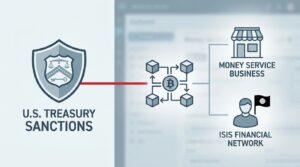
The U.S. Treasury’s Office of Foreign Assets Control (OFAC) designated three individuals and six entities on June 22 for facilitating financial transactions on behalf of the Islamic State of Iraq and Syria (ISIS). The targeted network relied on money service businesses and cryptocurrency to funnel ISIS funds across borders. This action underscores Washington’s intensifying focus on the intersection of terrorist financing and digital assets, a domain where regulatory enforcement has accelerated sharply over the past 18 months.
What the Latest OFAC Designations Signal for Crypto Compliance
These sanctions are not routine housekeeping. They reflect a deliberate escalation in how U.S. authorities trace and disrupt illicit financial flows through decentralized channels. Before examining the broader implications, here are the core strategic takeaways:
- Nine total designations (three individuals, six entities) tied directly to ISIS financial facilitation, marking one of the more targeted crypto-related sanctions actions this year
- The network combined traditional hawala-style money service businesses with cryptocurrency transfers, illustrating a hybrid laundering model that regulators increasingly encounter
- OFAC’s willingness to name specific entities suggests improved blockchain forensics capabilities and intelligence-sharing pipelines between Treasury and law enforcement
- Crypto exchanges and compliance teams face renewed pressure to screen against expanding sanctions lists, particularly for cross-border transaction patterns consistent with terrorist financing typologies
- The action reinforces the U.S. government’s position that digital assets remain firmly within the perimeter of existing sanctions frameworks
A Hybrid Financial Pipeline
What makes this case particularly instructive is the operational architecture. The sanctioned network did not rely exclusively on crypto. Instead, it blended conventional money service businesses with digital asset transfers, creating a layered system designed to obscure the origin and destination of funds. That combination is harder to detect than either method alone.
Money service businesses, especially those operating in conflict-adjacent regions, have long been vectors for terrorist financing. But layering cryptocurrency on top introduces additional complexity: pseudonymous wallets, cross-chain swaps, and jurisdictional gaps that slow investigative timelines. The fact that OFAC was able to identify and designate specific entities within this structure suggests that blockchain analytics firms and Treasury investigators have narrowed the gap between on-chain activity and real-world attribution (a distinction that matters enormously for compliance teams trying to operationalize sanctions screening).
Why This Matters Beyond Counterterrorism
Sanctions designations like these ripple outward. Every new OFAC listing expands the compliance burden on virtual asset service providers, banks with crypto-adjacent clients, and fintech platforms processing cross-border payments. And while the immediate target here is ISIS, the enforcement methodology applies equally to other sanctioned actors.
Consider the downstream effects. Exchanges operating under U.S. jurisdiction must now screen for wallet addresses and transaction patterns associated with nine additional sanctioned parties. Failure to do so carries severe penalties under the International Emergency Economic Powers Act (IEEPA), including fines exceeding $300,000 per violation and potential criminal liability.
Still, the practical challenge remains formidable. Sanctioned actors rarely use the same wallet twice. They exploit privacy-enhancing technologies, nested exchanges, and peer-to-peer platforms that sit outside conventional compliance perimeters. Whether the current screening infrastructure at most exchanges can keep pace with these tactics is a question the industry has yet to answer convincingly.
Regulatory Trajectory and Enforcement Patterns
This designation fits within a broader pattern. OFAC’s sanctions programs and enforcement actions have increasingly targeted crypto-facilitated networks since 2022, when the office sanctioned the Tornado Cash mixing protocol. Since then, Treasury has pursued a strategy of naming not just individuals but the infrastructure they use.
The shift carries legal weight. By designating entities rather than just persons, OFAC effectively freezes any U.S.-nexus assets held by those businesses and prohibits American persons from transacting with them. For crypto platforms, this means automated screening must extend beyond individual wallet addresses to encompass entity-level identifiers, corporate structures, and associated networks.
Reframing Risk: How Compliance Teams Should Respond
Arguably, the most important takeaway for industry participants is not the specific designations themselves but the velocity at which the sanctions list is growing. Compliance frameworks built for quarterly updates are insufficient when OFAC issues new designations on a near-monthly cadence. Real-time screening, dynamic risk scoring, and proactive transaction monitoring are no longer aspirational goals. They are baseline requirements.
Organizations should consider several practical adjustments:
- Integrate OFAC’s Specially Designated Nationals (SDN) list updates into automated compliance workflows with minimal lag time
- Map entity relationships beyond direct wallet associations to capture secondary and tertiary connections within sanctioned networks
- Conduct enhanced due diligence on money service business counterparties, particularly those operating in jurisdictions with weak AML oversight
- Review internal typology libraries to include hybrid fiat-crypto laundering patterns consistent with the structures described in this designation
The Broader Strategic Landscape
Washington’s message is increasingly unambiguous: cryptocurrency does not exist outside the reach of U.S. sanctions law. Each new enforcement action reinforces that position and narrows the space for actors who assumed digital assets offered a degree of immunity from traditional financial controls. Yet enforcement alone cannot eliminate the problem. The decentralized architecture of blockchain networks means that sanctioned actors can reconstitute operations under new wallets and entities faster than regulators can designate them.
That asymmetry is the central tension in crypto sanctions enforcement. And it is unlikely to resolve cleanly.
Frequently Asked Questions
What did OFAC sanction in this action?
OFAC designated three individuals and six entities for facilitating financial transactions on behalf of ISIS, using a combination of money service businesses and cryptocurrency to move funds across borders.
How does this affect cryptocurrency exchanges?
Exchanges under U.S. jurisdiction must screen for and block transactions involving the newly designated parties. Non-compliance can trigger significant penalties under IEEPA, including fines and criminal prosecution. The practical challenge lies in identifying wallets and entities that sanctioned actors may use only briefly before rotating to new infrastructure.
Is cryptocurrency itself illegal under U.S. sanctions law?
No. Cryptocurrency is legal to use in the United States. What is prohibited is transacting with sanctioned persons, entities, or jurisdictions, regardless of whether the transaction occurs in dollars, euros, or digital assets.
Why did the network use both traditional and crypto methods?
Combining money service businesses with cryptocurrency creates layered obfuscation. Traditional channels provide local liquidity and access, while crypto enables cross-border transfers that are harder to trace through conventional banking surveillance systems.