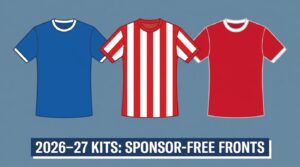
Three English football clubs have taken a striking step away from convention. Chelsea, Sunderland, and Nottingham Forest have each unveiled their 2026–27 season kits without a front-of-shirt sponsor, signalling a potential shift in how top-tier clubs approach commercial partnerships and jersey design. The move, while not entirely unprecedented, raises pointed questions about the evolving economics of shirt sponsorship in English football and whether other clubs might follow.
What the Blank Shirts Actually Signal for Football’s Sponsorship Market
At first glance, releasing a kit without a front sponsor might look like a missed revenue opportunity. But the calculus here is more layered than a simple absence of branding. Each of these clubs appears to be navigating distinct commercial circumstances, and the decision to go sponsor-free (at least on paper) could reflect ongoing negotiations, strategic repositioning, or a deliberate bet that clean kits drive higher merchandise sales among fans.
- Revenue timing matters: Clubs sometimes release kits before finalising sponsorship deals, preferring to capture early-season merchandise demand rather than delay launches.
- Fan sentiment is shifting. Supporter groups across the Premier League and Championship have increasingly voiced frustration with cluttered jerseys, and clean designs tend to sell better at retail.
- The absence of a front sponsor does not necessarily mean these clubs are walking away from sponsorship income altogether — sleeve deals, training kit branding, and stadium naming rights remain active revenue channels.
- Negotiating leverage: Launching without a sponsor can, paradoxically, strengthen a club’s hand in talks with potential partners by demonstrating willingness to leave the space empty rather than accept below-market terms.
Why These Three Clubs, and Why Now?
Chelsea’s commercial operations have been in flux since the Todd Boehly-Clearlake Capital ownership group completed its takeover. The club’s previous front-of-shirt deal with Infinite Athlete drew mixed reactions, and the decision to release the 2026–27 kit without a replacement partner suggests that Chelsea’s commercial team may be holding out for a higher-value agreement. Given the club’s global fanbase and Premier League visibility, the expectation is that any eventual deal would need to reflect a premium valuation.
Sunderland’s situation is different. Still building momentum after their return to the Championship and with ambitions of Premier League promotion, the club’s appeal to sponsors is tied closely to on-pitch trajectory. A blank shirt now could become a more valuable canvas later, particularly if promotion materialises.
Nottingham Forest, meanwhile, have established themselves as a competitive Premier League side. Their willingness to release a kit without front branding hints at a broader rethink. Forest’s recent seasons have seen growing commercial interest, and the club may be positioning itself to secure a deal that reflects its improved standing rather than settling for terms negotiated during less stable years.
The Broader Commercial Landscape in English Football
Shirt sponsorship remains one of the most lucrative revenue streams for football clubs. Manchester United’s deal with Qualcomm’s Snapdragon brand, reportedly worth around £60 million per season, sits at the top of the market. Yet not every club commands that kind of pull. For mid-table Premier League sides and Championship clubs, front-of-shirt deals typically range from £5 million to £20 million annually, depending on exposure metrics and competition performance.
What makes this moment notable is the convergence of three clubs simultaneously choosing — or being forced into — the same outcome. Whether coordinated or coincidental, it reflects a market where sponsors are becoming more selective and clubs more assertive about valuation.
| Club | League (2026–27) | Previous Front Sponsor | Current Status |
|---|---|---|---|
| Chelsea | Premier League | Infinite Athlete | No front sponsor announced |
| Sunderland | Championship | Various short-term deals | Kit released without front branding |
| Nottingham Forest | Premier League | UNHCR / various | Sponsor-free jersey unveiled |
How Fan Psychology Shapes Kit Purchasing Decisions
There is a well-documented behavioural pattern among football supporters when it comes to merchandise. Fans form emotional attachments to kits that feel authentic, uncluttered, and connected to club identity. Neuro-linguistic programming principles suggest that visual simplicity triggers stronger identity association — when a supporter sees their club’s colours without commercial interruption, the emotional resonance deepens. That bond translates directly into purchasing behaviour.
Clubs have quietly acknowledged this for years. Retro kit sales, which almost universally feature minimal or no sponsorship, consistently outperform expectations. The nostalgia effect is real, but it is also rooted in something more fundamental: supporters want to wear their club’s identity, not a corporation’s logo. And while sponsorship revenue dwarfs merchandise income in most club budgets, the reputational and engagement benefits of a clean kit create compounding value over time.
Still, the tension between commercial pragmatism and supporter sentiment is unlikely to resolve neatly. Clubs operate under intense financial pressure, particularly with rising wage bills and FFP constraints. A sponsor-free shirt might delight the fanbase, but the board will eventually need to fill that space — or find equivalent revenue elsewhere. The question is whether the temporary goodwill generated by a blank jersey translates into measurable loyalty metrics that justify the short-term shortfall.
Even so, the psychological framing matters. When Nottingham Forest unveiled their clean home shirt, social media engagement spiked. Supporters described the design as “pure” and “classic.” That language is telling — it reflects an anchoring effect where the absence of commercial branding reframes the entire product as more desirable.
Frequently Asked Questions
Why would a club release a kit without a front sponsor?
Several reasons: ongoing negotiations with potential partners, a strategic decision to hold out for a higher-value deal, or simply a gap between the expiry of one contract and the signing of another. In some cases, clubs calculate that early kit sales without a sponsor generate enough goodwill and revenue to offset the delay.
Does this mean these clubs have lost sponsorship income?
Not necessarily. Sponsorship agreements can be finalised after kit launches, with sponsors added to shirts later in the production cycle. Sleeve sponsors, training kit deals, and other commercial partnerships often continue independently.
Could more clubs follow this approach?
Possibly. The market dynamics that led Chelsea, Sunderland, and Forest here are not unique to them. As sponsor expectations rise and clubs push back on undervaluation, temporary gaps may become more common across English football.
Do sponsor-free kits sell better?
Anecdotal evidence and retro kit trends suggest they do, though comprehensive data comparing like-for-like sales remains scarce. What is clear is that fan reception tends to be warmer.



