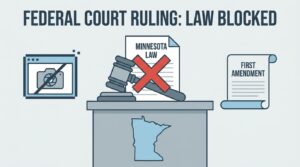
A federal court has halted enforcement of Minnesota’s pioneering state law that sought to criminalize the creation and dissemination of deepfake nonconsensual intimate imagery. The ruling, issued by a U.S. District Court judge, found that portions of the statute likely violate First Amendment protections, marking a significant setback for state-level efforts to regulate AI-generated explicit content. The decision arrives at a moment when legislators across the country are racing to address the proliferation of synthetic media, and it raises hard questions about where the boundary sits between protecting victims and restricting speech.
What the Minnesota Ruling Means for AI Content Regulation
Before diving into the strategic implications, it’s worth understanding the weight of this case. Minnesota was among the first states to pass legislation specifically targeting deepfake pornography, and the law was widely viewed as a template for other jurisdictions. Its partial invalidation by a federal court doesn’t just affect one state. It sends a signal to every legislature currently drafting similar bills.
- Constitutional friction exposed: The court’s reasoning suggests that broadly worded deepfake statutes risk being struck down unless they can satisfy strict scrutiny, the highest standard of judicial review for laws that restrict speech.
- Chilling effect on legislative momentum: At least a dozen states have introduced or passed deepfake-related bills in 2024 and 2025. This ruling could slow adoption or force significant redrafting.
- Victims of nonconsensual deepfake imagery now face an uncertain patchwork of protections that varies dramatically by jurisdiction.
- Tech industry implications: Companies developing generative AI tools may interpret the ruling as reducing their compliance exposure at the state level, at least temporarily.
- Federal legislation pressure increases: With state-level approaches now legally vulnerable, the case strengthens arguments for a unified federal framework.
Inside the Court’s Reasoning
The judge’s order focused on the law’s breadth. Minnesota’s statute criminalized the knowing creation or distribution of digitally altered intimate images without the depicted person’s consent. But the court found that certain provisions swept too broadly, potentially encompassing protected expression such as satire, political commentary, or artistic works that use synthetic media techniques. That distinction matters enormously in First Amendment jurisprudence.
Strict scrutiny requires the government to demonstrate that a law serves a compelling interest and is narrowly tailored to achieve that interest. The court acknowledged that protecting individuals from nonconsensual intimate imagery is a compelling goal. Where the law faltered was on tailoring. By not carving out sufficient exceptions or defining its terms with enough precision, the statute risked criminalizing speech that falls well outside the harm it was designed to prevent.
Still, the ruling was not a wholesale rejection. The court left open the possibility that a more carefully drafted version of the law could survive constitutional challenge (a distinction regulators have been slow to internalize in the broader AI governance debate).
The Deepfake Crisis by the Numbers
| Metric | Data Point |
|---|---|
| Estimated deepfake videos online (2024) | Over 95,000, per industry tracking |
| Percentage that are nonconsensual intimate imagery | Approximately 98% |
| States with some form of deepfake legislation | More than 30 have introduced bills; roughly 10 have enacted laws |
| Federal deepfake bill status | Multiple proposals pending in Congress, none yet signed into law |
| Average time to generate a convincing deepfake | Under 25 minutes with consumer-grade tools |
These figures underscore the scale of the problem. And while the legal framework struggles to keep pace, the technology accelerates.
Why State Legislatures Are Struggling to Get This Right
Drafting laws that regulate synthetic media without colliding with the First Amendment is genuinely difficult. The challenge is not unique to Minnesota. Legislators must thread a needle: defining prohibited conduct with enough specificity to survive judicial review while remaining broad enough to capture the rapidly evolving techniques used to generate deepfakes.
Several states have attempted different approaches. Some focus narrowly on distribution rather than creation. Others target intent, requiring proof that the creator acted with the purpose of harassing, intimidating, or defrauding the depicted individual. A few have opted for civil remedies rather than criminal penalties, sidestepping some constitutional concerns but offering arguably weaker deterrence.
What remains less clear is whether any of these approaches would survive the kind of scrutiny applied in the Minnesota case. The court’s analysis suggests that even well-intentioned statutes need to grapple more seriously with the expressive dimensions of synthetic media. That’s an uncomfortable reality for advocates who, rightly, point to the devastating real-world harm inflicted on victims.
Generative AI Governance and the Road Ahead
This case sits at the intersection of two fast-moving policy currents: the regulation of artificial intelligence and the protection of individual privacy and dignity in digital spaces. Organizations like the Electronic Frontier Foundation have long argued that content-based speech restrictions require extreme care, even when the underlying harms are severe. On the other side, victim advocacy groups contend that the absence of enforceable law leaves millions exposed.
The tension is real, and it won’t resolve cleanly. Federal proposals such as the DEFIANCE Act and the DEEPFAKES Accountability Act have gained bipartisan attention but remain stalled in committee. Without a federal baseline, the legal landscape will continue to fragment, with some states offering robust protections and others offering virtually none.
For companies building generative AI platforms, the Minnesota ruling doesn’t eliminate risk. It shifts it. Platforms that host or enable the creation of synthetic intimate imagery still face potential liability under existing harassment, defamation, and privacy statutes. And public pressure on major AI developers to implement safeguards continues to mount, regardless of what any single court decides.
Frequently Asked Questions
Does this ruling make deepfake pornography legal in Minnesota?
Not exactly. The court blocked enforcement of specific provisions it found constitutionally problematic, but other state and federal laws addressing harassment, defamation, and privacy may still apply. The ruling is about the particular statute’s breadth, not a blanket endorsement of deepfake content.
Can Minnesota revise the law and try again?
Yes. The court’s order suggests that a more narrowly tailored statute could pass constitutional muster. Legislators would need to define prohibited conduct more precisely and build in exceptions for protected speech.
Are other states’ deepfake laws at risk?
Potentially. Any state law that uses similarly broad language could face comparable challenges. States with narrower statutes focused on intent or distribution may be on firmer ground, though no approach has been definitively tested at the appellate level.
What should victims of deepfake imagery do right now?
Victims can pursue remedies under existing civil and criminal frameworks, including harassment and privacy laws. Several organizations offer resources for reporting and removing nonconsensual intimate images from platforms. The legal picture is fragmented, but options exist.



