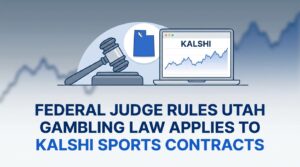
A federal judge has determined that Utah gambling law applies to Kalshi’s sports-related event contracts, delivering a ruling that could reshape how prediction markets operate across state lines. The decision rejected arguments from the Commodity Futures Trading Commission (CFTC)-regulated exchange that its contracts fall outside the scope of state gambling statutes. For an industry that has rapidly expanded since Kalshi’s landmark legal victories against the CFTC in 2023 and 2024, this ruling introduces a new layer of regulatory complexity that market participants had largely avoided confronting.
What the Utah Ruling Means for Prediction Markets
The case centers on whether event contracts tied to sports outcomes constitute gambling under Utah’s notably strict anti-gambling framework. Utah remains one of only two U.S. states with a constitutional prohibition against all forms of gambling (a distinction regulators have been slow to test in the context of derivatives). The judge’s decision effectively pierces the regulatory shield that federally regulated exchanges have relied upon, treating sports-linked contracts not as financial instruments immune from state law, but as activities subject to local gambling prohibitions.
This matters because Kalshi and similar platforms have operated under the assumption that CFTC oversight preempts state-level gambling regulation. That assumption just got considerably weaker, at least in Utah.
Strategic Implications for Kalshi and the Broader Industry
Before diving into the key takeaways, it is worth understanding the cascading effects this ruling could trigger. Prediction markets have attracted significant venture capital and retail interest over the past 18 months, partly because the regulatory path seemed to be clearing. This decision complicates that narrative and forces exchanges to reckon with a patchwork of state laws they had previously treated as irrelevant.
- State-by-state compliance burden: Kalshi and competitors may now need to evaluate gambling statutes in all 50 states, not just federal derivatives law, before offering sports-related contracts to residents in those jurisdictions.
- Preemption doctrine weakened: The ruling suggests federal CFTC regulation does not automatically override state gambling laws, opening the door for other states to challenge prediction market offerings.
- Investor confidence in the prediction market sector could soften as the legal landscape grows more fragmented and litigation costs rise.
- Product design pressure: Exchanges may need to restructure contracts or limit sports-adjacent offerings to avoid triggering state gambling definitions, potentially narrowing their most popular product categories.
- Regulatory arbitrage narrows: The gap between what federal regulators permit and what states prohibit is now a live legal question rather than a theoretical one.
Utah’s Unique Position in U.S. Gambling Law
Utah’s constitutional ban on gambling predates the modern prediction market era by decades. The state has no casinos, no lottery, and no legal sports betting. When the Supreme Court struck down the Professional and Amateur Sports Protection Act (PASPA) in 2018, most states moved to legalize sports wagering. Utah did not.
That rigidity makes it an unusual but potent testing ground. If a CFTC-regulated contract cannot survive legal scrutiny in the most restrictive state, the question becomes whether moderately restrictive states will follow suit. Several states maintain gambling laws broad enough to encompass event contracts if courts adopt similar reasoning.
How Prediction Markets Reached This Inflection Point
Kalshi, which operates as a CFTC-regulated event contract exchange, won a closely watched federal court battle in 2023 that allowed it to list contracts on congressional election outcomes. That victory was widely interpreted as a green light for expansion into sports and other event categories. Trading volumes surged. New competitors entered the space.
But the Utah ruling exposes a blind spot in that expansion strategy. Federal courts may approve certain contract types at the CFTC level while state courts simultaneously classify those same contracts as illegal gambling within their borders. The result: a market caught between two frameworks that don’t communicate well with each other.
What Distinguishes a Derivative from a Wager?
This is arguably the central tension the prediction market industry has never fully resolved. Derivatives law treats event contracts as risk-transfer instruments. Gambling law treats them as bets on uncertain outcomes. Both descriptions are technically accurate. The legal outcome depends entirely on which lens a court applies, and this judge chose the gambling lens.
Still, the distinction carries real consequences for how these products are taxed, regulated, and marketed. An event contract classified as a derivative falls under CFTC jurisdiction with relatively light consumer-facing restrictions. The same contract classified as a wager triggers state licensing requirements, age verification mandates, and in Utah’s case, an outright ban.
Frequently Asked Questions
Does this ruling ban Kalshi from operating nationwide?
No. The ruling applies specifically to Utah and its gambling laws. However, it establishes a legal precedent that other states with broad gambling prohibitions could invoke to restrict prediction market access within their borders.
Can the CFTC override state gambling laws?
That question remains contested. Kalshi and industry advocates have argued that federal derivatives regulation preempts state gambling statutes, but this ruling suggests courts may not uniformly agree. The preemption argument will likely face further litigation.
What types of contracts are affected?
The ruling specifically targets sports-related event contracts. Whether it extends to political, economic, or weather-related contracts in Utah depends on how broadly the state’s gambling definition is interpreted in future cases.
How might this affect prediction market growth?
Growth could slow in the near term as exchanges reassess their state-level legal exposure. Product offerings may narrow, and compliance costs will almost certainly increase for platforms seeking to operate across all 50 states.
The Regulatory Fragmentation Challenge Ahead
What makes this ruling particularly consequential is its timing. The prediction market industry is at a stage where rapid user acquisition and product expansion depend on regulatory clarity. Fragmentation across state lines introduces friction that digital-first platforms are poorly equipped to absorb without significant operational changes. Geofencing technology, already standard in legal sports betting, may become necessary for prediction market exchanges, adding infrastructure costs that eat into margins.
And while the CFTC has signaled openness to event contracts as legitimate financial products, the commission has not aggressively defended its preemptive authority against state challenges. Whether that changes under current leadership remains an open question.
For Kalshi specifically, the path forward likely involves appeals, legislative engagement in key states, and possibly restructuring certain contract types to fall outside state gambling definitions. None of those options are quick or inexpensive. The prediction market boom that began in 2023 now faces its first serious structural headwind, and the industry’s response will determine whether these platforms mature into mainstream financial infrastructure or remain confined to a regulatory gray zone that keeps shrinking.