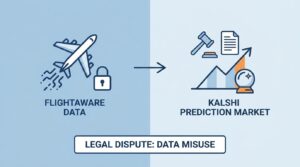
FlightAware, the aviation data and technology company, has filed a lawsuit against prediction market operator Kalshi in New York, alleging that Kalshi used its proprietary flight-tracking data without authorization to power event contracts tied to airline delays and cancellations. The legal action opens a new front in the rapidly expanding prediction markets sector, where data sourcing and intellectual property rights are becoming increasingly contested. At stake is not just the relationship between two companies, but a broader question about how prediction platforms source the real-world data that underpins their contracts.
What the Lawsuit Alleges and Why It Matters for Prediction Markets
Before diving into the specifics, it helps to frame the strategic significance of this dispute. Prediction markets like Kalshi depend on verifiable, real-time data to settle contracts. When the provenance of that data comes under legal challenge, the entire settlement mechanism of a platform faces scrutiny. Here are the core takeaways from the case so far:
- FlightAware claims Kalshi scraped or otherwise accessed its proprietary flight data to create and settle prediction market contracts related to flight delays and cancellations
- The lawsuit was filed in New York, a jurisdiction with significant precedent in intellectual property and data rights cases
- Kalshi’s event contracts tied to airline performance rely on accurate, granular flight data, and the source of that data is now legally disputed
- This case could set a precedent for how prediction market operators are required to license or attribute third-party data
- The outcome may influence regulatory expectations around data governance for CFTC-regulated event contracts
How FlightAware Built Its Data Moat
FlightAware’s real-time flight tracking platform aggregates data from multiple sources, including ADS-B receivers, FAA feeds, airline-reported positions, and its own proprietary algorithms. The company has spent nearly two decades building what amounts to one of the most comprehensive aviation data ecosystems in the world. That dataset isn’t just a product. It is, arguably, the company’s most valuable asset.
FlightAware licenses its data to airlines, airports, corporate travel departments, and third-party developers through structured API agreements. These agreements typically govern how the data may be used, redistributed, and displayed. The allegation against Kalshi centers on whether the prediction market operator circumvented these licensing arrangements.
Kalshi’s Expansion Into Real-World Event Contracts
Kalshi, a CFTC-regulated exchange, has aggressively expanded its menu of event contracts over the past two years. From weather events to economic indicators to, more recently, airline performance metrics, the platform has positioned itself as a destination for trading on measurable real-world outcomes. That expansion has not been without friction (a distinction regulators have been slow to fully address).
The airline delay contracts in question required a reliable, authoritative source of flight status data. Whether Kalshi had proper authorization to use FlightAware’s data for this purpose is the central factual dispute. And while Kalshi has not yet publicly commented in detail on the allegations, the company’s broader posture has been to defend its right to offer contracts on publicly observable events.
Still, there is a meaningful difference between trading on a publicly known outcome and using a specific company’s proprietary dataset to determine that outcome.
The Data Licensing Gap in Prediction Markets
This lawsuit exposes a structural vulnerability that extends well beyond FlightAware and Kalshi’s prediction market platform. As event contract exchanges proliferate, the question of where settlement data comes from, and under what terms, has largely been treated as an operational detail rather than a compliance imperative.
Consider the parallel in sports betting. Sportsbooks pay substantial licensing fees to leagues and data providers for official statistics used to settle bets. The prediction markets space, at least on paper, has not yet developed equivalent norms. FlightAware’s lawsuit could force that conversation into the open.
| Aspect | Sports Betting | Prediction Markets (Current) |
|---|---|---|
| Data sourcing | Licensed from leagues/official providers | Often unstructured; varies by platform |
| Settlement authority | Defined by contract with data provider | Platform-determined, sometimes disputed |
| Regulatory oversight of data use | State gaming commissions | CFTC (limited data-sourcing rules) |
| Licensing cost | Significant, often percentage-based | Minimal or absent in many cases, though this may be changing |
Reframing Risk: What Operators Should Be Asking Now
For prediction market operators, this case should trigger an immediate internal audit. Not just of flight data, but of every data source feeding into contract settlement. The legal theory FlightAware is advancing, that proprietary data used without a license constitutes misappropriation, could apply to weather data, economic statistics sourced from private aggregators, or any number of other domains.
But the implications run deeper than legal exposure. Trust is the currency of any exchange. When traders place positions on an event contract, they assume the settlement mechanism is both accurate and legitimate. If the underlying data source is contested in court, the integrity of every settled contract built on that data comes into question. That reputational risk may prove more damaging than any damages award.
Frequently Asked Questions
What is FlightAware alleging against Kalshi?
FlightAware alleges that Kalshi used its proprietary flight-tracking data without proper authorization to create and settle prediction market contracts tied to airline delays and cancellations. The company contends this constitutes misappropriation of its data assets.
Is Kalshi regulated?
Yes. Kalshi operates as a CFTC-regulated designated contract market, which gives it authority to list event contracts. However, CFTC oversight focuses primarily on market structure and contract approval, not necessarily on the licensing arrangements behind settlement data sources.
Could this case affect other prediction market platforms?
Potentially, yes. If FlightAware prevails, the ruling could establish a precedent requiring prediction market operators to secure explicit data licenses before using proprietary datasets for contract settlement. That would reshape cost structures and compliance requirements across the sector.
Why does data sourcing matter for event contracts?
The entire value proposition of a prediction market contract depends on reliable, undisputed settlement. When the data source itself becomes the subject of litigation, it undermines confidence in the contract’s resolution and, by extension, the platform offering it.
What Comes Next
The case is in its early stages, and Kalshi’s formal response will shape the trajectory of the litigation. Whether this ends in a settlement, a licensing agreement, or a precedent-setting ruling, the signal to the market is already clear: data governance can no longer be an afterthought for prediction platforms building contracts on someone else’s information infrastructure.



