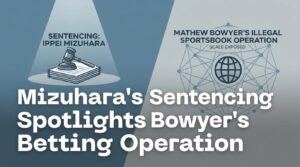
Ippei Mizuhara, the former interpreter for Los Angeles Dodgers star Shohei Ohtani, faces sentencing after pleading guilty to bank fraud charges tied to an illegal gambling operation run by Mathew Bowyer. Bowyer operated an unlicensed sportsbook that served more than 700 customers, processing millions of dollars in wagers outside any regulated framework. The case has drawn intense scrutiny not just for its celebrity connection, but for what it reveals about the persistence of black-market sports betting even as legal markets expand across the United States.
What the Mizuhara-Bowyer Case Tells Us About Underground Betting
Before diving into the key takeaways, it’s worth understanding the broader architecture of this case. Mizuhara didn’t simply place a few bets with a local bookie. He funneled roughly $17 million of Ohtani’s money to cover gambling debts accumulated through Bowyer’s operation, a scheme that required systematic bank fraud and deception over an extended period. The scale of Bowyer’s customer base (a distinction regulators have been slow to confront in enforcement terms) suggests this was no marginal enterprise.
- Unlicensed operations remain resilient: Despite the rapid expansion of legal sports betting across more than 30 U.S. states, Bowyer’s sportsbook attracted over 700 active customers willing to wager outside regulated channels.
- Bank fraud as a downstream consequence: Mizuhara’s guilty plea to federal bank fraud charges illustrates how illegal gambling creates cascading financial crimes that extend well beyond the bets themselves.
- The case raises uncomfortable questions for professional sports leagues about how close illegal gambling networks can get to marquee athletes and their inner circles.
- Regulatory gaps persist: California, where much of this activity occurred, still lacks legal online sports betting, arguably creating fertile ground for operators like Bowyer.
- Reputational fallout: The Dodgers organization and Major League Baseball’s integrity programs face renewed pressure to demonstrate that proximity to illegal gambling won’t be tolerated at any level.
Inside Bowyer’s Operation
Mathew Bowyer ran what federal prosecutors described as a sophisticated illegal sportsbook. With more than 700 customers, the operation handled substantial volume. Yet Mizuhara stood out as the most prominent client, not because of his own profile, but because of whose money he was spending.
The mechanics were straightforward in concept but elaborate in execution. Mizuhara placed bets through Bowyer’s network, accumulated significant losses, and then accessed Ohtani’s bank accounts to cover those debts. Wire transfers, falsified authorizations, and repeated deception kept the scheme running for what appears to have been a considerable stretch of time. Federal investigators eventually traced the financial trail back through banking records.
What remains less clear is how many other high-profile individuals may have used Bowyer’s services. Prosecutors have focused their public case on Mizuhara, but a 700-person customer list almost certainly contains names that haven’t surfaced yet.
Why California’s Regulatory Vacuum Matters
California voters rejected Proposition 27 in November 2022, which would have legalized online sports betting statewide. That decision left the nation’s most populous state without a regulated digital wagering market. And while the rejection reflected legitimate concerns about tribal gaming sovereignty and the influence of commercial operators, the practical effect has been to leave demand unmet by legal supply.
Bowyer’s operation thrived in that gap. Customers who wanted to bet on sports had limited legal options within the state, making unlicensed bookmakers an accessible alternative. This dynamic isn’t unique to California, but the state’s sheer population magnifies the consequences.
| Factor | California | States with Legal Online Betting |
|---|---|---|
| Legal online sportsbooks | None | 30+ states with active markets |
| Estimated illegal market exposure | High, given population of ~39 million | Reduced but not eliminated |
| Regulatory enforcement tools | Limited to federal prosecution | State gaming commissions plus federal oversight |
| Consumer protections for bettors | Absent in unlicensed channels | Mandated responsible gambling programs, deposit limits |
The Psychology Behind High-Stakes Gambling Behavior
Cases like Mizuhara’s don’t happen in a vacuum. Understanding the behavioral patterns that drive someone to steal $17 million to cover gambling losses requires looking beyond the surface narrative of greed or poor judgment. Cognitive distortions play a central role. The gambler’s fallacy, the belief that a losing streak must eventually reverse, can trap individuals in escalating cycles of risk. Each loss feels like it brings the next win closer, which is mathematically false but psychologically compelling.
There’s also the anchoring effect at work. Once Mizuhara had placed his first large unauthorized bet, the psychological threshold for the next one dropped. The initial transgression became the new baseline. Behavioral economists call this “moral licensing in reverse,” where a person who has already crossed a line finds it progressively easier to cross it again.
Compulsive gambling rewires reward pathways in ways that mirror substance addiction. The dopamine response associated with placing a bet, particularly under conditions of uncertainty, can override rational decision-making. Mizuhara’s position of trust and access to enormous sums created what psychologists might describe as a perfect storm of opportunity and compulsion. Still, the structural enabler was the existence of an unregulated market willing to accept virtually unlimited action without the safeguards that licensed operators are required to maintain.
Reframing this through an NLP lens, Mizuhara’s internal representation of risk likely shifted over time. What began as a manageable activity became, through repeated exposure and escalating stakes, a pattern so deeply embedded that the consequences felt abstract. Breaking such patterns typically requires external intervention, which in this case came in the form of federal investigators rather than a responsible gambling program.
What Happens Next
Mizuhara’s sentencing will set a marker for how federal courts treat individuals caught in the orbit of illegal gambling operations. Prosecutors have recommended a significant prison term, reflecting both the dollar amount involved and the breach of trust.
Bowyer himself faces separate legal proceedings. The outcome of his case could influence how aggressively federal authorities pursue unlicensed sportsbook operators in states that lack their own regulatory infrastructure.
For the broader sports betting industry, the case serves as a pointed reminder: legalization doesn’t eliminate the black market. It competes with it. And in states where legalization hasn’t arrived, the black market doesn’t just survive. It recruits.
Frequently Asked Questions
What did Ippei Mizuhara plead guilty to?
Mizuhara pleaded guilty to federal bank fraud charges for stealing approximately $17 million from Shohei Ohtani’s accounts to cover gambling debts.
Who is Mathew Bowyer?
Bowyer operated an unlicensed sportsbook with more than 700 customers. His operation is at the center of the federal case involving Mizuhara.
Is sports betting legal in California?
No. California does not currently permit legal online sports betting. Voters rejected a legalization measure in 2022, and no new legislation has advanced since.
How does this case affect Major League Baseball?
It intensifies scrutiny on how professional sports organizations vet the individuals closest to their athletes, and whether existing integrity protocols are sufficient to detect illegal gambling connections before they escalate.



