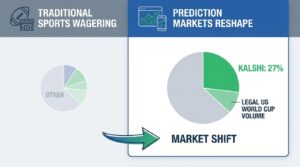
Prediction markets seized roughly 27% of legal US World Cup sports betting volume, positioning Kalshi as a disruptive force in a landscape long dominated by traditional sportsbooks. The figure, drawn from early tournament data, signals that event-contract platforms are no longer a niche curiosity but a genuine competitor for bettor attention and dollars. What makes this notable isn’t just the number itself; it’s the speed at which prediction markets have carved out share in one of the most heavily wagered global sporting events.
What Kalshi’s World Cup Numbers Reveal About Shifting Bettor Behavior
The 27% share demands context. Traditional sportsbooks have spent years building infrastructure, loyalty programs, and regulatory relationships across dozens of US states. Kalshi, by contrast, operates under a different regulatory framework as a CFTC-regulated exchange, offering event contracts rather than conventional sports bets. That distinction (one regulators have only recently begun to grapple with in earnest) has allowed the platform to attract a segment of bettors who either prefer the contract-based model or are drawn to the simplicity of binary yes/no outcomes.
Several factors help explain the uptake:
- World Cup matches generate intense but episodic interest, making simple outcome contracts appealing to casual participants who may not engage with point spreads or parlays
- Prediction market pricing functions as a real-time probability indicator, which attracts a more analytically minded user base
- Kalshi’s regulatory status as a designated contract market lets it operate nationally without needing state-by-state sports betting licenses, giving it reach that some sportsbooks still lack
- The platform’s fee structure and settlement mechanics differ from vig-based sportsbook models, creating a cost advantage for certain bet types
The Regulatory Divide That Made This Possible
At the core of Kalshi’s expansion into sports is a jurisdictional question that remains only partially resolved. The Commodity Futures Trading Commission approved Kalshi’s sports-related event contracts after a protracted legal battle, opening the door for the exchange to list contracts on major sporting events. Traditional sportsbooks, regulated at the state level under frameworks established after the 2018 repeal of PASPA, have watched this development with a mix of concern and frustration.
State gaming commissions argue that event contracts on sports outcomes are, functionally, sports bets. The CFTC’s position has been more permissive. And while Kalshi’s event contract exchange continues to expand its sports offerings, the tension between federal commodity regulation and state gambling oversight shows no sign of resolution. Whether Congress eventually steps in to clarify the boundary is anyone’s guess, but the market isn’t waiting for legislative clarity.
How Prediction Markets Compare to Traditional Sportsbooks for Major Events
| Feature | Prediction Markets (Kalshi) | Traditional Sportsbooks |
|---|---|---|
| Regulatory Body | CFTC (federal) | State gaming commissions |
| Bet Structure | Binary yes/no contracts | Moneylines, spreads, parlays, props |
| Geographic Reach | Nationwide (with some restrictions) | State-by-state licensing required |
| Pricing Model | Market-driven probability pricing | Odds set by bookmakers with built-in vig |
| User Profile | Skews analytical, newer to sports betting | Broad demographic, established user base with loyalty incentives and promotional offers |
Why 27% Is a Threshold Number, Not a Ceiling
A quarter of legal volume is substantial for a platform category that barely existed in US sports betting two years ago. But the trajectory matters more than the snapshot. If prediction markets can hold or grow that share during the NFL season or March Madness, the implications for DraftKings, FanDuel, and BetMGM become harder to dismiss as marginal.
Still, there are structural limits. Prediction markets currently offer fewer bet types. You won’t find same-game parlays or live micro-bets on Kalshi. The experience is leaner, more transactional. For bettors who treat wagering as entertainment, that’s a drawback. For those who treat it as a market, it’s the point.
The question sportsbook operators are quietly asking: does this 27% represent a temporary spike driven by World Cup novelty, or a durable reallocation of bettor spend?
Framing the Opportunity: What Decision-Makers Should Weigh
For executives in the regulated gaming industry, the rise of prediction markets introduces a strategic variable that doesn’t fit neatly into existing competitive models. This isn’t a new sportsbook entering the market with a bigger bonus offer. It’s a structurally different product operating under a different regulatory umbrella, and it’s pulling volume in a way that challenges assumptions about bettor loyalty and product stickiness.
Understanding how bettors perceive value is arguably more important here than tracking handle numbers alone. Prediction markets succeed, in part, because they reframe the wagering decision. Instead of asking “who will win and by how much,” the contract asks a simpler question: will this happen, yes or no? That cognitive simplicity lowers the barrier to participation. It also changes how users process risk, anchoring their decisions to a probability percentage rather than decoding American odds formats that many casual bettors find unintuitive.
There’s a behavioral dimension worth noting. When a bettor sees a contract priced at 72 cents for “yes,” they immediately grasp the implied probability. Traditional odds require translation. This transparency creates a sense of control, even if the underlying risk is identical. In practice, platforms that reduce friction in decision-making tend to capture disproportionate engagement from newer market participants, which is precisely the demographic both sportsbooks and prediction markets are competing to acquire.
Operators who dismiss prediction markets as a regulatory anomaly may find themselves revising that view sooner than expected. The smarter play is to study what Kalshi’s user acquisition curve looks like after the World Cup ends.
Frequently Asked Questions
Are prediction markets legal for sports betting in the US?
Kalshi operates as a CFTC-regulated designated contract market, which allows it to list event contracts on sports outcomes at the federal level. This differs from state-regulated sportsbooks, and the legal boundaries between the two frameworks remain a subject of ongoing regulatory debate.
How does betting on Kalshi differ from using a sportsbook?
On Kalshi, users buy and sell binary event contracts priced between $0 and $1, reflecting the market’s implied probability of an outcome. Traditional sportsbooks offer a wider range of bet types with odds set by bookmakers. The experience is fundamentally different in structure, even when the underlying event is the same.
Could prediction markets overtake traditional sportsbooks?
That scenario remains unlikely in the near term given the product breadth and entertainment features sportsbooks offer. But capturing 27% of World Cup volume suggests prediction markets are not a fringe product. Their growth trajectory over the next two major US sports seasons will be the real test.