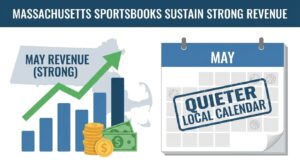
Massachusetts sportsbooks posted another robust month in May, maintaining elevated revenue figures even as the state’s major professional teams wound down their seasons. Without the Celtics deep in a playoff run or the Patriots in action, the handle dipped slightly from April’s peak, but operators still converted wagers into healthy margins. The result: a market that continues to mature and diversify its betting base beyond hometown loyalties.
What May’s Numbers Signal for Bay State Operators
While raw handle figures softened compared to the frenzy of March Madness and early NBA playoffs, Massachusetts sportsbooks demonstrated that their revenue engine doesn’t stall when local rooting interests fade. Here are the strategic takeaways from the month:
- Sportsbook revenue remained high, suggesting operators are improving hold percentages and promotional efficiency rather than relying solely on volume
- The absence of deep Celtics or Bruins playoff runs didn’t crater engagement the way some analysts had projected
- Baseball, international soccer, and combat sports filled gaps in the betting calendar, pointing to a broadening bettor appetite
- Tax revenue flowing to the state held steady, reinforcing the fiscal case regulators made during the 2022 legalization push
- Mobile wagering continued to dominate retail, with in-person sportsbooks accounting for a small fraction of total handle
Handle Composition and the Shift Away from Seasonal Dependence
One pattern worth watching in Massachusetts is how quickly the market has moved past its initial reliance on hometown teams. In the state’s first full year of legal sports betting, Celtics and Patriots games drove outsized shares of handle. That dynamic has loosened.
May’s wagering activity leaned heavily on MLB, with the Red Sox providing a local hook but national baseball matchups drawing substantial action as well. UFC events and European soccer leagues, particularly late-season Premier League fixtures, also contributed meaningfully. Bettors in the Commonwealth, it turns out, are willing to wager on events they might not watch in a bar on Boylston Street.
This diversification matters for operators because it smooths revenue across the calendar year. A market that spikes only during football season or the NBA Finals carries more financial risk than one generating consistent monthly volume. And while Massachusetts hasn’t fully flattened its seasonal curve (arguably no state has), the trajectory points toward a more resilient betting ecosystem.
How Operators Are Sharpening Their Edge
Hold percentage tells a sharper story than handle alone. Massachusetts operators have been tightening their promotional spending since the early months of legalization, when sign-up bonuses and risk-free bets ate into margins. By May, the promotional credit burn rate had declined noticeably from a year earlier.
That shift translates directly into higher net revenue per dollar wagered. DraftKings, headquartered in Boston, has a particular incentive to perform well in its home market, and the company’s national strategy of pulling back on unsustainable promotions appears to be playing out locally. FanDuel, BetMGM, and other licensed operators have followed a similar playbook, competing more on product quality and user experience than on pure bonus generosity.
Still, the competitive dynamics aren’t settled. Smaller operators face a squeeze: they lack the marketing budgets of the top two but can’t differentiate enough on odds or features to carve out meaningful share. Whether consolidation or niche strategies emerge remains an open question the market hasn’t answered yet.
Regulatory Landscape and Tax Revenue Implications
Massachusetts taxes retail sportsbook revenue at 15% and mobile revenue at 20%, a structure that places it in the middle tier nationally (a distinction that has drawn both praise for moderation and criticism for leaving money on the table). May’s steady revenue means the state’s tax receipts from sports wagering continued to accumulate without the volatility that plagues states overly dependent on a single sport or season.
The Massachusetts Gaming Commission has maintained a relatively hands-off posture since launch, focusing enforcement efforts on advertising compliance and responsible gambling measures rather than aggressive market intervention. No major regulatory actions were announced in May, though the commission continues to monitor promotional practices and data reporting standards.
Revenue Snapshot: Massachusetts Sports Betting
| Metric | Trend in May | Context |
|---|---|---|
| Total Handle | Slight decline from April | Expected seasonal dip without NBA/NHL peaks |
| Gross Revenue | Remained elevated | Improved hold rates offset lower volume |
| Promotional Credits | Continued to decrease year-over-year | Operators maturing past acquisition-heavy phase |
| Mobile vs. Retail Split | Mobile dominant (~90%+) | Consistent with national patterns across legal states |
| State Tax Revenue | Steady | No major fluctuation from prior months |
The Behavioral Dimension: Why Bettors Stay Engaged
Beyond the spreadsheets, there’s a behavioral layer to Massachusetts’ sustained betting activity that deserves attention. Neuro-linguistic programming principles offer a useful lens here. When sportsbook apps send push notifications framed around loss aversion (“Your parlay is about to lock!”) or social proof (“Trending bet in your area”), they’re activating deeply embedded cognitive patterns. The language isn’t accidental.
Operators have invested heavily in UX design that mirrors the anchoring effect: showing potential payouts prominently before a user commits to a stake. This visual framing shapes how bettors perceive value, often inflating the attractiveness of long-shot parlays relative to their actual probability. The pacing of in-app prompts, the color choices on “Place Bet” buttons, even the micro-animations that follow a winning wager all draw from behavioral science research on reward anticipation and dopamine response cycles.
What makes this relevant to May’s numbers is that these engagement techniques work regardless of which teams are playing. A bettor conditioned to check odds daily during football season doesn’t simply stop in May. The habit loop, once established, transfers across sports. Operators know this. Their retention strategies are built around maintaining that loop through personalized odds boosts and sport-specific onboarding flows that introduce baseball or tennis betting to users who initially signed up for the NFL.
Responsible gambling advocates have flagged some of these techniques as potentially problematic, particularly for vulnerable populations. The Massachusetts Gaming Commission requires operators to provide self-exclusion tools and deposit limits, but the effectiveness of those guardrails against sophisticated behavioral design remains, at best, an evolving conversation.
Frequently Asked Questions
Is sports betting legal in Massachusetts?
Yes. Massachusetts legalized sports betting in 2022, with retail sportsbooks launching in January 2023 and mobile wagering following in March 2023.
What tax rates apply to Massachusetts sportsbook operators?
Retail sportsbook revenue is taxed at 15%, while mobile sportsbook revenue faces a 20% rate. These rates apply to adjusted gross revenue after deducting promotional credits and winning payouts.
Which sportsbooks operate in Massachusetts?
Several licensed operators are active, including DraftKings, FanDuel, BetMGM, Caesars Sportsbook, and others. The Massachusetts Gaming Commission maintains the full list of licensed entities on its website.
How did May compare to the state’s peak betting months?
Handle was lower than March and the early weeks of the NBA playoffs, but revenue held up well due to improved operator margins and reduced promotional spending. Not every dip in volume means a dip in what actually matters to the bottom line.



