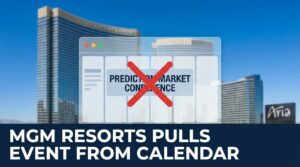
MGM Resorts International has quietly removed a scheduled prediction market conference from the Aria Resort & Casino’s event calendar in Las Vegas. The move, which surfaced without a formal public statement from the company, raises fresh questions about how major hospitality brands navigate the regulatory grey zones surrounding prediction markets and event-based trading platforms. While the specific reasons behind the cancellation remain unconfirmed by MGM, the timing coincides with heightened regulatory scrutiny of prediction markets across the United States.
What MGM’s Calendar Change Signals for the Prediction Market Sector
The decision to pull the conference from Aria’s schedule carries weight beyond a single cancelled event. For an industry still fighting for mainstream legitimacy, losing visibility at a flagship Las Vegas venue sends a particular kind of message to operators, investors, and regulators watching closely.
- Brand risk management in action: MGM’s move suggests that even indirect association with prediction market platforms may now carry reputational risk for major gaming and hospitality operators.
- The cancellation lands at a moment when the CFTC continues to evaluate the regulatory boundaries between prediction markets and traditional derivatives trading.
- Venue access matters: Prediction market firms have relied on high-profile conference settings to attract institutional interest and signal credibility. Losing a venue like Aria narrows that playbook considerably.
- Whether this reflects a broader MGM policy shift or a one-off decision tied to this specific event remains an open question the company has not addressed.
Why Las Vegas Venues Are Caught in a Regulatory Crossfire
Las Vegas has long served as neutral ground for industries that operate in regulatory limbo. Crypto conferences, cannabis expos, and sports betting summits have all found homes on the Strip. But prediction markets occupy an unusually awkward position: they look like gambling to some regulators, like financial instruments to others, and like neither to the platforms themselves (a distinction regulators have been slow to enforce).
For MGM Resorts and its portfolio of premium Las Vegas properties, the calculus is straightforward. The company holds gaming licences across multiple jurisdictions. Any perceived endorsement of unlicensed or unauthorised wagering activity could invite scrutiny from state gaming commissions. And in Nevada, where the Gaming Control Board maintains one of the strictest oversight regimes in the country, even hosting a conference can be read as a signal.
That may explain the quiet removal rather than a public cancellation announcement. No press release, no statement. Just a gap in the calendar.
The CFTC’s Shadow Over Prediction Market Growth
The Commodity Futures Trading Commission has been the central regulatory body shaping the trajectory of prediction markets in the U.S. Its ongoing review of platforms like Kalshi and Polymarket has created an environment where legal certainty remains elusive. In 2023, the CFTC blocked Kalshi’s attempt to list event contracts tied to U.S. congressional elections, a decision Kalshi challenged in federal court and initially won before the CFTC appealed.
That legal battle is far from settled. And while it plays out, every adjacent industry participant faces a version of the same question: how close do you want to stand to something a federal regulator is actively contesting?
MGM, it appears, has answered that question with distance.
Reputational Calculus in Hospitality and Gaming
What makes this episode instructive is not the cancellation itself but what it reveals about how large, publicly traded hospitality companies assess emerging sectors. MGM reported $16.2 billion in net revenues for fiscal year 2023. Its brand portfolio spans Bellagio, Mandalay Bay, and the Cosmopolitan. The company operates under intense regulatory oversight in every market it touches.
Hosting a prediction market conference at Aria would have placed MGM adjacent to an industry whose regulatory status remains unsettled at the federal level. Even if the conference itself involved no trading activity, the optics carry weight. Gaming regulators in Nevada have historically taken a broad view of what constitutes association with unauthorised gambling activity. Still, the line between a conference about prediction markets and an endorsement of prediction markets is one that lawyers and compliance teams draw very differently.
| Factor | Implication for MGM | Implication for Prediction Market Industry |
|---|---|---|
| Nevada gaming licence obligations | High sensitivity to any association with unlicensed wagering | Reduced access to premium conference venues in key markets |
| CFTC regulatory uncertainty | Prudent to avoid sectors under active federal review | Legitimacy gap widens without mainstream venue partnerships |
| Public company reputation | Shareholder and board-level risk awareness | Industry conferences may shift to less regulated jurisdictions or virtual formats |
| No public statement issued | Minimises media exposure and regulatory attention | Creates ambiguity that could deter future venue partnerships across the Strip |
How Industry Perception Shapes Regulatory Outcomes
There is a behavioural dimension to this story that extends beyond corporate risk management. In the framework of how industries achieve legitimacy, perception often precedes regulation. When mainstream brands embrace an emerging sector, regulators face implicit pressure to accommodate it. When those same brands pull back, the opposite dynamic takes hold.
Prediction market advocates have spent years arguing that these platforms serve a genuine informational purpose, aggregating collective intelligence about future events in ways that polls and forecasts cannot. Academic research supports parts of that claim. Yet the framing battle is far from won. Every time a major venue or brand distances itself from the sector, the narrative shifts slightly toward risk rather than innovation. The psychological anchoring effect here is real: once an industry is associated with cancellation and withdrawal, rebuilding trust requires disproportionate effort.
For prediction market operators, the path forward arguably depends less on legal victories than on sustained, visible partnerships with credible institutions. Conferences at recognised venues function as trust signals. Losing them forces the industry to find alternative ways to project stability and seriousness, whether through academic affiliations, regulatory engagement, or strategic alliances with established financial services firms.
Frequently Asked Questions
Why did MGM remove the prediction market conference from Aria’s calendar?
MGM has not issued a public explanation. The most likely driver is regulatory caution, given the company’s gaming licences and the unsettled federal status of prediction markets under CFTC oversight.
Are prediction markets legal in the United States?
Their legal status depends on the specific contracts offered and the platform’s regulatory approvals. Some platforms operate under CFTC-designated contract market status, while others face active legal challenges. The landscape remains fragmented and contested.
Does this affect other prediction market events in Las Vegas?
Not directly, at least on paper. But MGM’s decision could influence how other Strip venues evaluate similar booking requests going forward, particularly those operators who hold Nevada gaming licences.