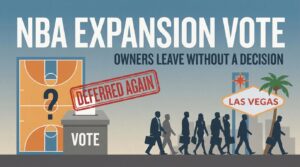
The NBA wrapped up its latest Board of Governors meetings in Las Vegas this week without taking a formal vote on league expansion, extending a process that has stretched well beyond what many observers initially expected. Commissioner Adam Silver acknowledged that while discussions around adding new franchises remain active, the ownership group was not prepared to move forward with a binding decision at this stage. The delay leaves prospective expansion cities and their investor groups in a familiar holding pattern, one that carries real financial and strategic consequences for all parties involved.
What the Latest Delay Signals for Prospective Ownership Groups
Before dissecting the broader implications, here are the core takeaways from the meetings:
- No formal expansion vote was held during the Las Vegas owners meetings, despite widespread anticipation that the topic would advance
- Commissioner Silver indicated that the league continues to evaluate expansion but offered no firm timeline for a decision
- Las Vegas and Seattle remain the two cities most frequently cited as frontrunners for potential new franchises
- The ongoing media rights negotiations, valued in the tens of billions, arguably complicate the expansion calculus by raising questions about revenue dilution
- Existing owners must weigh the upfront expansion fee (reportedly expected to exceed $4 billion per team) against long-term revenue sharing with additional franchises
Why the Timing Keeps Slipping
At the surface level, the deferral looks procedural. Dig slightly deeper and the economics tell a more revealing story. The NBA’s ongoing media rights cycle has reshaped the financial landscape for every franchise, with the league’s new broadcast agreements reportedly worth upward of $76 billion over 11 years. That kind of revenue surge changes the math on expansion in two competing directions.
On one hand, a massive expansion fee (some estimates place it north of $4 billion per team) would deliver an immediate windfall split among the existing 30 ownership groups. On the other, adding two teams means splitting future media revenue 32 ways instead of 30. For owners already sitting on rapidly appreciating assets, the urgency to dilute their share is not obvious.
And that tension sits at the heart of the delay.
Las Vegas and Seattle: Two Cities, Two Very Different Pitches
Las Vegas has transformed itself into a legitimate major-league sports market over the past seven years. The city now hosts the Raiders (NFL), the Golden Knights (NHL), and the Aces (WNBA), along with a growing calendar of marquee sporting events. Its tourism infrastructure, lack of state income tax, and arena-ready footprint make it a compelling candidate on paper. Still, questions linger about whether the market can sustain another major professional franchise alongside the existing tenants (a concern that not all market participants agree on).
Seattle presents a different case entirely. The city lost the SuperSonics to Oklahoma City in 2008, and the wound has never fully healed. A passionate fan base, a major metropolitan area, and the renovated Climate Pledge Arena give Seattle strong fundamentals. But the ownership group and financial terms would need to satisfy a league that has become increasingly selective about who joins the club.
What remains less clear is whether both cities would be approved simultaneously or whether the league might stagger its expansion, granting one franchise before the other.
The Revenue Dilution Debate Among Owners
Expansion economics in professional sports leagues are never straightforward. The table below illustrates the basic financial tension at play:
| Factor | Pro-Expansion Argument | Anti-Expansion Argument |
|---|---|---|
| Expansion Fee | Immediate cash distribution to existing owners, potentially $4B+ per team | One-time payment versus perpetual revenue sharing dilution |
| Media Revenue | New markets could increase total viewership and future deal value | Splitting $76B deal across 32 teams reduces per-team share by roughly 6.25% |
| Competitive Balance | Fresh franchises generate fan interest and new rivalries | Talent dilution across a larger league could reduce product quality near-term |
| Franchise Valuations | League growth narrative supports higher valuations across the board | More teams could, in theory, slow the pace of individual franchise appreciation |
The expansion fee alone makes this a compelling proposition for current owners. Yet the long tail of revenue sharing means that the decision carries implications stretching decades into the future, which partly explains why the vote keeps getting pushed.
How Framing Shapes the Expansion Narrative
One underappreciated dimension of this story involves how the league and its stakeholders frame the expansion question itself. In practice, the language used by commissioners, owners, and media outlets subtly shapes public and investor expectations. When Silver describes expansion as “ongoing” and “active,” he anchors the conversation in forward momentum without committing to a deadline. That framing keeps prospective ownership groups engaged and cities investing in readiness, all while preserving maximum optionality for the league.
This kind of strategic ambiguity is not accidental. It mirrors patterns seen across high-stakes negotiations in business and governance, where the party controlling the timeline holds disproportionate leverage. Prospective buyers, city officials, and arena developers are left interpreting signals rather than responding to concrete terms. The psychological effect is significant: it sustains engagement while deferring commitment, a dynamic that benefits the NBA far more than it benefits the applicants. For cities like Seattle, which has been waiting over 15 years, the emotional investment compounds with each passing meeting cycle. The league, at least on paper, loses nothing by waiting. The cities absorb all the uncertainty.
Whether that patience holds indefinitely is another question. Political leaders in both Las Vegas and Seattle have tied portions of their public agendas to the prospect of landing an NBA franchise. At some point, the cost of sustained ambiguity begins to erode goodwill, and the league knows it.
Frequently Asked Questions
When is the NBA expected to vote on expansion?
No official date has been set. Commissioner Silver has indicated the league is still evaluating the matter, and the next Board of Governors meeting could bring the topic back, though there are no guarantees a vote will occur then either.
How much would an NBA expansion franchise cost?
Estimates suggest the expansion fee could exceed $4 billion per team, which would make it the largest expansion fee in North American professional sports history. The final figure will depend on negotiations between the league and prospective ownership groups.
Which cities are most likely to get NBA expansion teams?
Las Vegas and Seattle are widely considered the leading candidates. Both have strong market fundamentals, though each presents distinct advantages and challenges that the league continues to weigh.
Why haven’t the owners voted yet?
The interplay between massive new media rights deals, revenue dilution concerns, and the sheer size of the financial commitment involved has made consensus difficult. Owners are balancing a large one-time payout against long-term structural changes to how league revenue gets divided.



