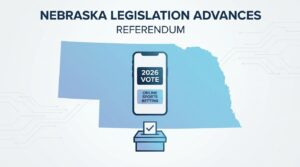
Nebraska’s Tax Relief and Revenue Committee has moved forward a proposal that could place online sports betting on the ballot for November 3, 2026. The measure, if approved by the full legislature, would let Nebraska voters decide whether to authorize mobile and online wagering across the state. It marks a significant shift for a state that has so far restricted legal sports betting to in-person venues at licensed horse racing tracks. The timing aligns with a broader national pattern of states reconsidering digital gambling frameworks as tax revenue pressures mount.
What Nebraska’s Sports Betting Push Means for Stakeholders
Several forces converge behind this legislative effort, from fiscal pressures on state budgets to competitive dynamics with neighboring states already offering mobile wagering. Here are the strategic takeaways worth tracking:
- Revenue gap: Nebraska’s current in-person-only model captures a fraction of the potential sports betting market. Neighboring Iowa and Colorado, both with mature mobile platforms, likely siphon demand from Nebraska bettors willing to cross state lines or use offshore alternatives.
- Voter-driven authorization: By routing the decision through a ballot measure rather than a straight legislative vote, lawmakers insulate themselves from political risk while giving the policy democratic legitimacy.
- The 2026 timeline gives operators, regulators, and advocacy groups roughly 18 months to shape the public conversation around mobile betting.
- Tribal and track interests: Existing stakeholders in Nebraska’s gaming ecosystem, particularly horse racing tracks that currently host retail sportsbooks, will need to negotiate how online expansion affects their market position.
- Regulatory design matters: The specific language of the ballot question and any accompanying legislation will determine tax rates, licensing structures, and whether the state adopts a competitive multi-operator model or a more restrictive framework.
How Nebraska Got Here
Nebraska legalized in-person sports betting in 2021 after voters approved a ballot initiative the previous year. That measure authorized wagering exclusively at the state’s six licensed horse racing tracks, a compromise that satisfied racing interests but left the digital market untouched. Since then, sportsbook operators at those tracks have reported modest handle figures compared to states with online platforms.
The gap is hard to ignore.
States like Iowa, which launched mobile sports betting in 2021, have seen monthly handles regularly exceed $200 million. Nebraska’s retail-only approach, by contrast, limits accessibility and constrains both consumer participation and state tax receipts. When the Tax Relief and Revenue Committee advanced the current proposal, it did so against this backdrop of unrealized fiscal potential. And while the committee’s vote doesn’t guarantee the measure reaches the ballot, it clears a critical procedural hurdle that signals genuine legislative appetite for expansion.
The Competitive Landscape Around Nebraska
Geography plays a quiet but decisive role in this debate. Nebraska shares borders with six states, several of which already permit online sports betting. Colorado’s market, operational since May 2020, generated over $7.6 billion in total handle during its first full fiscal year of maturity. Iowa’s mobile platform has become a fixture. Even Kansas, to the south, launched online wagering in September 2022.
For Nebraska, the practical consequence is leakage. Residents in Omaha can place a legal mobile bet by driving a few minutes into Iowa. That dynamic creates a peculiar situation where Nebraska bears the social costs associated with gambling (a distinction regulators have been slow to quantify) while neighboring states collect the tax revenue. Whether the 2026 ballot measure can reframe this equation depends on the specific regulatory architecture lawmakers attach to the proposal.
What Operators and Investors Should Watch
Major sportsbook brands are almost certainly monitoring Nebraska’s legislative trajectory. Companies like DraftKings, which operates across dozens of U.S. states, and FanDuel would view Nebraska as a mid-tier expansion opportunity with upside tied to the Omaha and Lincoln metro areas. Still, the ballot measure route introduces uncertainty that pure legislative authorization does not. Voter sentiment can shift, and organized opposition from anti-gambling coalitions or existing retail operators could complicate the campaign.
Tax rate design will be another critical variable. States have adopted wildly different approaches: New York’s 51% tax on gross gaming revenue sits at one extreme, while states like Colorado and Iowa levy rates closer to 10–20%. Where Nebraska lands on that spectrum will shape operator interest and, ultimately, the consumer experience.
| State | Online Sports Betting | Tax Rate (GGR) | Launch Year |
|---|---|---|---|
| Iowa | Yes | 6.75% | 2021 (mobile) |
| Colorado | Yes | 10% | 2020 |
| Kansas | Yes | 10% | 2022 |
| Nebraska | Retail only | 20% | 2023 (retail) |
| New York | Yes | 51% | 2022 |
The Psychology of Ballot Measures and Public Perception
Ballot measures carry a different psychological weight than legislative votes. When voters are asked directly, the framing of the question becomes everything. Research in behavioral decision-making suggests that how options are presented, whether emphasizing revenue benefits or potential social harms, can swing outcomes by significant margins. Nebraska’s 2020 experience offers a useful precedent: voters approved casino gambling and sports betting at racetracks by a comfortable margin, suggesting baseline public comfort with expanded gaming.
But online betting triggers different cognitive associations. The perceived accessibility of mobile wagering, the idea that anyone with a smartphone could place a bet from their couch, activates concerns about problem gambling and youth exposure that retail-only models tend to sidestep. Proponents will need to anchor their messaging in concrete outcomes: jobs created, tax dollars directed to specific programs, regulatory safeguards already proven in other states. Abstract promises of economic benefit rarely survive organized opposition that leads with personal stories of gambling harm.
Arguably, the most effective campaigns in other states have succeeded by tying revenue to a visible public good, whether education funding, infrastructure, or property tax relief. Nebraska’s framing will likely follow a similar playbook, especially given that the proposal originated in the Tax Relief and Revenue Committee. That institutional origin story writes its own narrative.
Frequently Asked Questions
Is online sports betting currently legal in Nebraska?
No. Nebraska permits sports betting only at licensed horse racing tracks. The current proposal would ask voters to authorize online and mobile wagering statewide.
When would Nebraska voters decide on online sports betting?
If the legislature approves the measure, it would appear on the November 3, 2026 general election ballot.
Which companies could enter Nebraska’s market?
Major national operators like DraftKings, FanDuel, BetMGM, and Caesars Sportsbook would be likely applicants, though licensing terms and tax rates will influence which brands pursue entry aggressively. The state’s existing racetrack operators may also seek online partnerships or licenses.
How much revenue could online sports betting generate for Nebraska?
No official projections have been released yet. Comparable mid-sized states with mobile platforms typically generate tens of millions in annual tax revenue, though the exact figure depends heavily on tax rates, the number of licensed operators, and consumer adoption patterns.



