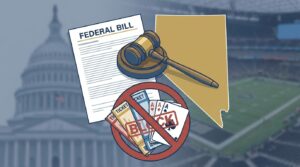
Nevada legislators have introduced a new federal legislative effort aimed at preventing sports event contracts from operating as de facto gambling products outside regulated frameworks. The move targets a growing grey area where prediction markets and event-based contracts blur the line between financial instruments and sports wagering. With the American sports betting market already generating billions in annual revenue through licensed channels, Nevada’s delegation is positioning this as both a consumer protection issue and a competitive fairness concern for states that have built out regulated sportsbook infrastructure.
Why Nevada’s Federal Push on Event Contracts Matters Now
The timing here is far from accidental. Prediction markets have surged in visibility and volume over the past two years, with platforms offering contracts tied to the outcomes of professional and collegiate sporting events. These products, structured as binary options or event-based derivatives, have operated in a regulatory gap (a distinction regulators have been slow to enforce) between the Commodity Futures Trading Commission’s jurisdiction and state-level gambling oversight.
Below are the strategic takeaways from this legislative development:
- Regulatory clarity is the real prize: Nevada’s push would force a federal determination on whether sports event contracts belong under gambling law or commodities law, ending years of jurisdictional ambiguity.
- Licensed sportsbooks stand to benefit if event contracts tied to sports outcomes are classified as wagering products subject to state regulation.
- Prediction market platforms like Kalshi, which have aggressively expanded into sports-adjacent contracts, face direct operational risk from this legislation.
- State revenue models are at stake: Nevada and other states with mature sports betting tax frameworks lose potential revenue when equivalent products trade on federally regulated exchanges without state-level taxation.
- The bill signals a broader congressional appetite for drawing harder lines around what constitutes gambling in digital markets.
The Regulatory Gap That Created This Fight
For years, the CFTC maintained a general prohibition on event contracts that involved gaming or activity unlawful under state law. But enforcement was inconsistent, and the definition of what constitutes “gaming” in the context of exchange-traded contracts remained contested. When Kalshi began listing contracts on sports event outcomes, the CFTC initially moved to block them. A federal court ruling in late 2024, however, sided with the exchange, finding that the CFTC had not adequately justified its prohibition.
That ruling cracked the door open. And Nevada noticed immediately.
The state’s gaming industry generates roughly $15 billion in annual revenue, with sports betting representing one of its fastest-growing segments. Allowing unregulated event contracts to siphon volume from licensed sportsbooks without equivalent consumer protections or tax obligations strikes at the economic model Nevada has spent decades building. State regulators and casino operators alike have argued that a contract paying out based on whether the Kansas City Chiefs win the Super Bowl is, functionally, a sports bet.
What the Proposed Legislation Would Actually Do
The bill, introduced by members of Nevada’s congressional delegation, seeks to amend the Commodity Exchange Act to explicitly classify event contracts linked to the outcome of sporting events as falling under state gambling jurisdiction rather than federal commodities oversight. In practice, this would mean:
| Current Framework | Proposed Change |
|---|---|
| CFTC oversees event contracts on regulated exchanges | Sports-linked event contracts reclassified as wagering products |
| No state-level licensing required for exchange-traded sports contracts | Platforms must obtain state gaming licenses to offer sports event contracts |
| Tax treatment follows commodities/derivatives rules | State gambling tax rates would apply, varying by jurisdiction |
| Consumer protections governed by exchange rules and CFTC oversight | State gaming commissions gain enforcement authority over these products |
The distinction matters enormously for platform economics. State gaming licenses carry significant compliance costs, and tax rates on gross gaming revenue can reach 51% in some jurisdictions. That is a fundamentally different business model than operating under CFTC exchange registration.
Broader Industry Implications and the Framing Battle
Not everyone sees this as straightforward consumer protection. Prediction market advocates argue that event contracts serve a legitimate price discovery function, providing information about probabilities that financial markets and media organizations increasingly rely on. Restricting them, the argument goes, would push activity offshore or into less transparent venues.
Still, the framing battle arguably favors Nevada’s position. When a retail customer places a $50 contract on a basketball game’s outcome and receives a payout if their prediction is correct, the functional experience is indistinguishable from placing a bet through DraftKings or FanDuel. Whether the backend settlement mechanism involves a derivatives clearinghouse or a sportsbook’s risk engine is, at least from the consumer’s vantage point, irrelevant.
And this is where the NLP dimension becomes instructive. The language used to describe these products shapes regulatory outcomes. Calling something an “event contract” anchors it in financial markets terminology, triggering associations with sophistication, hedging, and institutional participation. Calling the same product a “sports bet” anchors it in gambling, triggering associations with consumer risk, addiction, and the need for state oversight. Nevada’s legislative strategy is, in part, a reframing exercise. By shifting the dominant label from “contract” to “wager,” proponents change the cognitive frame through which legislators and regulators evaluate the product. This linguistic anchoring effect is well-documented in decision science: the category a product is placed in determines which rules people believe should apply to it. Nevada’s delegation understands that winning the definitional argument is tantamount to winning the regulatory one. The bill’s text deliberately uses gambling-adjacent language throughout, reinforcing the frame at every turn. Whether this reframing succeeds at the federal level will depend on which cognitive anchor proves stickier among members of Congress who may have limited familiarity with either derivatives markets or sports betting regulation. Yet the strategic intent is unmistakable: control the language, control the outcome.
What Happens If This Gains Traction?
Should the bill advance through committee, expect aggressive lobbying from both sides. The American Gaming Association has already signaled support for clearer boundaries between regulated sports betting and event contracts. Exchange operators, meanwhile, are likely to argue that congressional intervention would stifle financial innovation and set a precedent for restricting other types of event-based contracts.
One question lingers beneath the surface of this debate. If sports event contracts are reclassified as gambling, what stops the same logic from being applied to political prediction markets, entertainment outcome contracts, or weather derivatives? The boundary, once redrawn, may prove difficult to contain.
Frequently Asked Questions
What are sports event contracts?
Sports event contracts are exchange-traded instruments that pay out based on the outcome of a sporting event. They function similarly to binary options, where a buyer profits if a specified outcome occurs and loses their stake if it does not.
Why is Nevada leading this effort?
Nevada has the most established legal sports betting market in the United States and views unregulated event contracts as a competitive threat to its licensed sportsbook operators and state tax revenue.
Would this bill ban prediction markets entirely?
No. The proposed legislation specifically targets contracts tied to sporting event outcomes. Other categories of prediction markets, such as those involving economic indicators or geopolitical events, would not be directly affected, though the precedent could invite future scrutiny.
How does the CFTC currently regulate these products?
The CFTC oversees event contracts traded on designated contract markets under the Commodity Exchange Act, but its authority to prohibit sports-related contracts was challenged successfully in court in 2024, creating the regulatory uncertainty this bill seeks to resolve.