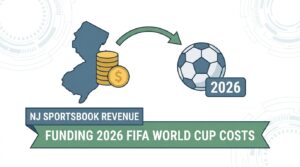
New Jersey legislators have introduced a proposal that would redirect a portion of sports betting tax revenue toward covering the state’s share of hosting costs for the 2026 FIFA World Cup. The measure, if enacted, would tap into one of the country’s most lucrative regulated sports wagering markets to offset public expenditure tied to matches scheduled at MetLife Stadium in East Rutherford. It marks an unusual intersection of sports betting policy and mega-event financing, one that could set a precedent for how U.S. states approach the economics of hosting global sporting events.
What the Proposal Actually Asks Of Sportsbooks
The bill under consideration in Trenton would carve out a defined portion of the tax revenue generated by licensed sportsbooks operating in New Jersey and earmark it specifically for World Cup-related infrastructure, security, and operational costs. Rather than imposing a new levy, the mechanism redirects existing tax flows. That distinction matters: operators would not face an additional financial burden on paper, but the reallocation could reduce funds available for other state priorities currently supported by sports betting revenue.
New Jersey’s sports betting market has generated billions in handle since launching in 2018, with the state collecting hundreds of millions in cumulative tax revenue. Diverting even a modest percentage toward World Cup costs could represent a significant sum, though the exact figures proposed have not been finalized publicly.
Why New Jersey’s Sportsbook Market Is Central to This Conversation
Few states carry the same weight in U.S. sports betting as New Jersey. The state was the plaintiff in the landmark Murphy v. NCAA Supreme Court case that dismantled the federal ban on sports wagering in 2018. Since then, operators like FanDuel’s sportsbook platform and DraftKings have built massive customer bases there, with monthly handle figures routinely exceeding $1 billion during peak seasons.
That revenue engine is precisely what makes the proposal viable, at least on paper. But it also raises a harder question: should a revenue stream originally justified as a way to fund education, responsible gambling programs, and general state coffers be repurposed for a one-time sporting event?
Not everyone sees it that way. Proponents argue the World Cup will generate its own economic windfall through tourism, hospitality spending, and global visibility for the region. The sportsbook contribution, in their framing, functions as a down payment on a much larger return.
Hosting Costs and the MetLife Stadium Factor
MetLife Stadium, home to both the New York Giants and New York Jets, is confirmed as one of the key venues for the 2026 tournament. The facility sits in New Jersey, which means the state bears direct responsibility for surrounding infrastructure, transit logistics, law enforcement deployment, and public safety coordination during match days.
Estimates for total hosting costs across all U.S. venues have ranged widely, and individual state obligations remain somewhat opaque. What is clear: the financial commitment extends well beyond the stadium itself. Road improvements, transit capacity expansions, temporary facilities, and enhanced security protocols all carry price tags that local and state governments must absorb or finance creatively.
This is where the sportsbook revenue redirect enters the picture. It offers a politically palatable funding mechanism (no new taxes, no bond issuances) while still mobilizing real dollars.
Key Stakeholders at a Glance
| Stakeholder | Role | Potential Impact |
|---|---|---|
| New Jersey Legislature | Bill sponsor and decision-maker | Sets precedent for event-linked tax reallocation |
| Licensed Sportsbooks | Revenue source via existing tax obligations | No new levy, but reduced visibility into where tax dollars flow |
| FIFA / Local Organizing Committee | Event organizer and requirements setter | Benefits from improved host-state infrastructure commitment |
| New Jersey Taxpayers | Indirect stakeholders | Programs currently funded by betting revenue may see reduced allocation |
| Hospitality and Tourism Sector | Economic beneficiaries of World Cup traffic | Stands to gain significantly from state investment in event readiness |
Strategic Implications for the U.S. Sports Betting Industry
The proposal carries implications that stretch beyond New Jersey’s borders. Here is a concise breakdown of the strategic takeaways for industry stakeholders and policymakers watching this develop:
- Revenue fungibility is now on the table. If New Jersey successfully redirects sportsbook tax revenue for event hosting, other states may adopt similar mechanisms for stadiums, conventions, or infrastructure projects.
- Operators face reputational, not financial, exposure. The bill doesn’t increase tax rates, but sportsbooks could find themselves publicly tied to World Cup spending debates they did not initiate.
- The move implicitly validates sports betting as a mature, reliable state revenue stream, significant for an industry still fighting perception battles in several legislatures.
- Responsible gambling funding could be squeezed. If earmarked dollars shift toward event costs, programs designed to address problem gambling may compete for a smaller pool.
- Whether this becomes a template depends entirely on how transparently New Jersey accounts for the reallocation and its outcomes.
What Remains Less Clear
Several dimensions of this proposal still lack public detail. The percentage of revenue to be redirected, the duration of the diversion, and the oversight structure governing how funds are spent have not been laid out in full. And while the bill’s sponsors have framed it as fiscally responsible, independent fiscal analysis of the trade-offs (what programs lose funding, and by how much) has yet to surface.
There is also the question of timing. The 2026 World Cup is approaching fast, and infrastructure investments tied to hosting typically require multi-year lead times. Whether legislative action can move quickly enough to make the funding mechanism operational before costs peak is an open concern.
Frequently Asked Questions
Would sportsbooks pay higher taxes under this proposal?
No. The bill as proposed redirects a portion of existing tax revenue rather than imposing a new or increased tax on operators. The financial mechanics stay the same for sportsbooks; what changes is where the state sends the money.
Which matches will be held at MetLife Stadium?
FIFA has confirmed MetLife Stadium as a 2026 World Cup venue, though the specific match schedule, including whether it will host knockout-round games, has not been fully announced.
Has any other state used sports betting revenue for event hosting?
Not in this specific way. The New Jersey proposal would be among the first instances of a state explicitly linking regulated sports wagering tax revenue to the financing of a global sporting event. That novelty is part of what makes the bill worth watching closely.