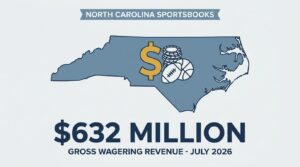
North Carolina’s regulated sports betting market generated $632 million in gross wagering revenue during July 2026, marking a notable year-over-year increase that underscores the state’s rapid maturation as a competitive wagering jurisdiction. The figures, reported by the North Carolina State Lottery Commission, reflect sustained consumer engagement across both mobile and retail channels. With tax receipts climbing in tandem, the results carry direct fiscal implications for the state’s education and infrastructure funding streams.
What July’s Revenue Surge Signals for the Tar Heel State
The $632 million gross wagering revenue figure didn’t arrive in a vacuum. It sits within a broader trajectory that has seen North Carolina’s handle and revenue numbers climb steadily since the state launched legal online sports betting in March 2024. Below are the strategic takeaways from the latest reporting period:
- Gross wagering revenue of $632 million in a single month places North Carolina firmly among the top-tier U.S. sports betting states by revenue volume
- Year-over-year growth suggests the market has not yet plateaued, a pattern that diverges from several earlier-launch states where revenue flattened after 18–24 months
- The state’s tax structure continues to channel a meaningful share of operator revenue toward public services, particularly education
- Operator competition remains intense, with promotional spending still elevated but showing signs of rationalization compared to the initial launch period
- July’s performance, typically a softer month for sports betting given the absence of NFL and college football, hints at growing engagement with MLB, golf, and international soccer wagering
A Market That Defies the Summer Slump
July is historically one of the quieter months on the U.S. sports calendar. No NFL. No March Madness. College football still weeks away. Yet North Carolina’s operators managed to push past the $600 million threshold in gross revenue, which raises a question worth sitting with: is the state’s bettor base simply larger than expected, or are operators getting better at retaining casual bettors through the off-peak months?
Both explanations likely hold some truth. The state’s population of roughly 10.7 million, combined with a relatively late entry into legal sports betting, means the addressable market still contains first-time bettors discovering the product. And operators have invested heavily in same-game parlays, live in-play betting, and micro-market offerings that keep users engaged regardless of which sport is in season.
Operator Landscape and Competitive Dynamics
North Carolina’s market features a mix of national and regional operators. FanDuel’s sportsbook platform and DraftKings have consistently captured the largest share of handle in the state, a pattern that mirrors their dominance across most U.S. jurisdictions. But smaller entrants have carved out niches, particularly through localized marketing tied to the Carolina Panthers, Charlotte Hornets, and the state’s passionate college sports fanbase.
Promotional spending remains a factor. While operators have begun pulling back on the most aggressive sign-up bonuses (a shift visible nationally), North Carolina’s relative youth as a market means promotional credits still account for a meaningful deduction against gross revenue. The gap between gross and net revenue, in other words, is wider here than in more mature states like New Jersey or Pennsylvania.
Tax Revenue and Public Benefit
North Carolina taxes sports betting revenue at a rate that directs proceeds toward the state’s general fund, with earmarks for education and problem gambling programs. July’s $632 million in gross revenue, even after promotional deductions, translates into a substantial tax contribution.
| Metric | July 2026 |
|---|---|
| Gross Wagering Revenue | $632 million |
| Primary Tax Beneficiary | Education / General Fund |
| Market Launch Date | March 2024 |
| Estimated Active Operators | 8–10 licensed platforms |
Still, the relationship between gross revenue and actual tax yield is not always straightforward. Promotional deductions, federal excise taxes, and varying operator margins all compress the final number. What the state ultimately collects is a fraction of the headline figure (a distinction that often gets lost in public discourse around sports betting economics).
Behavioral Patterns Shaping the Market’s Growth
Understanding why North Carolina’s market continues to expand requires looking beyond the numbers and into the behavioral drivers that sustain engagement. From a neuro-linguistic programming perspective, operators have become remarkably adept at framing the betting experience in ways that activate reward anticipation and social identity.
Consider the language used in push notifications and app interfaces. Phrases like “your pick,” “lock it in,” and “you called it” are not accidental. They anchor the user’s sense of agency, creating a perception of skill and control that reinforces continued participation. This linguistic architecture taps into what NLP practitioners call “modal operators of possibility,” words that expand the user’s mental model of what they can achieve.
Operators also leverage anchoring effects in how odds and potential payouts are displayed. A parlay payout shown as “+1200” activates a different cognitive response than the equivalent decimal or fractional representation. The plus sign itself functions as a presupposition of gain. And the social proof embedded in features like “popular bets” or “trending parlays” activates herd behavior, a well-documented NLP pattern where individuals calibrate their decisions based on perceived group consensus.
North Carolina’s demographic profile amplifies these effects. The state’s large military population, its college towns, and its growing urban centers in Charlotte and Raleigh-Durham create overlapping communities where sports fandom is deeply tied to identity. When betting becomes an extension of that identity, engagement becomes self-reinforcing. Operators who understand this are not just selling a product; they are embedding themselves into a social ritual.
Frequently Asked Questions
When did North Carolina launch legal online sports betting?
The state went live with mobile sports betting in March 2024, following legislative approval the prior year.
How does North Carolina’s sports betting tax rate compare to other states?
North Carolina’s rate is competitive within the mid-range of U.S. jurisdictions. It falls below the notably high rates imposed by states like New York but above the more operator-friendly structures in places like Nevada or Iowa. Exact comparisons depend on how promotional deductions are treated.
Where does the tax revenue from sports betting go?
Proceeds are directed primarily toward the state’s general fund, with allocations earmarked for education programs and problem gambling initiatives.
Is the market still growing?
July 2026’s figures suggest yes. The year-over-year increase indicates the state has not yet reached a revenue ceiling, though the rate of growth will likely moderate as the market matures.