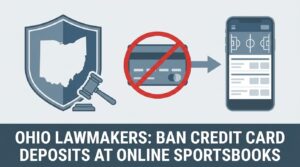
A legislative push in Ohio aims to strip credit cards from the list of accepted funding methods for online sports betting accounts. The proposal, introduced in the state legislature, targets what consumer advocates have long flagged as a risky intersection between gambling and unsecured debt. If enacted, Ohio would join a growing number of states restricting how bettors can load money onto digital platforms. The timing is notable: Ohio’s regulated sports betting market launched only in January 2023, and legislators are already recalibrating the consumer protection framework around it.
What the Credit Card Ban Would Mean for Ohio Bettors and Operators
Before diving into the specifics, it’s worth framing the strategic stakes. Restricting credit card deposits doesn’t just affect individual bettors; it reshapes the economics of customer acquisition and retention for every licensed sportsbook operating in the state. Here are the key implications:
- Consumer debt exposure drops: Bettors would no longer be able to wager with borrowed money through credit lines, reducing the risk of gambling-fueled financial distress.
- Operator deposit volumes may contract: Credit cards have historically been a frictionless funding method, and removing them could slow the pace of account top-ups, particularly among casual bettors.
- Sportsbooks will need to push alternative payment rails harder, from ACH transfers to prepaid cards and digital wallets.
- Regulatory precedent strengthens: Ohio’s move reinforces a national pattern where states are tightening responsible gambling guardrails post-launch rather than waiting for federal action.
- The proposal could accelerate conversations in neighboring states still weighing similar restrictions.
Why Credit Cards and Sports Betting Make an Uncomfortable Pair
The core concern is straightforward. Credit cards let users gamble with money they don’t have. Unlike debit cards or bank transfers, which draw from existing funds, credit card deposits effectively convert a wager into a loan, one that accrues interest if not repaid within a billing cycle. For problem gamblers, this mechanism can accelerate losses at a pace that outstrips their ability to recover financially.
Several major credit card issuers, including Capital One and certain Citibank products, already block gambling transactions on their own initiative. But the patchwork nature of these issuer-level restrictions means enforcement is inconsistent. A state-level ban would remove the ambiguity entirely.
And while the gambling industry often points to responsible gaming tools built into platforms (a distinction regulators have been slow to enforce uniformly), critics argue that allowing credit card deposits undermines those very safeguards. It’s difficult to claim you’re protecting vulnerable users while simultaneously offering them the easiest possible path to wagering beyond their means.
How Ohio’s Market Has Evolved Since Launch
Ohio’s sports betting market generated significant handle in its first full year of operation. The state permitted both retail and online wagering, with major operators like DraftKings, FanDuel, and BetMGM entering the market at launch. The Ohio Casino Control Commission oversees licensing and compliance, and has already processed billions in total wagers since the market opened.
Still, the rapid scaling of online betting has surfaced friction points that weren’t fully anticipated during the legislative drafting phase. Credit card usage is one. Advertising saturation was another, prompting earlier discussions about marketing restrictions. The credit card proposal fits within a broader recalibration effort, one that treats the first year of data as a diagnostic tool rather than a victory lap.
A Comparison: State-Level Credit Card Policies for Online Betting
| State | Credit Card Deposits Allowed? | Market Launch Year |
|---|---|---|
| New Jersey | No | 2018 |
| Pennsylvania | Yes (issuer-dependent) | 2019 |
| Illinois | No | 2020 |
| Ohio | Currently yes; ban proposed | 2023 |
| Massachusetts | Yes (under review) | 2023 |
The Behavioral Economics Behind Payment Friction
There’s a well-documented principle in behavioral economics: the more friction you introduce into a spending decision, the more likely a person is to pause and reconsider. Removing credit cards from the deposit equation doesn’t eliminate gambling. But it introduces a cognitive speed bump. Bettors who must transfer funds from a checking account or load a prepaid card are forced into a moment of deliberation that credit card tapping bypasses entirely.
This matters beyond individual outcomes. When regulators design payment frameworks, they’re essentially shaping the default architecture of decision-making for millions of users. The choice between a frictionless credit card tap and a two-step bank transfer isn’t neutral. It’s a policy lever disguised as a payment option. Research in neuro-linguistic programming and decision science consistently shows that environmental cues, including how easy it is to complete a transaction, profoundly influence behavior. Reframing the deposit process as something that requires active engagement rather than passive convenience could shift betting patterns at scale.
Operators understand this dynamic well. The entire UX design philosophy of modern sportsbook apps is built around reducing friction: one-tap bets, instant deposits, push notification prompts. Removing credit cards disrupts one node in that chain. Whether it materially reduces problem gambling rates is an empirical question Ohio’s data will eventually help answer, but the directional logic is sound.
What Comes Next for Operators in Ohio?
Sportsbooks operating in the state will likely lobby against the restriction, arguing that consumer choice should remain broad and that existing responsible gaming tools are sufficient. Yet the political momentum behind gambling consumer protection measures has been building across multiple state legislatures in 2024 and into 2025.
For operators, the practical adjustment isn’t catastrophic. Most platforms already support multiple deposit methods, and markets like New Jersey have functioned without credit card deposits for years. The real question is whether Ohio’s move triggers a cascade. If three or four more states follow within the next legislative cycle, the industry may quietly standardize around non-credit payment methods on its own, preempting further regulation.
Frequently Asked Questions
Would this ban apply to debit cards as well?
No. The proposal specifically targets credit card transactions. Debit cards, which draw from existing bank balances, would remain an accepted deposit method under the current language of the bill.
When could the ban take effect?
The timeline depends on the legislative process in Ohio. The bill would need to pass both chambers and receive the governor’s signature. No firm effective date has been announced.
Do other states already prohibit credit card deposits for sports betting?
Yes. New Jersey and Illinois, among others, already restrict or prohibit credit card use for online sportsbook deposits. The approach varies by state, and some rely on individual credit card issuers to enforce their own blocks rather than imposing a blanket statutory prohibition.
How would this affect existing sportsbook accounts?
Bettors who currently use credit cards would need to switch to an alternative funding method. Sportsbooks would likely prompt users to update their payment preferences ahead of any enforcement date, though the transition mechanics haven’t been detailed in the proposal yet.