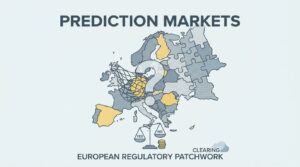
Prediction markets have surged in visibility over the past two years, driven by high-profile platforms and growing public appetite for event-based trading. Yet across Europe, there is no unified regulatory framework governing these platforms, leaving operators stranded between gambling legislation, financial services rules, and in some jurisdictions, outright legal ambiguity. The result: a market caught between two frameworks, with no clear path toward harmonisation.
What Europe’s Fragmented Approach Means for Operators and Users
Before diving into the specifics, it helps to frame the core tension. Prediction markets sit at an uncomfortable intersection of finance and wagering, and European regulators have not agreed on which side of that line they fall. The strategic implications ripple across compliance costs, market access, and product design.
- No single EU-wide classification exists for prediction market contracts, forcing operators to navigate country-by-country licensing regimes that often contradict one another.
- Some member states treat prediction markets as gambling products, subjecting them to national gambling authority oversight and consumer protection rules designed for bookmakers.
- Others lean toward classifying certain contracts as financial instruments under MiFID II, which triggers an entirely different set of capital, reporting, and conduct obligations.
- Platforms operating cross-border face compounding compliance burdens, arguably the steepest barrier to scaling in the European market
- Regulatory clarity is unlikely before 2026 at the earliest, given the EU’s current legislative calendar and the absence of a dedicated consultation on prediction markets.
Gambling Law or Financial Regulation? The Classification Problem
At the heart of this fragmentation lies a deceptively simple question: is a prediction market contract a bet or a derivative? The answer depends almost entirely on geography.
In the United Kingdom, the Gambling Commission has historically treated binary outcome contracts on events (elections, weather, sports) as gambling products. Operators need a licence. Consumer protections apply. Advertising restrictions kick in. But when the underlying contract starts to resemble a financial derivative, the Financial Conduct Authority may assert jurisdiction instead. The boundary between the two has never been drawn with precision (a distinction regulators have been slow to enforce), and platforms have learned to design products that sit deliberately in the grey zone.
Continental Europe presents its own complications. France’s ANJ regulates online gambling but has not issued specific guidance on prediction markets tied to non-sporting events. Germany’s Interstate Treaty on Gambling, revised in 2021, focuses heavily on sports betting and online casino products. Prediction markets built around political or economic outcomes don’t map neatly onto these categories.
And then there is Malta.
The Malta Gaming Authority has positioned itself as one of Europe’s more flexible licensing regimes, attracting a range of innovative gambling and quasi-financial platforms. Some prediction market operators have explored Malta Gaming Authority licensing pathways as a pragmatic entry point into the EU market. Still, an MGA licence does not automatically passport into other member states for products that local regulators might classify differently.
How MiFID II Complicates the Picture
When a prediction market contract is structured as a binary option or a contract for difference, it can fall squarely under the Markets in Financial Instruments Directive. ESMA’s 2018 prohibition on the sale of binary options to retail clients remains in force, which means any prediction market product that resembles a binary option faces immediate distribution constraints across the EU.
This creates a paradox. Platforms that try to professionalise their offering by structuring contracts as financial instruments run headlong into restrictions designed to protect retail investors from speculative losses. Those that stay on the gambling side avoid MiFID II but inherit a patchwork of national gambling laws that were never designed for event-driven trading on geopolitical outcomes. What remains less clear is whether ESMA or national competent authorities will revisit these boundaries as prediction market volumes grow.
Cross-Border Operations: Where Compliance Costs Compound
For any platform with ambitions beyond a single jurisdiction, the economics are punishing. Each country demands its own legal analysis, its own licensing application, its own compliance infrastructure. A platform licensed in one EU member state under gambling law cannot assume it can offer the same product in another without additional authorisation.
| Jurisdiction | Primary Regulatory Lens | Key Challenge for Prediction Markets |
|---|---|---|
| United Kingdom | Gambling (Gambling Commission) / Financial (FCA) | Unclear boundary between gambling and derivatives classification |
| France | Gambling (ANJ) | No specific guidance on non-sporting event contracts |
| Germany | Gambling (GGL under Interstate Treaty) | Framework oriented toward sports betting; poor fit for political or economic event markets |
| Malta | Gambling (MGA) | Flexible licensing, but no EU-wide passporting for hybrid products |
| EU-wide | Financial (MiFID II / ESMA) | Binary options ban constrains retail-facing financial product design significantly |
Even platforms like Polymarket’s blockchain-based prediction trading platform, which have gained traction in the US market, face structural barriers to serving European users at scale. Decentralised architecture does not exempt operators from regulatory obligations, at least on paper.
Why This Regulatory Vacuum Persists
Part of the explanation is institutional. The European Commission has been consumed by MiCA implementation for crypto-assets, the AI Act, and ongoing digital finance strategy work. Prediction markets, while growing, have not generated the kind of consumer harm headlines that typically accelerate regulatory action. There is no political urgency.
But the vacuum carries risks. Without clear rules, consumer protection standards vary wildly. Dispute resolution mechanisms differ. And the potential for regulatory arbitrage grows with every month that passes without coordination. Operators that establish themselves in the most permissive jurisdiction today may find themselves facing retrospective enforcement if standards tighten.
Frequently Asked Questions
Are prediction markets legal in Europe?
There is no blanket prohibition, but legality depends on how a specific country classifies the product. Some jurisdictions treat them as gambling, others as financial instruments, and several have issued no specific guidance at all.
Can a prediction market platform operate across multiple EU countries with one licence?
Generally, no. Gambling licences do not passport across EU borders the way financial services licences can under MiFID II. Even under MiFID II, the binary options ban creates significant constraints for retail-facing platforms. Each market typically requires separate regulatory engagement.
When might the EU introduce harmonised rules?
No formal legislative proposal or consultation has been announced. Given the Commission’s current priorities around crypto regulation and AI governance, dedicated prediction market rules are unlikely before 2026, and possibly later.
What is the biggest risk for operators right now?
Regulatory reclassification. A platform operating under a gambling licence could find its product reclassified as a financial instrument by a national authority, triggering immediate compliance gaps and potential enforcement action.