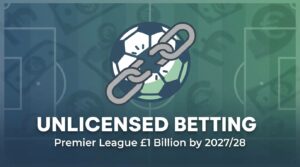
A stark warning has emerged about the scale of unlicensed gambling activity surrounding English football’s top division. According to industry projections, unlicensed betting on Premier League matches could reach £1 billion per season from 2027/28, driven by the proliferation of offshore operators and the growing accessibility of unregulated digital platforms. The figure underscores a widening gap between the regulated market and a shadow economy that continues to operate beyond the reach of UK licensing authorities (a distinction regulators have been slow to enforce with meaningful consequence).
What a £1 Billion Shadow Market Means for English Football
Before examining the granular implications, it is worth framing the scale of what this projection represents. A billion-pound unlicensed betting market doesn’t just erode tax revenue. It compounds integrity risks across the sport, weakens the commercial position of licensed operators, and creates regulatory blind spots that are difficult to close retroactively. Here are the key strategic takeaways:
- Integrity threat escalation: Unlicensed operators sit outside the monitoring frameworks that detect suspicious betting patterns, making match-fixing harder to identify and prosecute
- Revenue leakage from the regulated market: Every pound wagered with an unlicensed operator is a pound that generates no levy, no tax, and no contribution to responsible gambling programmes
- Licensed bookmakers face competitive pressure from platforms that carry none of the compliance costs associated with a UK Gambling Commission licence
- Consumer protection gaps widen: Bettors using unlicensed platforms have no recourse through UK dispute resolution mechanisms and no access to self-exclusion tools like GAMSTOP
- The Premier League’s own commercial model, which depends partly on betting sponsorship revenue, faces reputational risk if the sport becomes associated with large-scale unregulated wagering
Where the Growth Is Coming From
The trajectory toward £1 billion is not speculative guesswork. It reflects observable trends in how consumers access betting markets globally. Offshore platforms, many operating from jurisdictions with minimal regulatory oversight, have become increasingly sophisticated in targeting UK audiences through social media advertising, influencer partnerships, and cryptocurrency payment rails that bypass traditional banking controls. And while the Gambling Commission has powers to block unlicensed websites, enforcement remains reactive rather than systematic.
The Premier League’s global broadcast reach amplifies the problem. Matches are watched in over 180 countries, and in many of those markets, local regulation of online betting is either nascent or non-existent. That creates fertile ground for operators who can offer odds on English football without ever obtaining a licence from a UK or European regulator.
How Regulators and the Industry Are Responding
The UK Gambling Commission has historically focused its enforcement resources on licensed operators, issuing fines and licence reviews for compliance failures. But the unlicensed market presents a fundamentally different challenge. You cannot fine an operator you cannot reach. You cannot suspend a licence that was never issued.
Some progress has been made through ISP blocking orders, which require internet service providers to restrict access to identified unlicensed gambling websites. Still, the effectiveness of these measures is limited. VPN usage among consumers is rising, and new domains can be registered faster than regulators can act against them. The UK Gambling Commission’s approach to tackling unlicensed operators has drawn scrutiny from both industry stakeholders and parliamentary committees questioning whether current tools are adequate.
The Premier League itself has invested in betting integrity monitoring through partnerships with organisations like the International Betting Integrity Association (IBIA). These systems track unusual betting patterns across licensed markets. What they cannot track is activity on platforms that operate entirely outside regulated ecosystems.
The Commercial Ripple Effect on Licensed Operators
For licensed betting companies operating in the UK, the growth of an unlicensed parallel market creates a paradox. Compliance costs continue to rise. Affordability checks, enhanced due diligence requirements, and advertising restrictions introduced under the 2023 White Paper on gambling reform all add operational burden. Meanwhile, unlicensed competitors face none of these constraints.
That asymmetry matters.
It risks creating a two-tier market where the most compliant operators lose market share to the least accountable ones. Several industry bodies have argued that overly restrictive regulation of the licensed sector inadvertently pushes consumers toward unregulated alternatives, though not all market participants agree on this point. The Betting and Gaming Council has repeatedly warned that friction in the regulated customer journey, particularly around deposit limits and verification processes, drives migration to offshore platforms that offer a frictionless experience.
| Factor | Licensed Market | Unlicensed Market |
|---|---|---|
| Regulatory oversight | Full UKGC compliance required | None; operates outside UK jurisdiction |
| Tax contribution | 21% remote gaming duty | Zero |
| Consumer protection | GAMSTOP, affordability checks, dispute resolution | No formal protections available to UK consumers |
| Integrity monitoring | Integrated with IBIA and sport governing bodies | Largely invisible to monitoring systems |
| Advertising restrictions | Subject to ASA and UKGC codes | Unrestricted; often targets consumers via social media and encrypted messaging apps with no oversight whatsoever |
Why the 2027/28 Timeline Carries Weight
The projection aligns with the start of the Premier League’s next domestic and international broadcast cycle. Broadcast deals are expected to push the league’s global audience even higher, which in turn expands the addressable market for unlicensed operators. At least on paper, every new territory that gains access to Premier League coverage without corresponding gambling regulation becomes another entry point for unregulated wagering.
Whether the £1 billion figure proves conservative or optimistic depends on several variables: the pace of regulatory coordination between jurisdictions, the effectiveness of payment blocking measures, and whether technological solutions like blockchain-based identity verification can create new barriers to unlicensed activity. Less clear is whether any of these interventions can move fast enough to match the speed at which offshore platforms adapt.
Frequently Asked Questions
What qualifies as unlicensed betting?
Any gambling operator offering services to UK consumers without holding a licence from the UK Gambling Commission is operating on an unlicensed basis. This includes offshore websites, unregulated apps, and peer-to-peer betting facilitated through social media or messaging platforms.
Is placing a bet with an unlicensed operator against the law for consumers?
Under current UK legislation, it is the provision of unlicensed gambling services that constitutes an offence, not the act of placing a bet as a consumer. That said, bettors using such platforms have no legal protections if disputes arise.
How does this affect the Premier League directly?
The league faces heightened integrity risks because suspicious betting activity on unlicensed platforms is far harder to detect. There are also broader reputational concerns, particularly as the league negotiates sponsorship and broadcast agreements that assume a well-regulated betting environment surrounds the sport.