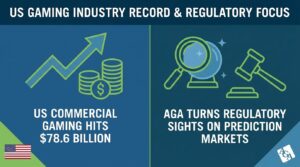
The US commercial gaming industry posted $78.6 billion in gross gaming revenue during 2025, a 9% year-on-year jump that cements another record-breaking cycle for the sector. The figures come from the American Gaming Association’s State of the States 2026 report, the trade group’s flagship annual analysis of the domestic gaming landscape. But the headline number arrived alongside a pointed warning from AGA President and CEO Bill Miller, who singled out prediction markets as the most urgent regulatory threat facing licensed operators. The message is clear: the industry’s next lobbying battle has already been chosen.
What the $78.6 Billion Revenue Milestone Signals for the Industry
Before unpacking the strategic implications, it helps to frame the key business takeaways from the AGA’s latest data and positioning. These are the points that matter most for operators, regulators, and investors watching the US gaming market evolve.
- Revenue growth remains robust: A 9% increase in GGR to $78.6 billion suggests that consumer demand for regulated gaming products has not yet plateaued, even as macroeconomic headwinds persist in other consumer sectors.
- The AGA is pivoting its advocacy resources from sweepstakes casinos, where it secured legislative wins in 2025, toward prediction markets as the next front in its regulatory campaign.
- Prediction markets classified as “encroachment”: Bill Miller’s language frames these platforms not as competitors in the traditional sense, but as unlicensed actors operating in regulatory grey zones that erode the integrity of the licensed gaming ecosystem.
- State-level action expected: With the AGA’s track record of coordinating multi-state legislative pushes, operators should anticipate targeted lobbying efforts in jurisdictions where prediction market activity is growing fastest.
From Sweepstakes to Prediction Markets: A Deliberate Pivot
The AGA’s 2025 campaign against sweepstakes casinos yielded tangible results. Several states moved to restrict or ban unlicensed sweepstakes operations, responding to industry pressure that framed these platforms as unregulated competitors siphoning revenue from tax-paying, licensed operators. That playbook worked. And now the association is applying a similar framework to prediction markets.
What makes this pivot notable is the speed. Prediction markets have grown rapidly in the US, particularly following the high-profile expansion of platforms that allow users to wager on political, economic, and cultural outcomes. The American Gaming Association’s annual state-by-state analysis positions these platforms as the industry’s most pressing regulatory concern heading into 2026, a designation that carries real weight given the AGA’s lobbying infrastructure.
Still, the comparison to sweepstakes casinos isn’t perfect. Prediction markets occupy a different legal and conceptual space (a distinction regulators have been slow to enforce). Some operate under CFTC oversight. Others exist in jurisdictional gaps. Whether state gaming regulators have the appetite or the authority to act as aggressively as they did against sweepstakes operations remains an open question.
Why Bill Miller’s Language Matters
Calling prediction markets an “encroachment” is a deliberate rhetorical choice. It frames the issue not as market competition but as territorial intrusion, suggesting that these platforms are operating in spaces that rightfully belong to regulated gaming. That framing has consequences. It shapes how legislators perceive the issue, how media covers it, and how regulators prioritize enforcement.
Miller’s positioning also serves a unifying function within the industry. Licensed operators across sports betting, iGaming, and brick-and-mortar casinos don’t always agree on policy priorities. Prediction markets, however, represent a shared threat to the regulatory framework that all licensed operators depend on. By elevating this issue, the AGA creates common ground.
The Revenue Picture in Context
| Metric | 2024 | 2025 | Change |
|---|---|---|---|
| Total US Commercial GGR | $72.1 billion (approx.) | $78.6 billion | +9% YoY |
| AGA Primary Regulatory Target | Sweepstakes Casinos | Prediction Markets | Strategic pivot |
| State-Level Legislative Wins (AGA-backed) | Multiple sweepstakes restrictions passed | Campaign underway for prediction market oversight | Early stage |
How Reframing Shapes Regulatory Outcomes
The way an industry defines a problem determines, in large part, how that problem gets solved. This principle applies directly to the AGA’s current strategy. By categorizing prediction markets as regulatory encroachment rather than innovation or competition, the association anchors the conversation around consumer protection, tax compliance, and licensing standards. These are frames that resonate with state legislators who have already built revenue expectations around licensed gaming taxes.
Consider the psychological dimension. When stakeholders hear “encroachment,” they instinctively think about boundaries being violated. That triggers a protective response, one that favors regulatory action over a wait-and-see approach. The AGA understands this. Its messaging is designed to create urgency without appearing alarmist, a balance that requires careful calibration. Operators who align their own public communications with this framing will find it easier to participate in coalition-building efforts at the state level.
There’s also a timing element worth noting. Prediction markets attracted enormous public attention during the 2024 US election cycle, which means legislators are already familiar with the concept. The AGA doesn’t need to explain what prediction markets are. It only needs to explain why they should be regulated like gaming products. That’s a significantly easier argument to make when public awareness is already high.
Frequently Asked Questions
What are prediction markets, and why does the AGA consider them a threat?
Prediction markets are platforms where users trade contracts based on the outcome of real-world events, from elections to economic indicators. The AGA views them as operating in regulatory grey zones that overlap with licensed gaming, potentially diverting revenue and undermining consumer protections that regulated operators are required to maintain.
How much did US commercial gaming revenue grow in 2025?
The industry reached $78.6 billion in gross gaming revenue, representing a 9% increase over the prior year according to the AGA’s State of the States 2026 report.
Did the AGA succeed in its campaign against sweepstakes casinos?
Yes. Several states enacted restrictions or bans on unlicensed sweepstakes casino operations during 2025, outcomes the AGA actively lobbied for. The trade group now considers that campaign a template for its approach to prediction markets.
What happens next in the prediction markets debate?
Expect state-level legislative activity in 2026 and 2027, particularly in jurisdictions with mature sports betting and iGaming frameworks. The AGA has signalled it will deploy significant advocacy resources toward this issue, though the regulatory path is less straightforward than it was with sweepstakes casinos.



