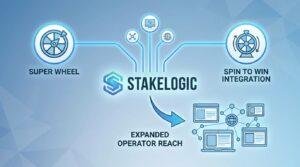
Stakelogic, the Netherlands-based game development studio, has secured a new operator partnership that brings its portfolio of slot titles alongside its proprietary Super Wheel and Spin to Win engagement mechanics. The deal broadens the supplier’s distribution footprint at a time when differentiation through in-game features has become a competitive lever for both studios and operators. While the specific operator was not named in full detail, the integration signals Stakelogic’s continued push to bundle content with its gamification tools as a single package proposition.
What This Partnership Means for Operator Strategy
The integration is more than a content supply agreement. By packaging Stakelogic’s game library with its Super Wheel and Spin to Win overlay mechanics, the operator gains access to player retention tools that sit on top of base games, adding secondary win opportunities without altering the core game logic. Here’s what stands out from a business perspective:
- Bundled gamification as a differentiator: Operators increasingly seek suppliers who deliver not just games but engagement layers that extend session times and boost KPIs like average revenue per user.
- Reduced integration friction: Deploying both content and mechanics from a single provider simplifies the technical lift compared to sourcing overlay tools from third parties.
- Stakelogic’s proprietary features give operators something competitors on the same aggregation platforms may not have access to, at least on paper.
- Market positioning: The deal reinforces Stakelogic’s strategy of competing on feature depth rather than sheer volume of titles, a shift several mid-tier studios have adopted over the past 18 months.
How Super Wheel and Spin to Win Actually Work
Super Wheel triggers randomly during gameplay, presenting players with a wheel-of-fortune-style bonus round layered on top of the base slot. Spin to Win operates on a similar principle but with a different visual and reward structure, offering multipliers and instant prizes. Both mechanics are designed to interrupt standard spin cycles with moments of heightened anticipation (a distinction that matters more to retention metrics than to raw RTP calculations).
What makes these tools commercially interesting is their modularity. Stakelogic can activate or deactivate them per market, per operator, or even per player segment, depending on regulatory constraints and commercial agreements. That flexibility matters in a compliance environment where jurisdictions like the UK, Sweden, and the Netherlands each impose different rules on bonus features and autoplay mechanics.
The Broader Supplier Landscape Is Shifting
This deal arrives against a backdrop of consolidation and feature competition across the iGaming supply chain. Large aggregators like Evolution and Pragmatic Play dominate shelf space, which forces smaller studios to compete on innovation rather than catalogue size. Stakelogic has carved a niche by investing in proprietary engagement tools that operators can deploy without additional vendor relationships.
Still, the question of whether overlay mechanics genuinely move the needle on player lifetime value remains debated. Some operators report measurable uplift in session duration when gamification layers are active. Others argue the effect plateaus quickly, especially among experienced players who recognize the mechanics as cosmetic rather than structural. Not everyone in the industry sees these tools the same way.
And yet, the deals keep coming. Stakelogic’s growing list of operator integrations suggests the market is voting with its procurement decisions, even if the long-term data on player engagement remains mixed.
Regulatory Considerations Worth Watching
Overlay mechanics like Super Wheel sit in a grey zone in certain regulated markets. Regulators in the UK have scrutinized features that could be perceived as encouraging extended play or creating misleading win expectations. The Dutch regulator, Kansspelautoriteit, has similarly tightened rules around bonus structures since the market opened in October 2021.
Stakelogic, holding licences in multiple European jurisdictions, has so far navigated these requirements by making its features configurable per market. Whether that configurability holds up as regulatory frameworks evolve is something the company will need to monitor closely, particularly as the European Commission explores harmonisation of certain gambling advertising and feature standards.
Frequently Asked Questions
What is Stakelogic’s Super Wheel feature?
Super Wheel is a randomly triggered bonus overlay that appears during base gameplay in Stakelogic slots. It presents a wheel-based prize mechanic offering multipliers and instant rewards, designed to increase player engagement without modifying the underlying game mathematics.
How does Spin to Win differ from Super Wheel?
Both are engagement overlays, but Spin to Win uses a different visual format and reward distribution. The core purpose is the same: interrupt standard gameplay with a secondary win opportunity. Stakelogic positions them as complementary rather than interchangeable.
Are these features available in all regulated markets?
Not necessarily. Stakelogic configures feature availability on a per-market basis to comply with local regulatory requirements. Markets with stricter bonus feature rules may see modified or deactivated versions of these mechanics.
Where Gamification Meets Player Psychology
The appeal of tools like Super Wheel and Spin to Win draws heavily on well-documented principles of behavioural engagement. Variable ratio reinforcement, the same mechanism that makes slot games compelling in the first place, gets amplified when an unexpected overlay disrupts the rhythm of play. The player’s attention resets. Anticipation spikes. And the perceived value of the session increases even when the mathematical expectation hasn’t changed.
From a neuro-linguistic programming perspective, these mechanics operate on sensory anchoring. The visual and auditory cues associated with a Super Wheel trigger create a conditioned response over time: the player begins to associate the game environment with moments of surprise and reward, strengthening the emotional connection to the product. Operators who understand this dynamic can use it to shape player journeys more deliberately, deploying gamification not as a gimmick but as a structured engagement architecture.
Framing effects also play a role. Presenting a multiplier win through a spinning wheel rather than a static notification changes how the player processes the outcome. The same 5x multiplier feels different when it arrives through a dramatic reveal versus a line item in a paytable. This is not speculation; it is grounded in decades of research on how presentation context alters perceived value. Studios like Stakelogic are, arguably, applying these principles more consciously than the industry gives them credit for.
The tension, of course, is between effective engagement design and responsible gambling obligations. Regulators are increasingly aware that these psychological levers exist, and the industry’s ability to self-regulate on feature design will likely determine how much latitude studios retain in the years ahead.



