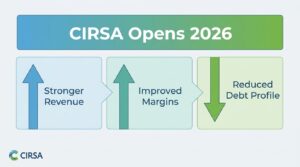
Spanish gaming and leisure operator CIRSA posted a robust start to 2026, reporting higher revenue, improved profitability, and a materially lighter balance sheet compared to the same period last year. The company’s first-quarter results reflect ongoing operational momentum across its core markets in Latin America and Southern Europe, while a new concession win in Peru adds a forward-looking growth dimension. For an operator that has spent recent years restructuring its capital stack, the combination of organic earnings growth and deleveraging marks a notable inflection point.
What CIRSA’s Q1 2026 Numbers Signal for Stakeholders
The quarterly results carry implications that extend well beyond a single reporting period. CIRSA’s trajectory suggests a business transitioning from debt-heavy recovery into a phase where capital allocation flexibility becomes a genuine strategic lever. Here are the key takeaways:
- Revenue growth was accompanied by margin expansion, indicating that top-line gains are not being diluted by proportional cost increases
- Debt reduction was substantial enough to alter the company’s leverage profile meaningfully, giving it more room to pursue concessions and acquisitions
- The Peru concession win opens a new revenue stream in a market where regulated gaming is still consolidating, potentially positioning CIRSA ahead of slower-moving competitors
- Profitability improvements suggest that operational efficiencies, likely driven by digital integration and venue optimization, are beginning to compound
- The results strengthen CIRSA’s hand in any future refinancing or capital markets activity, a factor bondholders will be watching closely
Revenue and Profitability: The Underlying Mechanics
CIRSA’s revenue increase in Q1 2026 was not a single-market story. Growth came across multiple geographies, with Latin American operations continuing to outpace European segments in percentage terms. Yet the European business, particularly in Spain and Italy, contributed stable, high-margin revenue that anchors the group’s overall earnings quality.
What stands out is the profit improvement relative to revenue growth. When earnings expand faster than the top line, it typically points to one of three things: pricing power, cost discipline, or operating leverage from scale. In CIRSA’s case, all three appear to be at work. The company has been investing in technology across its casino and slot machine operations, and those investments are arguably starting to yield returns that show up in the margin line.
A single quarter does not make a trend. But this is the continuation of a pattern visible across several recent reporting periods, which makes it harder to dismiss as seasonal or one-off.
Debt Reduction Changes the Conversation
The most consequential number in the release may not be revenue or EBITDA. It’s the debt figure.
CIRSA’s balance sheet has historically carried significant leverage, a legacy of its 2018 acquisition by Blackstone and subsequent capital structure decisions. Reducing that debt load has been a stated priority, and Q1 2026 shows meaningful progress. A lighter debt profile does several things simultaneously: it reduces interest expense (which flows directly to the bottom line), improves credit metrics that rating agencies monitor, and creates headroom for strategic investment without triggering covenant concerns.
For bondholders and lenders, the deleveraging trajectory matters as much as the absolute number. If CIRSA can sustain this pace of debt paydown while growing earnings, its credit story shifts from “managing leverage” to “choosing how to deploy capacity.” That’s a qualitatively different narrative (and one that tends to compress spreads).
Peru Concession: Timing and Strategic Fit
CIRSA’s new concession in Peru arrives at an interesting moment. The Peruvian gaming market has been undergoing regulatory tightening, with authorities pushing to formalize operations and squeeze out unlicensed operators. For a company with CIRSA’s established compliance infrastructure and multi-market experience, that regulatory environment is more opportunity than obstacle.
Peru represents a market where per-capita gaming spend remains below regional peers like Colombia and Argentina, suggesting room for growth as the formal market expands. CIRSA’s existing Latin American footprint in countries including Panama, Colombia, and Mexico gives it operational templates that can be adapted to Peru without building from scratch. Still, execution risk in new markets is real. Regulatory timelines can shift, local partnerships require careful management, and consumer behavior does not always follow macroeconomic logic.
How CIRSA’s Position Compares Across the Sector
| Metric | CIRSA (Q1 2026) | Sector Context |
|---|---|---|
| Revenue Trend | Year-over-year increase | Mixed across European operators; LatAm generally stronger |
| Profit Margins | Expanding | Many peers facing cost pressure from regulation and wages |
| Leverage | Materially reduced | Several competitors still carrying post-acquisition debt loads above 4x EBITDA |
| Geographic Diversification | Strong (Europe + LatAm) | Few operators match this dual-hemisphere spread with meaningful scale in both regions |
| New Market Entry | Peru concession secured | Competitor activity in Peru remains limited among large-scale international operators |
The Broader Operating Environment
CIRSA’s results land against a backdrop of uneven performance across the global gaming industry. Online segments continue to attract the bulk of investor attention and capital, but land-based operations, particularly in markets with growing middle-class populations, are quietly delivering steady returns. The distinction matters because land-based gaming tends to carry higher barriers to entry, longer concession durations, and more predictable regulatory frameworks than digital alternatives.
Latin America in particular has become a battleground for gaming operators seeking growth outside saturated European and North American markets. Regulatory modernization in countries like Brazil, Colombia, and now Peru is creating new addressable markets. CIRSA’s early positioning in several of these jurisdictions gives it a structural advantage that newer entrants will struggle to replicate quickly.
And while macroeconomic headwinds, including currency volatility in some Latin American markets, remain a factor, CIRSA’s geographic diversification provides a natural hedge that pure-play operators lack.
Frequently Asked Questions
What drove CIRSA’s revenue growth in Q1 2026?
Growth came from multiple geographies, with Latin American markets contributing strongly alongside stable European operations. Technology investments and venue-level optimization also played a role in both attracting customers and improving per-visit economics.
How significant is the debt reduction?
It’s arguably the most strategically important element of the quarter. Lower leverage reduces interest costs, improves credit metrics, and opens up capital allocation options that were previously constrained. The pace of deleveraging, if sustained, could fundamentally reposition how the market prices CIRSA’s risk.
What does the Peru concession mean for CIRSA’s growth?
Peru adds a new regulated market to CIRSA’s portfolio at a time when the country is formalizing its gaming sector. The opportunity is real but comes with execution risk typical of new market entries.
Is CIRSA publicly traded?
No. CIRSA is privately held, owned by Blackstone since 2018. Its debt instruments, however, trade in public markets, making its financial performance closely watched by fixed-income investors.