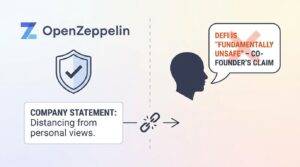
OpenZeppelin, the smart contract security firm whose open-source libraries serve as foundational infrastructure for the vast majority of DeFi protocols, issued a public rebuttal Tuesday against a viral post authored by its co-founder and former CTO, Manuel Aráoz. Aráoz had declared all of decentralized finance fundamentally unsafe. The company moved swiftly to clarify that his remarks do not reflect its official position, a distinction that carries weight given OpenZeppelin’s outsized role in the ecosystem. The episode raises pointed questions about how personal commentary from high-profile founders can ripple through markets built on trust in shared code.
What OpenZeppelin’s Response Signals for the DeFi Security Debate
When a co-founder of one of crypto’s most relied-upon security firms calls the entire DeFi stack unsafe, the industry pays attention. But context matters here, and OpenZeppelin’s response suggests the company views this as a reputational firefight rather than a technical concession. Below are the key strategic takeaways from this dispute:
- Institutional credibility at stake: OpenZeppelin’s contracts library is embedded in protocols managing billions of dollars in total value locked. Any perception that the firm questions DeFi’s viability could trigger downstream confidence erosion among developers and institutional allocators alike.
- Founder speech vs. corporate position: The incident highlights a growing tension in crypto — former executives retain personal brands large enough to move sentiment, even when they no longer set company strategy.
- Aráoz’s post, while provocative, did not cite specific vulnerabilities in OpenZeppelin’s own code, which limits the technical fallout but amplifies the narrative risk.
- Timing is notable: The viral post surfaced during a period of renewed institutional interest in DeFi infrastructure, making the reputational stakes arguably higher than they would have been a year ago.
The Viral Post and Its Fallout
Manuel Aráoz, who co-founded OpenZeppelin and served as its CTO before stepping back from day-to-day operations, published a post that characterized the entire DeFi landscape as inherently insecure. The post gained rapid traction across crypto social channels, drawing reactions from developers, auditors, and protocol teams who depend on OpenZeppelin’s smart contract libraries and security tooling.
What made the post particularly combustible was its source. Aráoz isn’t a casual observer. He helped build the very infrastructure that underpins token standards, access control patterns, and upgradeability frameworks used across Ethereum and EVM-compatible chains. His critique, however broad, carried an implicit authority that few other commentators could match.
OpenZeppelin’s official response was direct: the views expressed were personal and did not represent the company’s assessment of DeFi’s security posture. Still, the company stopped short of dismantling Aráoz’s argument point by point, opting instead for a clean separation between individual opinion and institutional stance.
Why This Matters Beyond the Headlines
The deeper issue here isn’t whether one person’s blog post can destabilize DeFi. It can’t. But the incident exposes a structural vulnerability in how trust operates in open-source crypto infrastructure.
Consider the mechanics. OpenZeppelin’s Contracts library has been integrated into thousands of deployed smart contracts. Developers treat it as a de facto standard (a distinction regulators have been slow to formalize). When the person who helped create that standard publicly questions the safety of the ecosystem it supports, the signal is ambiguous. Is it a warning? A philosophical musing? Or something that should prompt protocol teams to reassess their dependency chains?
In practice, most teams will likely do nothing. The code itself hasn’t changed. No new exploit was disclosed. Yet the reputational layer — the trust layer — took a hit, however brief.
How Founder Commentary Shapes Market Perception
This isn’t the first time a founder’s personal views have collided with a company’s market position in crypto. But the pattern is becoming more consequential as institutional capital flows into DeFi. Fund managers and compliance teams increasingly evaluate not just code audits but the credibility signals surrounding the firms that produce them.
A single viral post won’t unwind that credibility. What it can do is introduce friction — the kind that slows partnership discussions, complicates due diligence, and forces communications teams into reactive mode at exactly the wrong moment.
The State of DeFi Security: A Broader View
| Metric | 2023 | 2024 (YTD) |
|---|---|---|
| Total DeFi exploit losses | ~$1.7 billion | Estimated $800M+ through mid-year |
| Number of audited protocols exploited | Multiple high-profile cases | Trend continuing, though audit coverage has expanded significantly |
| OpenZeppelin library adoption | Used in majority of ERC-20 and ERC-721 deployments | Remains the dominant standard |
Exploit losses remain substantial, which lends at least surface-level support to Aráoz’s broader concern. But attributing systemic risk to the entire DeFi stack conflates protocol-level failures with infrastructure-level soundness. Most exploits trace back to custom logic errors, oracle manipulation, or governance attacks — not to flaws in widely audited base libraries.
Reframing Trust in Open-Source Security Infrastructure
What this episode ultimately tests is whether the crypto industry has matured enough to separate individual voices from institutional reliability. In traditional finance, a retired CTO of a major bank publishing a blog post questioning the banking system’s safety would generate headlines but little systemic concern. The regulatory and institutional scaffolding absorbs the shock.
DeFi lacks that scaffolding. Trust is more concentrated, more personal, and more fragile. A single authoritative voice can punch above its weight precisely because there are fewer counterbalancing institutions to absorb the narrative impact. And while OpenZeppelin’s response was measured and appropriate, the fact that it needed to respond at all tells you something about where the ecosystem stands on the maturity curve.
Whether this incident accelerates conversations around formal standards for smart contract libraries — or simply fades into the next news cycle — depends on how seriously protocol teams and their backers take the underlying question Aráoz raised. Even if his framing was too broad, the discomfort it generated is real.
Frequently Asked Questions
Did OpenZeppelin identify any specific vulnerabilities in its code?
No. The company’s response focused solely on distancing its institutional position from Aráoz’s personal commentary. No new vulnerabilities were disclosed, and the Contracts library remains actively maintained and audited.
Is Manuel Aráoz still involved with OpenZeppelin?
Aráoz co-founded the company and previously served as CTO, but he stepped back from operational responsibilities. His current relationship with the firm appears limited to his historical role.
Should DeFi developers reconsider using OpenZeppelin’s libraries?
The technical case for OpenZeppelin’s libraries hasn’t changed as a result of this episode. They remain the most widely adopted and peer-reviewed smart contract standards in the Ethereum ecosystem. What developers might reasonably do is ensure they’re running the latest versions and layering additional audits on top of any custom logic built around those libraries.