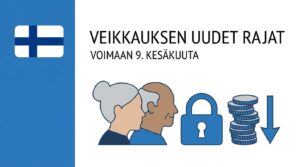
Veikkaus, Finland’s state-owned gambling monopoly, is set to enforce new mandatory loss thresholds differentiated by age group starting June 9. The move targets improved harm prevention across the operator’s customer base, with younger players facing tighter spending caps. It marks one of the more granular approaches to responsible gambling seen in a European monopoly market, and the timing aligns with broader Nordic regulatory momentum around player protection.
What the New Age-Based Thresholds Mean for Players and the Market
Before unpacking the specifics, it’s worth framing why this matters beyond Finland’s borders. Age-segmented loss limits are still rare in regulated gambling markets globally, and Veikkaus’s decision could establish a template that other jurisdictions watch closely. The strategic signal here is clear: blanket limits are giving way to more targeted, data-informed controls.
- Younger players will face lower mandatory loss ceilings, reflecting evidence that early gambling exposure correlates with higher lifetime harm risk
- The thresholds apply across Veikkaus’s product range, not just high-risk verticals like slots or live casino
- Finland’s monopoly structure gives Veikkaus the ability to implement such changes without multi-operator coordination, a luxury competitive markets lack
- This positions Veikkaus ahead of several EU peers on harm mitigation granularity
- Whether the limits are calibrated tightly enough to meaningfully reduce harm remains an open question among researchers
How Age-Segmented Limits Differ from Flat Caps
Most jurisdictions that impose loss limits do so uniformly. A single ceiling applies regardless of whether the player is 18 or 58. Veikkaus is breaking from that model. By introducing different thresholds for different age brackets, the operator acknowledges something the gambling research community has argued for years: risk profiles are not uniform across demographics.
Younger adults, particularly those between 18 and 24, tend to exhibit higher rates of problem gambling behaviour. Studies from the Finnish Institute for Health and Welfare have consistently flagged this cohort as disproportionately vulnerable. And while correlation is not causation, the policy logic is straightforward: reduce exposure where risk concentrates.
Still, a structural advantage helps here. Veikkaus operates as Finland’s sole licensed gambling provider, which means implementation doesn’t require negotiation across competing commercial interests. That’s a meaningful operational distinction (and one that licensed multi-operator markets like the UK or Netherlands cannot easily replicate).
Nordic Regulatory Context: Not an Isolated Move
Finland isn’t acting in a vacuum. Sweden’s Spelinspektionen has tightened deposit limit frameworks repeatedly since 2020. Norway’s Norsk Tipping operates under similarly strict state controls. Denmark, while running a licensed model, has increased its enforcement posture on affordability checks.
Across the Nordics, the regulatory direction is unmistakable. But Veikkaus’s age-based approach adds a new dimension. Rather than simply lowering limits for everyone, it introduces a principle of proportionality that could prove influential in EU-level discussions around the Digital Services Act’s intersection with gambling regulation.
| Country | Operator Model | Loss Limit Approach | Age Differentiation |
|---|---|---|---|
| Finland | State monopoly (Veikkaus) | Mandatory, age-segmented (from June 9) | Yes |
| Sweden | Licensed multi-operator | Mandatory deposit caps (temporary measures extended) | No |
| Norway | State monopoly (Norsk Tipping) | Mandatory loss limits | No |
| Denmark | Licensed multi-operator | Voluntary, with regulatory pressure increasing | No |
The Behavioural Science Behind Targeted Limits
From a neuro-linguistic programming and behavioural design perspective, age-based thresholds tap into something more nuanced than simple restriction. They reframe the gambling experience at a cognitive level for younger users, anchoring their perception of “normal” spending at a lower baseline during formative gambling years. This anchoring effect, well-documented in behavioural economics, can shape long-term habits more effectively than retroactive interventions.
There’s also a framing dimension. When a system communicates that limits exist specifically because of a player’s age group, it introduces an identity-linked cue. The message isn’t just “you’ve spent too much.” It’s closer to “people your age are protected differently.” That distinction matters. Research on self-concept and decision-making suggests that identity-relevant cues carry more motivational weight than generic warnings. Players are more likely to internalise a limit that feels personally calibrated rather than arbitrarily imposed.
Veikkaus could amplify this effect further by pairing the thresholds with personalised messaging, nudges that reference a player’s own patterns rather than population-level statistics. Whether the operator plans to layer behavioural interventions on top of the structural limits hasn’t been confirmed. But the infrastructure for doing so exists within modern player tracking systems, and the combination of hard limits with soft nudges represents what many harm prevention researchers consider the most promising frontier.
One subtlety worth noting: if younger players perceive the limits as paternalistic rather than protective, the intervention risks triggering reactance, a well-studied psychological phenomenon where restricted individuals push harder against boundaries. How Veikkaus communicates the rationale will matter as much as the thresholds themselves.
What Comes After June 9?
Implementation is one thing. Measurement is another. Veikkaus will need to demonstrate that the new thresholds actually reduce harm indicators among younger cohorts, not just reduce revenue from those segments. The distinction is critical, because a drop in spending without a corresponding drop in problem gambling prevalence would suggest the limits are too high, or that affected players are migrating to unlicensed offshore platforms.
Finland’s grey market challenge is real. Unlicensed operators actively target Finnish players through foreign-licensed sites, and tighter domestic controls can inadvertently push vulnerable users toward less regulated environments. Veikkaus and Finnish regulators will need to monitor channelisation data carefully in the months following the policy change.
Frequently Asked Questions
When do the new Veikkaus loss limits take effect?
The age-based loss thresholds are scheduled to go live on June 9, 2025.
Do the limits apply to all Veikkaus products?
Yes, the thresholds are designed to cover the operator’s full product portfolio, spanning lottery, sports betting, and casino-style games. Specific cap amounts per age group have not yet been publicly detailed in full.
Why is Veikkaus using age-based limits instead of a single cap?
The approach reflects research showing that younger adults face disproportionately higher gambling harm risk. A uniform cap doesn’t account for that variation, and Veikkaus is attempting to match its controls more precisely to where harm concentrates.
Could this model spread to other countries?
Arguably, yes. But replication depends heavily on market structure. Monopoly operators can implement such changes unilaterally. In multi-operator licensed markets, regulators would need to mandate the approach across all licensees, a more complex regulatory undertaking.



