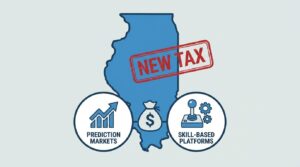
Illinois legislators have embedded a fresh set of gaming tax provisions into the state’s FY2027 budget, targeting prediction markets and skill-based gaming platforms for the first time. The move positions Illinois among a small but growing number of states attempting to bring emerging wagering formats under formal tax regimes. Governor JB Pritzker’s administration backed the budget package, which passed both chambers in late May 2025, and the new levies are expected to generate additional revenue for the state’s general fund starting in the next fiscal year.
What the Illinois Gaming Tax Expansion Actually Covers
The budget language carves out two distinct categories that had previously operated in regulatory grey zones within the state. Prediction markets, where participants wager on the outcomes of real-world events ranging from elections to economic indicators, now fall under a defined tax framework. Skill-based gaming platforms, which blend elements of traditional gaming with player proficiency, face a parallel set of obligations.
Both categories will be subject to a privilege tax on adjusted gross revenues. The precise rate structure mirrors elements of Illinois’s existing sports wagering tax tiers, though the legislature stopped short of applying the same graduated brackets used for the state’s largest sportsbook operators (a distinction that may matter more as these markets scale).
Strategic Implications for Operators and Investors
Before diving into the specifics, it’s worth framing what this means for the broader industry. Illinois is the sixth-largest U.S. state by population and already one of the top sports betting markets by handle. When it moves on tax policy, other states pay attention.
- Prediction market operators face their first state-level tax obligation in a major U.S. market. Platforms like Kalshi’s event contracts marketplace and Polymarket now have a concrete compliance benchmark to plan around.
- Skill-based gaming companies must reassess unit economics. Margins on these platforms tend to be thinner than traditional casino or sportsbook operations, and a privilege tax on gross revenues could compress them further.
- The legislative text does not distinguish between domestically licensed and offshore-facing platforms, raising enforcement questions that regulators will need to resolve in rulemaking.
- Revenue projections remain modest for now. The Illinois Commission on Government Forecasting and Accountability has not published a standalone estimate for these categories, suggesting lawmakers view the provision as forward-looking infrastructure rather than an immediate revenue driver.
- Other states with active prediction market debates, including New Jersey and Nevada, will likely study Illinois’s approach before crafting their own frameworks
Why Prediction Markets Drew Legislative Attention Now
Timing matters here. The 2024 U.S. presidential election cycle saw prediction markets surge in visibility and volume. Kalshi secured a federal court ruling affirming its right to offer event contracts on congressional elections, and trading volumes across platforms spiked during the campaign season. That visibility created political pressure in state capitals. Illinois legislators, already comfortable with an expansive gaming regulatory apparatus, saw an opening to assert taxing authority before the federal landscape settles.
Still, the legal footing is not entirely settled. The Commodity Futures Trading Commission retains oversight of event contracts at the federal level, and the interplay between CFTC jurisdiction and state tax authority remains untested in court. Illinois appears to be betting, in a sense, that its tax claim will hold.
Skill-Based Gaming: A Quieter but Significant Target
Less discussed in the initial coverage but arguably more consequential for day-to-day operators is the inclusion of skill-based gaming. These platforms have proliferated in states where their legal classification sits somewhere between regulated gaming and casual entertainment. By pulling them explicitly into the tax code, Illinois is making a definitional statement: if money changes hands based on competitive outcomes, the state wants its share.
That framing could accelerate similar moves elsewhere. And it puts pressure on industry groups that have lobbied to keep skill-based platforms outside traditional gaming regulation.
How This Fits Into Illinois’s Broader Revenue Strategy
The FY2027 budget carries a projected general fund of approximately $53.5 billion. Gaming taxes across all categories contributed roughly $2.1 billion in FY2024, a figure that has climbed steadily since the legalization of sports betting in 2019. The prediction market and skill-based gaming provisions represent a marginal addition to that total today. But the structural significance outweighs the near-term dollars.
| Gaming Category | Current Tax Status in Illinois | FY2027 Change |
|---|---|---|
| Casino gaming | Graduated privilege tax up to 50% | No change |
| Sports wagering | Tiered tax on AGR (up to 40% for largest operators) | No change |
| Video gaming terminals | Flat tax on net terminal income | No change |
| Prediction markets | Previously untaxed at state level | New privilege tax on AGR introduced |
| Skill-based gaming | Ambiguous classification; largely untaxed | Formally classified and taxed under gaming code |
What Operators Should Prepare For
Rulemaking will follow the budget’s enactment, and the Illinois Gaming Board is expected to issue guidance on registration, reporting, and compliance timelines within the first quarter of FY2027. Operators who have treated Illinois as an unregulated or lightly regulated environment for these product categories need to move quickly.
The budget language grants the Gaming Board broad authority to define what qualifies as a taxable prediction market contract or skill-based game. That discretion could expand or narrow the scope considerably depending on how the Board interprets edge cases, such as fantasy sports contests with significant skill components or social gaming platforms that offer cash prizes.
Frequently Asked Questions
When do the new Illinois gaming taxes take effect?
The provisions are embedded in the FY2027 budget, which begins July 1, 2025. Actual enforcement timelines will depend on the Illinois Gaming Board’s rulemaking process, which could extend into late 2025 or early 2026.
Which prediction market platforms are affected?
Any platform offering event-based contracts to Illinois residents and generating adjusted gross revenue from those transactions would fall under the new framework. The legislation does not name specific companies, but major operators like Kalshi and similar CFTC-regulated exchanges are the most obvious targets.
Does this change affect daily fantasy sports?
Not directly. Daily fantasy sports operate under separate Illinois legislation. However, the Gaming Board’s interpretation of “skill-based gaming” could create overlap in certain product categories, particularly contests that blur the line between skill and chance.
How much revenue does Illinois expect from these new taxes?
No standalone revenue estimate has been published. Given the relatively nascent size of both markets in Illinois, the near-term fiscal impact is likely modest, though the structural precedent carries weight beyond the dollar figure.



