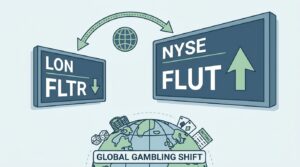
Flutter Entertainment, the parent company behind Paddy Power and FanDuel, completed its migration to the New York Stock Exchange as its primary listing venue in 2024. The move marked one of the most consequential corporate repositioning decisions in the global gambling sector, anchoring the Dublin-headquartered group firmly within the orbit of U.S. capital markets. For an operator already generating the majority of its revenue from North America, the listing shift was less a surprise than a strategic inevitability. But the downstream effects for investors, competitors, and regulators on both sides of the Atlantic deserve closer scrutiny.
Why Flutter’s NYSE Move Reshapes the Competitive Landscape
Flutter’s decision to prioritize its NYSE listing reflects a broader gravitational pull that U.S. sports betting has exerted on European-origin operators since the Supreme Court struck down PASPA in 2018. The following takeaways capture the strategic weight of this transition:
- Access to deeper capital pools: A primary NYSE listing gives Flutter direct exposure to the world’s largest equity market, improving liquidity and broadening its institutional investor base beyond what the London Stock Exchange could offer alone.
- FanDuel’s dominance as the growth engine: FanDuel holds roughly 40% of the U.S. online sports betting market. Listing where that revenue is generated aligns corporate identity with commercial reality.
- The move pressures other European-listed gambling groups to reconsider their own capital market strategies, particularly those with significant U.S. exposure.
- Regulatory signaling: Being NYSE-listed subjects Flutter to SEC oversight and U.S. disclosure standards, which arguably strengthens its credibility with American state regulators still evaluating licensing frameworks.
- Talent acquisition: A U.S.-primary listing makes equity compensation packages more straightforward for American-based executives and engineers, a non-trivial factor in a competitive hiring market.
The Mechanics Behind the Migration
Flutter retained its secondary listing on the London Stock Exchange after the transition, a dual-listing structure that preserves access to European investors while centering governance and reporting obligations in New York. The company had already been trading on the NYSE since May 2023 through a standard listing, but elevating it to primary status in early 2024 carried material implications for index inclusion, analyst coverage, and ETF eligibility.
Index inclusion matters more than most observers appreciate. Once a company qualifies for benchmarks like the S&P 500 (a distinction Flutter has been working toward), passive fund flows follow automatically. That structural demand can support share price stability in ways that active investor interest alone cannot.
Still, the transition was not without friction. Some UK-based institutional holders, bound by mandates restricting non-domestic equity exposure, faced pressure to reduce positions. Whether that selling pressure has fully cleared remains an open question.
FanDuel and the American Revenue Engine
At the heart of this listing decision sits FanDuel’s sportsbook and daily fantasy platform, which has become the single most valuable asset in Flutter’s portfolio. The brand operates in more than 20 U.S. states and has consistently outpaced rivals like DraftKings and BetMGM in market share metrics tracked by industry analysts.
Flutter’s U.S. revenue accounted for approximately 50% of group-wide income in recent reporting periods. That proportion is expected to grow as more states legalize online sports betting and iGaming. The arithmetic is straightforward: when half your revenue comes from one geography, your corporate home should reflect that.
And while Paddy Power remains a recognizable brand across the UK and Ireland, its contribution to group earnings has been progressively eclipsed. The legacy European business is not shrinking in absolute terms, but its relative importance within the Flutter portfolio has diminished year over year.
How Does This Compare to Peer Strategy?
Entain, which owns Ladbrokes and holds a joint venture with BetMGM, has not pursued a similar transatlantic listing shift. DraftKings, Flutter’s closest U.S. competitor, is already NASDAQ-listed and domestically rooted. The competitive dynamic creates an unusual asymmetry: Flutter operates with the scale of a European conglomerate but increasingly behaves like an American pure-play.
| Operator | Primary Listing | Key U.S. Brand | Estimated U.S. Market Share (Sports Betting) |
|---|---|---|---|
| Flutter Entertainment | NYSE | FanDuel | ~40% |
| DraftKings | NASDAQ | DraftKings | ~30% |
| Entain / MGM | LSE | BetMGM | ~15% |
| Caesars Entertainment | NASDAQ | Caesars Sportsbook | ~5–8% |
Regulatory and Governance Dimensions
Subjecting itself to full SEC reporting requirements is not merely a box-ticking exercise for Flutter. U.S. disclosure rules around executive compensation, related-party transactions, and material risk factors tend to be more granular than their UK equivalents under the Financial Conduct Authority’s regime (a distinction regulators have been slow to harmonize). For a company operating in a sector where regulatory trust is currency, this transparency upgrade carries real strategic value.
Yet governance cuts both ways. U.S. shareholder litigation culture is more aggressive than what Flutter would have encountered as a London-primary issuer. Class action exposure increases, and the cost of D&O insurance typically rises in tandem.
What This Means for the Broader Industry
Flutter’s listing migration is arguably a leading indicator rather than an isolated event. As U.S. states continue to liberalize gambling laws and the total addressable market expands, European operators with meaningful American revenue streams will face the same calculus Flutter already resolved. The question is not whether others will follow, but which ones can justify the transition costs and governance burden.
The London Stock Exchange, for its part, has watched a string of high-profile departures in recent years across sectors from technology to natural resources. Flutter’s move adds gambling to that list, reinforcing concerns about London’s competitiveness as a listing venue for globally oriented companies.
Frequently Asked Questions
Why did Flutter choose the NYSE over NASDAQ?
The NYSE has historically attracted larger, more established companies and offers a trading floor model that some issuers view as providing better price discovery during volatile sessions. Flutter’s market capitalization, which exceeds $30 billion, fits the NYSE’s typical profile.
Does Flutter still trade in London?
Yes. Flutter maintains a secondary listing on the London Stock Exchange, allowing European investors to continue trading shares in GBP. However, the primary regulatory and reporting obligations now sit with U.S. authorities.
What impact does this have on Paddy Power customers?
None directly. Listing decisions affect corporate governance and investor relations, not consumer-facing operations. Paddy Power continues to operate independently under the Flutter umbrella across its existing markets.