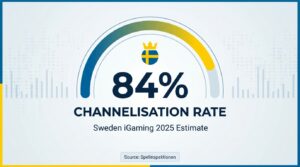
Sweden’s gambling regulator, Spelinspektionen, has placed the country’s 2025 igaming market channelisation rate at 84 per cent. The figure signals that a significant majority of online gambling activity in Sweden now flows through licensed operators, though roughly one in six players still wagers outside the regulated framework. For an industry that has grappled with the tension between consumer protection and commercial viability since Sweden re-regulated its market in January 2019, the number carries weight.
What Sweden’s 84% Channelisation Rate Tells the Industry
Before unpacking the strategic implications, it helps to frame what this estimate means in practice. Channelisation measures the share of total gambling spend captured by licensed, regulated operators versus unlicensed alternatives. At 84 per cent, Sweden sits among the stronger performers in European regulated markets, though the remaining 16 per cent gap still represents considerable revenue leaking to offshore and unlicensed platforms.
- Regulatory credibility reinforced: An 84% rate gives Spelinspektionen tangible evidence that its licensing regime is functioning, arguably strengthening its hand in any future policy debates around tax rates or advertising restrictions.
- Unlicensed competition persists: The 16% that remains outside the system is not trivial. For licensed operators competing on margins already compressed by regulation, that slice of the market represents both lost revenue and a competitive disadvantage against entities unburdened by compliance costs.
- Sweden’s figure will likely be cited by other European jurisdictions considering or refining their own regulatory models, particularly those debating how aggressively to restrict bonuses, advertising, or deposit limits.
- Operator confidence: A stable or rising channelisation rate tends to encourage investment from licensed operators who need assurance that the regulatory environment won’t inadvertently push players toward grey-market alternatives.
How Sweden Got Here
When Sweden transitioned from a state-monopoly model to a licensed multi-operator system on 1 January 2019, sceptics questioned whether the framework could hold. The initial years were turbulent. Temporary Covid-era deposit caps, evolving bonus restrictions, and a tightening advertising regime all tested operator patience. Some feared these measures would erode channelisation by making the licensed product less attractive relative to unregulated alternatives.
Yet the opposite appears to have happened, at least on paper.
The Swedish Gambling Authority’s regulatory approach has combined enforcement action against unlicensed operators with payment-blocking measures and ISP restrictions. That dual strategy of making the licensed market workable while raising the cost of operating outside it seems to be the mechanism behind the 84% figure. Whether the rate has plateaued or still has room to climb is a question the regulator has not directly addressed.
European Context: Where Does Sweden Stand?
Channelisation rates vary dramatically across Europe, and direct comparisons require caution because measurement methodologies differ. Still, the broad picture is instructive.
| Market | Estimated Channelisation Rate | Regulatory Model |
|---|---|---|
| United Kingdom | ~90%+ | Mature licensed market with extensive enforcement |
| Sweden | 84% | Licensed multi-operator since 2019 |
| Denmark | ~85% | Licensed since 2012, relatively stable |
| Netherlands | ~75–80% | Licensed since October 2021, still maturing |
| Germany | Disputed; some estimates below 70% | Interstate Treaty regime with restrictive product rules |
Germany’s comparatively lower rate (a distinction regulators there have been slow to confront publicly) illustrates what happens when product restrictions push too far beyond what players will accept. Sweden’s 84% suggests its regulatory calibration has avoided that trap, though the margin for error remains thin.
The 16% Problem Nobody Wants to Quantify
Sixteen per cent sounds manageable. But translate it into revenue and the picture sharpens. Sweden’s total online gambling market generates billions of kronor annually. Even a conservative reading puts hundreds of millions in the hands of unlicensed operators who pay no Swedish tax, submit to no responsible gambling oversight, and face no obligation to report suspicious activity.
And that raises a harder question: what tools does Spelinspektionen actually have left to close the gap further? Payment blocking has limits. ISP blocking is technically circumventable. Enforcement against offshore entities operating from jurisdictions with no cooperation agreements remains, in practice, largely symbolic. The regulator may be approaching the ceiling of what enforcement alone can achieve without further product or tax adjustments to make the licensed market more competitive.
What Operators and Regulators Should Watch Next
Several dynamics could shift Sweden’s channelisation trajectory in either direction over the coming 12 to 18 months. Proposed changes to deposit limit frameworks, any adjustment to the 18% gaming tax rate, and the evolving enforcement posture toward affiliates and marketing channels all carry the potential to move the needle. Operators already active in the Swedish market will be watching Spelinspektionen’s next regulatory review closely.
There is also the question of measurement itself. Channelisation estimates depend on assumptions about the size of the unlicensed market, which by definition resists precise quantification. The 84% figure is the regulator’s best estimate, not a census. How that estimate is constructed, what data sources feed it, and how it accounts for cryptocurrency-based gambling platforms that have grown rapidly across Europe are details that matter for anyone relying on the number for strategic planning.
Frequently Asked Questions
What does channelisation rate mean in gambling?
Channelisation rate measures the percentage of total gambling activity in a market that occurs through licensed, regulated operators rather than unlicensed or offshore alternatives. A higher rate generally indicates a healthier regulated market.
Why is Sweden’s 84% channelisation rate significant?
It suggests that Sweden’s 2019 re-regulation has been broadly effective at capturing the majority of online gambling spend within its licensed framework. The figure positions Sweden among the stronger regulated markets in Europe, though a meaningful share of activity still sits outside the system.
How does Sweden enforce against unlicensed gambling operators?
Spelinspektionen uses a combination of payment blocking through Swedish financial institutions, ISP-level restrictions, and direct enforcement actions. The effectiveness of these tools varies, and technically sophisticated players can sometimes circumvent them.
Could Sweden’s channelisation rate improve further?
Possibly, though each incremental percentage point becomes harder to capture. Further gains likely depend on a mix of enforcement innovation, product competitiveness within the licensed market, and potentially tax or regulatory adjustments that reduce the appeal of unlicensed alternatives.