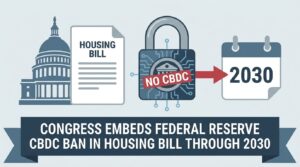
Congressional negotiators have inserted a statutory prohibition on a Federal Reserve-issued retail central bank digital currency into a bipartisan housing package, effectively blocking any Fed-issued digital dollar until December 31, 2030. The provision represents the most durable legislative CBDC ban assembled in Washington to date. By embedding the restriction inside a broader housing bill with cross-party support, sponsors have arguably made it far harder to strip out than a standalone digital currency measure would be on its own.
What the CBDC Ban Means for U.S. Digital Currency Policy
Before unpacking the strategic layers, here is what matters most for executives, regulators, and market participants tracking this development:
- A hard legislative ceiling through 2030: The Fed cannot issue a retail digital dollar for at least five and a half years, removing near-term uncertainty for private-sector stablecoin issuers and payment networks.
- Bundling strategy raises the political cost of reversal: Attaching the ban to a housing bill with bipartisan backing means opponents would need to challenge popular housing provisions to undo the CBDC restriction.
- Private stablecoins and tokenized deposit models now operate in a clearer competitive window, at least on paper.
- Global divergence deepens: While the European Central Bank advances its digital euro pilot and China continues expanding the e-CNY, the United States has now formally stepped back from retail CBDC development for the remainder of the decade.
- The ban applies specifically to retail issuance; wholesale or interbank digital currency experiments by the Fed remain outside its scope (a distinction regulators have been slow to clarify publicly).
Why Lawmakers Chose a Housing Bill
Standalone CBDC legislation has struggled to gain traction in prior sessions. Bills targeting the digital dollar directly tended to stall in committee or get swallowed by broader crypto regulatory debates that never reached the floor. This time, negotiators took a different route.
Folding the prohibition into a housing package accomplishes two things simultaneously. It shields the provision from the procedural gridlock that has plagued crypto-specific bills, and it attaches the CBDC ban to legislation that both parties have political incentives to pass. The calculus is straightforward: voting against affordable housing measures to preserve optionality on a digital dollar is not a trade most legislators want to make publicly.
Still, the maneuver is not without critics. Some policy analysts have questioned whether embedding monetary policy restrictions inside unrelated legislation sets a problematic precedent. That tension has not slowed the bill’s progress.
The Competitive Landscape Shifts for Stablecoins
With a retail CBDC off the table through 2030, the competitive dynamics for private digital dollar instruments change materially. Stablecoin issuers like Circle and Tether, along with banks exploring tokenized deposits, now face a regulatory environment where the Federal Reserve’s own digital currency ambitions cannot undercut their products for years.
That breathing room matters. One of the persistent anxieties in the stablecoin market has been the possibility that a government-backed digital dollar would render private alternatives redundant, or at minimum relegate them to niche use cases. This legislation removes that overhang.
But it also raises a harder question: does the absence of a public digital dollar leave gaps in financial inclusion that private issuers are not incentivized to fill? Not everyone in Washington agrees on the answer.
How the U.S. Compares Globally
| Jurisdiction | CBDC Status | Timeline |
|---|---|---|
| United States | Retail CBDC banned by statute | Through December 31, 2030 |
| European Union | Digital euro in advanced pilot phase | Potential launch 2027–2028 |
| China | e-CNY in active circulation across multiple provinces | Ongoing expansion since 2020 |
| United Kingdom | “Digital pound” under consultation; no launch date confirmed | Earliest 2025–2026 decision |
| India | Digital rupee pilot with select banks | Gradual rollout underway |
The gap between U.S. policy and the trajectory of other major economies is now codified, not just implied.
Reading Between the Lines: What Drives the Opposition to a Digital Dollar
Understanding the motivations behind this legislative push requires looking beyond the surface-level debate about technology. At its core, opposition to a Fed-issued retail CBDC draws from deeply held concerns about government surveillance, monetary control, and the architecture of financial privacy. Lawmakers backing the ban have consistently framed a digital dollar as a tool that could enable unprecedented tracking of individual transactions. Whether or not the Fed would design such a system with privacy protections, the perception of risk has proven politically potent.
There is also an institutional dimension. Community banks and credit unions have lobbied against a retail CBDC, worried it would disintermediate their deposit base. If consumers could hold accounts directly at the Fed, the reasoning goes, smaller financial institutions lose a foundational source of funding. That coalition of privacy advocates and community lenders has given the ban a broader political base than pure crypto-policy debates typically attract.
And yet, the wholesale side of the equation remains untouched. The Fed’s experiments with interbank settlement infrastructure and tokenized reserves continue without statutory interference. The line Congress has drawn is specific: no digital dollar in consumer wallets. What happens between banks is another matter entirely.
Frequently Asked Questions
Does this ban apply to all forms of digital currency in the U.S.?
No. The prohibition targets a Fed-issued retail central bank digital currency specifically. Private stablecoins, tokenized deposits, and wholesale digital currency experiments remain unaffected by this legislation.
Can the ban be reversed before 2030?
Technically, Congress could pass new legislation to override it. In practice, because the ban is embedded in a bipartisan housing package, unwinding it would require navigating significant political friction. The bundling strategy was designed precisely to make reversal costly.
What does this mean for people who use crypto or stablecoins today?
For everyday users, the immediate impact is minimal. The longer-term effect is that private-sector digital dollar products will not face direct competition from a government-issued alternative for at least several years, which could accelerate adoption and product development in the stablecoin market.
Is the U.S. falling behind other countries on CBDC development?
That depends on who you ask. Proponents of the ban argue the U.S. is protecting financial privacy and free-market innovation. Critics contend that ceding ground on CBDC development risks diminishing the dollar’s role in an increasingly digital global payments landscape.