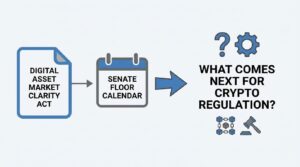
The Digital Asset Market Clarity Act has landed on the Senate Legislative Calendar as Calendar No. 423, placing it within reach of a floor vote whenever Senate leadership decides to act. House Agriculture digital-assets subcommittee chair Dusty Johnson signaled Thursday that the House intends to move quickly on a companion bill. The positioning marks a tangible acceleration in federal efforts to establish a comprehensive regulatory framework for digital assets, and it arrives at a moment when industry participants, institutional investors, and regulators alike have been pressing for statutory clarity.
Why the Calendar Placement Changes the Calculus
Before diving into the strategic implications, it helps to understand what this procedural step actually means. A bill placed on the Senate Legislative Calendar is no longer bottlenecked in committee. It can be called for debate and a vote at the majority leader’s discretion. That doesn’t guarantee passage, but it removes one of the most common legislative chokepoints.
- The bill’s calendar status (No. 423) signals bipartisan committee support strong enough to clear the markup stage, a hurdle that has stalled previous crypto legislation.
- Representative Dusty Johnson’s public commitment to a fast-tracked House companion bill suggests coordinated bicameral momentum, which is unusual for digital-asset policy.
- Institutional market participants now face a narrowing window to shape final language through lobbying and public comment before floor amendments are locked in.
- Exchanges, custodians, and token issuers operating without clear jurisdictional guidance between the SEC and CFTC could see that ambiguity resolved within a single legislative cycle.
- For DeFi protocols and stablecoin issuers, the bill’s definitions of “digital commodity” versus “digital security” will determine which federal agency holds primary oversight.
A Jurisdictional Tug-of-War, Possibly Settled
At the core of the Digital Asset Market Clarity Act is a question that has haunted the industry since at least 2018: which regulator owns what? The SEC has asserted broad authority over tokens it considers securities, while the CFTC has claimed jurisdiction over digital commodities. Courts have offered inconsistent guidance. And the industry has operated in a gray zone that punishes compliance-minded firms and rewards those willing to gamble on enforcement discretion (a distinction regulators have been slow to enforce).
This bill attempts to draw that line legislatively rather than through enforcement actions. If enacted, it would establish criteria for when a digital asset transitions from a security to a commodity, potentially based on the degree of decentralization of its underlying network. That framework matters enormously. It would give projects a roadmap for regulatory graduation, and it would give exchanges a defensible basis for listing decisions.
Still, the devil sits in the definitions. How “sufficiently decentralized” gets quantified in statutory text will determine whether the law creates genuine clarity or simply relocates the ambiguity.
House Momentum and the Johnson Signal
Dusty Johnson’s remarks Thursday were not casual. As chair of the House Agriculture Committee’s digital-assets subcommittee, his jurisdiction covers CFTC-regulated markets. His pledge to move fast on a companion bill suggests the House version may already be substantially drafted. That kind of parallel drafting typically indicates behind-the-scenes coordination between chambers, a sign that leadership in both bodies views the legislation as viable.
The House Agriculture Committee has historically been more receptive to industry input than its Financial Services counterpart. Whether that dynamic produces a more permissive House version remains to be seen. Conference reconciliation between a Senate bill and a potentially friendlier House companion could introduce friction, but the shared urgency appears genuine.
How Market Participants Should Read This
For exchanges and trading platforms, the bill’s progress demands immediate legal review. Firms that have structured operations around SEC no-action letters or informal CFTC guidance may need to reassess those foundations. Token projects currently relying on the Howey test as their primary compliance benchmark should begin modeling scenarios under the proposed framework.
| Stakeholder | Primary Impact | Timeline Sensitivity |
|---|---|---|
| Centralized Exchanges | Listing criteria and jurisdictional clarity | High — pre-vote lobbying window closing |
| DeFi Protocols | Decentralization thresholds for commodity classification | Medium — implementation rules will follow |
| Institutional Investors | Reduced regulatory risk premium on digital asset allocations | High — portfolio positioning may shift ahead of vote |
| Stablecoin Issuers | Potential carve-outs or separate treatment under companion legislation | Uncertain — depends on final bill scope |
| State Regulators | Preemption risk if federal framework overrides state-level licensing | Medium |
The Broader Regulatory Landscape Shifts
This legislative push does not exist in isolation. The EU’s Markets in Crypto-Assets Regulation (MiCA) is already operational, giving European firms a compliance framework that U.S. competitors lack. That gap has driven some projects and capital offshore. Congressional awareness of this competitive dynamic has arguably been the single strongest catalyst for bipartisan movement on domestic crypto legislation.
And while the Digital Asset Market Clarity Act addresses market structure, it does not fully resolve adjacent issues like stablecoin regulation, which may require separate legislation. The interaction between these parallel tracks will shape the final regulatory architecture. Coverage from The Defiant on digital asset policy developments has tracked this convergence closely.
What remains less clear is whether the Senate will attach the bill to a larger legislative vehicle or bring it standalone. Attaching it to a must-pass package would increase its odds but also expose it to unrelated political bargaining.
Framing the Opportunity: What Decision-Makers Need to Internalize
Regulatory clarity in digital assets has been discussed for years in abstract terms. This moment is different because the procedural barriers have thinned to a single vote. For executives navigating this space, the shift demands a reframing of risk. The question is no longer “will regulation come?” but “how quickly can we adapt when it does?”
Organizations that have invested in compliance infrastructure, built relationships with both the SEC and CFTC, and maintained flexible corporate structures will find themselves best positioned. Those that have deferred these investments on the assumption that regulatory ambiguity would persist are running out of runway.
Cognitive flexibility matters here. Leaders who anchor too heavily on the current enforcement-driven paradigm risk being caught flat-footed by a statutory regime that redraws jurisdictional lines. The most effective response involves scenario planning across at least three outcomes: passage as drafted, passage with significant amendments, and stall-out followed by continued enforcement-led regulation. Each scenario demands a distinct operational posture, and the time to model them is before the vote, not after.
Frequently Asked Questions
What is the Digital Asset Market Clarity Act?
It is proposed federal legislation that would establish clear jurisdictional boundaries between the SEC and CFTC for oversight of digital assets, defining when a token qualifies as a security versus a commodity.
What does Calendar No. 423 mean?
Being placed on the Senate Legislative Calendar means the bill has cleared committee and can be brought to the full Senate floor for debate and a vote at the majority leader’s discretion. It’s a procedural milestone, not a guarantee of passage.
How soon could this become law?
If the Senate schedules a vote and the House moves on its companion bill as Representative Johnson indicated, reconciliation and presidential signature could theoretically occur within the current congressional session. But legislative timelines in practice rarely follow the fastest possible path.
Does this bill address stablecoins?
Not comprehensively. Stablecoin-specific regulation is expected to be handled through separate legislation, though the two frameworks will need to be compatible.