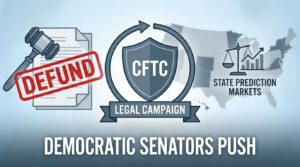
Seventeen Democratic senators have formally urged the Senate Appropriations Subcommittee to strip the Commodity Futures Trading Commission of funding used to pursue lawsuits against states attempting to regulate prediction-market platforms under local gambling statutes. The letter, spearheaded by Sens. Richard Blumenthal and Jeff Merkley, represents a sharp escalation in the ongoing jurisdictional tug-of-war between federal commodity regulators and state-level authorities. At its core, the dispute centers on whether prediction markets — platforms where users wager on the outcomes of real-world events — fall under federal derivatives oversight or state gambling enforcement. The timing is pointed: it arrives as prediction markets expand rapidly and regulatory clarity remains elusive.
What the Senators’ Letter Signals for Prediction-Market Oversight
Before diving into the specifics, it helps to understand the broader stakes. This isn’t merely a budgetary skirmish. The letter reflects a deeper institutional conflict over who gets to define the legal boundaries of a fast-growing asset class that straddles finance, technology, and gambling law. Here are the key strategic takeaways:
- Federal preemption under fire: The senators are challenging the CFTC’s assertion that its jurisdiction over derivatives automatically supersedes state gambling regulations when applied to prediction markets.
- Funding as leverage: Rather than pursuing legislative reform, the Democratic bloc is using the appropriations process to constrain agency behavior — a faster, if blunter, instrument.
- The letter could embolden state attorneys general who have hesitated to enforce local gambling laws against federally registered platforms.
- Industry uncertainty deepens: Prediction-market operators now face the prospect of navigating both federal and state regulatory regimes simultaneously, with neither offering a definitive safe harbor.
- Political fault lines: The move highlights a growing partisan divide on crypto-adjacent financial products, with Democrats increasingly skeptical of light-touch federal oversight.
Why the CFTC Went After States in the First Place
The CFTC’s legal offensive against state regulators didn’t emerge in a vacuum. Over the past two years, several states moved to classify prediction-market contracts as gambling instruments, subjecting platforms to licensing requirements, consumer protections, and in some cases outright bans. The CFTC responded by arguing that these contracts qualify as swaps or commodity options under the Commodity Exchange Act, placing them squarely within federal jurisdiction.
That position gave platforms like Kalshi, a CFTC-regulated prediction market exchange, a legal shield against state-level enforcement. But it also created an uncomfortable precedent: a federal agency effectively suing states to prevent them from protecting their own residents under established gambling frameworks (a distinction regulators have been slow to reconcile).
Still, the CFTC’s argument carries weight in certain legal contexts. Derivatives law has long operated on a preemption model, where federal registration displaces state regulation. Whether prediction markets genuinely fit that model — or whether they’re closer to sports betting dressed in financial language — remains an open and genuinely contested question.
The Appropriations Angle: Blunt but Effective?
Using the appropriations process to rein in a regulatory agency is not new. Congress has historically wielded the power of the purse to block SEC enforcement actions, limit EPA rulemaking, and curtail IRS audits. What makes this instance unusual is the target: the senators aren’t trying to stop the CFTC from regulating an industry. They’re trying to stop it from preventing states from regulating that industry.
That inversion matters.
If the subcommittee acts on the request, the CFTC would retain its authority to oversee prediction markets at the federal level but lose the resources to challenge state-level gambling enforcement. In practice, this could create a patchwork regulatory environment where platforms operate legally under federal rules in some states while facing gambling charges in others. For operators, compliance costs would rise. For consumers, protections would vary wildly depending on geography. And for the CFTC itself, the move would represent a significant institutional setback — an agency told by its own funders that one of its enforcement priorities is no longer worth paying for.
How Prediction Markets Are Caught Between Two Frameworks
| Dimension | Federal (CFTC) Framework | State Gambling Framework |
|---|---|---|
| Classification | Derivatives / event contracts | Wagers on future events |
| Oversight body | CFTC | State gaming commissions |
| Consumer protection | Margin and reporting requirements | Licensing, age verification, responsible gambling mandates |
| Legal basis | Commodity Exchange Act | State gambling statutes (varies significantly by jurisdiction) |
| Preemption claim | Federal law supersedes state regulation | States retain police power over gambling within their borders |
Reframing the Debate: What Decision-Makers Should Watch
For executives operating in or adjacent to prediction markets, the instinct might be to view this as a Washington procedural fight with limited operational impact. That reading underestimates the ripple effects. When seventeen senators publicly challenge an agency’s enforcement posture, it reshapes the risk calculus for every stakeholder in the chain — from platform operators and market makers to institutional investors evaluating exposure to event-contract products.
Consider the second-order effects. State regulators who previously deferred to the CFTC may now feel politically empowered to act independently. Compliance teams at prediction-market firms will need to model for dual-jurisdiction scenarios that, at least on paper, seemed foreclosed by federal preemption. And venture capital flowing into the space could slow as the regulatory outlook shifts from “one federal regulator” to “fifty potential state regulators.”
Yet there’s a counterargument worth weighing. Congressional appropriations riders are notoriously unstable. They expire with the fiscal year. They can be stripped in conference committee. They rarely survive a change in Senate leadership. Whether this particular effort gains traction depends heavily on the subcommittee’s composition and the broader political appetite for confronting the CFTC during an election cycle when crypto regulation is already a live issue.
Frequently Asked Questions
What are prediction markets?
Prediction markets are platforms where participants buy and sell contracts tied to the outcome of real-world events — elections, economic data releases, weather patterns, and more. They function similarly to financial derivatives but are often compared to sports betting by critics and state regulators.
Why are Democratic senators targeting the CFTC’s funding?
The senators argue the CFTC is overstepping by suing states that attempt to regulate prediction markets under local gambling laws. By cutting funding for those specific lawsuits, they aim to preserve state authority without needing to pass new legislation — a faster path, though arguably a less durable one.
Could this actually change how prediction markets are regulated?
In the near term, possibly. If the appropriations language survives the legislative process, the CFTC would lose its ability to challenge state gambling enforcement against prediction-market platforms. But appropriations riders are temporary by nature, and the underlying jurisdictional question would remain unresolved until Congress or the courts address it directly.