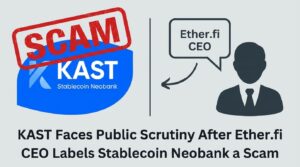
KAST, the stablecoin-powered neobank and card issuer that closed an $80 million Series A at a $600 million valuation in March, has spent the better part of a week fending off pointed accusations on Crypto Twitter. The firestorm began when ether.fi co-founder and CEO Mike Silagadze publicly branded the company a “Kasthole scammer,” a post that quickly gained traction across the decentralised finance community. What followed was a messy, public back-and-forth that raises broader questions about due diligence standards in crypto fundraising and the reputational fragility of fast-scaling Web3 startups.
Why the KAST Controversy Matters for Crypto Investors and Builders
The clash between a well-funded neobank and a prominent DeFi founder is more than a Twitter spat. It signals deeper tensions around transparency, product legitimacy, and how quickly sentiment can shift in an industry where trust is both currency and liability. Before diving into the details, here are the strategic takeaways worth noting:
- Valuation under pressure: KAST’s $600 million valuation, achieved just weeks ago, now faces reputational headwinds that could complicate future capital raises or partnership discussions.
- Founder credibility as a weapon: Silagadze’s standing in the DeFi ecosystem lent his accusation outsized weight, illustrating how a single post from a credible voice can destabilise a competitor’s narrative.
- The incident exposes how thin the line is between aggressive marketing and perceived misrepresentation in crypto product launches.
- Community sentiment shifted fast: KAST’s week-long defensive posture on social media suggests the company was caught off guard, raising questions about its crisis communications preparedness.
- Regulatory attention: Public fraud allegations, even unproven ones, tend to attract the gaze of regulators already sceptical of stablecoin-adjacent products.
What Sparked the Confrontation
Mike Silagadze, who co-founded and leads the liquid restaking protocol ether.fi, posted the accusation without extensive elaboration initially, but the label itself carried enough force to trigger a cascade of community reactions. Crypto Twitter, never short on appetite for controversy, amplified the post rapidly. KAST responded publicly, though the specifics of its defence and the substance behind Silagadze’s claims remain contested.
What makes this episode particularly notable is the timing. KAST had just completed a significant fundraise, the kind of milestone that typically buys a startup a window of goodwill. Instead, the company found itself litigating its legitimacy in public threads.
The Stablecoin Neobank Model Under a Microscope
KAST positions itself as a bridge between stablecoin infrastructure and everyday consumer payments, offering card products that let users spend digital dollars in traditional retail environments. The model is not unique (several competitors occupy adjacent territory) but the scale of KAST’s raise set it apart. An $80 million Series A is substantial by any standard. In crypto, where seed rounds sometimes masquerade as growth-stage capital, it was a statement of intent.
But intent and execution are different animals entirely.
Stablecoin-powered payment products face a tangle of regulatory requirements across jurisdictions, from money transmission licensing in the United States to electronic money institution authorisation in Europe. Whether KAST holds the appropriate licences for every market it targets has not been publicly clarified in granular detail (a distinction that matters more than most founders seem to appreciate). The company’s product documentation and public communications will likely face closer inspection now, both from potential partners conducting due diligence and from regulators monitoring the discourse.
How Crypto Fundraising Narratives Can Unravel
The speed at which KAST’s narrative shifted from “well-funded disruptor” to “company under siege” illustrates a structural vulnerability in crypto capital formation. Traditional fintech startups face scrutiny too, but they rarely contend with the kind of open-source, real-time reputation warfare that defines Crypto Twitter. A single accusation from a respected builder can do more damage than a negative analyst report in conventional markets.
And the dynamics are asymmetric. The accuser bears almost no cost. The accused bears nearly all of it.
| Factor | KAST | Traditional Fintech Peer |
|---|---|---|
| Series A Size | $80 million | Comparable rounds typically $30–60M |
| Valuation | $600 million | Varies widely; often lower multiples |
| Public scrutiny channel | Crypto Twitter, pseudonymous critics | Analyst reports, trade press |
| Regulatory clarity | Evolving; jurisdiction-dependent | More established frameworks |
| Crisis response speed required | Hours | Days to weeks, typically |
Reputation, Trust, and the Psychology of Crypto Communities
What this episode reveals goes beyond one company’s troubles. It touches something more fundamental about how trust operates in decentralised ecosystems. In traditional finance, trust is institutional. It flows from licences, audits, and regulatory oversight. In crypto, trust is largely social. It lives in Discord servers, Twitter threads, and the personal brands of founders.
This creates a fragile architecture. When a figure like Silagadze speaks, his words carry the accumulated credibility of ether.fi’s track record. KAST, by contrast, is newer and less battle-tested in the public eye. The asymmetry isn’t just about follower counts; it’s about perceived authenticity. Communities in DeFi have been burned enough times that they default to suspicion. A well-placed accusation activates that reflex almost instantly.
Still, suspicion is not evidence. The crypto community’s tendency to convict in the court of public opinion before facts are established has its own costs. Projects that are legitimate but poorly communicated can suffer irreparable damage. Projects that are genuinely problematic can sometimes survive simply by outlasting the news cycle. Neither outcome serves the ecosystem well.
For builders watching this unfold, the lesson is uncomfortable but clear: fundraising milestones do not insulate you from reputational risk. If anything, a large raise paints a bigger target. The companies that survive these moments tend to be the ones that over-invest in transparency before the crisis hits, not after.
Frequently Asked Questions
What is KAST?
KAST is a stablecoin-powered neobank and card platform designed to let users spend digital dollars through traditional payment networks. It raised $80 million in its Series A round in March 2025.
Who accused KAST of being a scam?
Mike Silagadze, co-founder and CEO of ether.fi, a liquid restaking protocol, publicly called KAST a “Kasthole scammer” on Crypto Twitter. The post gained significant attention across the DeFi community.
Has any regulator taken action against KAST?
No regulatory enforcement action against KAST has been publicly reported as of now. The accusations remain at the level of public discourse rather than formal regulatory findings.
What does this mean for KAST’s investors?
Investors who participated in the $80 million round may face questions about their due diligence process. Reputational damage of this nature can affect follow-on fundraising, partnerships, and user acquisition, though the long-term impact depends on how KAST addresses the allegations with verifiable evidence.