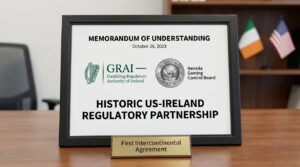
The Gambling Regulatory Authority of Ireland (GRAI) has entered into a Memorandum of Understanding with the Nevada Gaming Control Board (NGCB), establishing the first formal regulatory partnership between Ireland and a US gambling authority. The agreement connects one of Europe’s youngest regulatory bodies with what is arguably the world’s most established gaming oversight agency. Focused on cross-border digital betting and online gambling platforms, the MoU creates a framework for knowledge exchange, technical cooperation, and regulatory alignment across the Atlantic.
What This Transatlantic Alliance Signals for the Gambling Industry
At first glance, a partnership between Dublin and Las Vegas might seem geographically incongruous. But the logic is sharper than the optics suggest. Both jurisdictions are navigating the rapid expansion of digital gambling, and neither can afford to regulate in isolation. Below are the strategic takeaways for industry stakeholders:
- Cross-border enforcement gets teeth: The MoU enables both regulators to share intelligence on unlicensed operators, suspicious betting patterns, and compliance failures that span jurisdictions
- Ireland gains decades of institutional knowledge: Nevada has regulated gambling since 1955. For the GRAI, which only became fully operational in recent years, this partnership accelerates its learning curve considerably
- Operators active in both markets should expect greater scrutiny on consistency of compliance standards across their international portfolios
- A precedent for further agreements: The GRAI has signalled that this MoU is a template, not a one-off. Additional partnerships with other US state regulators or international bodies could follow
- Digital gambling platforms operating across borders face a narrowing window in which regulatory gaps between jurisdictions can be exploited
Why Nevada, and Why Now?
Nevada’s gaming regulatory apparatus predates every other US state’s by a wide margin. The Nevada Gaming Control Board has overseen the evolution of gambling from physical casino floors to mobile-first digital platforms, accumulating enforcement expertise that few regulators anywhere can match. For Ireland, the timing is deliberate. The GRAI has been building its operational capacity since the passage of the Gambling Regulation Act, and formalising an alliance with Nevada sends a clear signal to operators: Ireland intends to regulate with the rigour of a mature jurisdiction, not a fledgling one.
Still, the partnership carries asymmetric benefits. Ireland gains a mentor with deep institutional memory. Nevada, in turn, gets a window into European regulatory frameworks, particularly the EU’s evolving approach to digital services, data protection under GDPR, and consumer protection standards that differ markedly from US norms.
The Mechanics of Cooperation
MoUs between gambling regulators are not uncommon globally, but their practical value depends entirely on implementation. The GRAI-NGCB agreement reportedly covers several operational pillars:
| Area of Cooperation | Practical Scope |
|---|---|
| Information Sharing | Exchange of regulatory data, compliance records, and enforcement actions against operators active in both jurisdictions |
| Technical Expertise | Joint training programmes, secondments, and knowledge transfer on emerging technologies such as AI-driven risk monitoring |
| Licensing Standards | Alignment of due diligence processes for operator licensing, particularly for digital-first platforms |
| Responsible Gambling | Collaboration on harm minimisation frameworks, self-exclusion interoperability, and advertising standards — an area where Ireland’s regulatory posture is still taking shape |
Whether these pillars translate into measurable outcomes within the next 12 to 18 months remains an open question (a distinction that separates symbolic MoUs from consequential ones).
How This Reshapes Operator Strategy
For gambling operators with licences or ambitions in both Ireland and Nevada, the MoU introduces a new variable into compliance planning. Historically, operators could treat each jurisdiction as a discrete regulatory environment, tailoring their compliance posture to local requirements without much concern for cross-referencing. That approach becomes riskier when regulators are actively sharing notes.
Consider a scenario where an operator faces a compliance investigation in Ireland. Under the MoU framework, the GRAI could, at least on paper, request relevant data from the NGCB about the same operator’s conduct in Nevada. Inconsistencies between how a company presents itself to different regulators could surface more easily. And while MoUs are not legally binding instruments, they create political and reputational pressure that operators would be unwise to dismiss.
The Gambling Regulatory Authority of Ireland’s broader strategy appears oriented toward building a network of international partnerships that collectively raise the cost of non-compliance for operators who treat regulatory arbitrage as a business model.
A Wider Pattern in Global Gambling Regulation
This MoU fits within a broader trend. Gambling regulators worldwide have been moving toward bilateral and multilateral cooperation agreements at an accelerating pace. The UK Gambling Commission, Malta Gaming Authority, and several Australian state regulators have all signed similar arrangements in recent years. What distinguishes the GRAI-NGCB partnership is the transatlantic dimension and the pairing of a regulator still defining its enforcement identity with one that has been doing this for nearly seven decades.
Yet the real test is not the signing ceremony. It is whether this agreement produces tangible enforcement actions, shared investigations, or harmonised standards that operators can point to as concrete obligations. Many MoUs in the gambling sector have remained largely ceremonial. The GRAI has an opportunity to make this one different.
Frequently Asked Questions
What does the GRAI-NGCB Memorandum of Understanding cover?
The MoU establishes a framework for information sharing, technical cooperation, licensing alignment, and responsible gambling initiatives between Ireland’s gambling regulator and Nevada’s Gaming Control Board.
Is this MoU legally binding on gambling operators?
No. MoUs are cooperative agreements between regulators, not legal instruments that directly bind operators. In practice, however, they enable regulators to coordinate enforcement in ways that can materially affect operator compliance obligations.
Why did the GRAI choose Nevada as its first US partner?
Nevada operates the oldest dedicated gambling regulatory body in the United States, with enforcement expertise spanning physical and digital gambling. For a relatively new regulator like the GRAI, the institutional knowledge transfer is substantial. The choice also carries symbolic weight, signalling seriousness of intent to the broader industry.
Will this affect operators already licensed in Ireland or Nevada?
Potentially. Operators holding licences in both jurisdictions should anticipate greater information sharing between regulators, which could surface compliance inconsistencies that previously went unnoticed.



