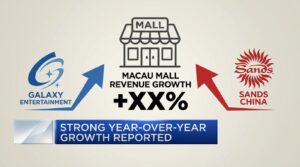
Galaxy Entertainment Group and Sands China have each reported notable year-over-year increases in revenue from their Macau retail mall operations, signalling a broader recovery in the territory’s non-gaming segments. The growth underscores a strategic pivot that both operators have been cultivating for years: reducing dependency on gaming tables by building out luxury retail, dining, and entertainment ecosystems within their integrated resorts. For an industry still calibrating its post-pandemic trajectory, these numbers carry weight beyond the balance sheet.
What the Mall Revenue Numbers Tell Us About Macau’s Recovery
Before diving into the specifics, it’s worth framing why retail mall performance inside integrated resorts matters at all. Macau’s government has been pushing concessionaires toward non-gaming diversification since the licence renewal process in 2022, and mall revenue is one of the clearest barometers of whether that push is translating into actual economic activity. Both Galaxy Entertainment and Sands China appear to be delivering on that front.
- Galaxy Entertainment’s retail mall operations showed sustained year-over-year revenue growth, reflecting increased foot traffic and tenant demand across its flagship properties.
- Sands China’s mall portfolio, anchored by The Londoner Macao and The Venetian Macao, similarly posted revenue gains, driven in part by a resurgence in mainland Chinese visitor spending.
- Non-gaming revenue is becoming a more meaningful share of total income for both operators, a structural shift that regulators have actively encouraged.
- The results suggest that Macau’s luxury retail corridor is recovering faster than some analysts projected at the start of 2024.
- Tenant mix optimisation and higher occupancy rates contributed to the upside at both companies’ properties.
Galaxy’s Retail Ecosystem Gains Momentum
Galaxy Entertainment has invested heavily in its Cotai Strip properties, and the returns are beginning to compound. The group’s retail operations benefit from a deliberate strategy of curating high-end tenants alongside experiential dining and entertainment offerings. That combination pulls visitors deeper into the resort ecosystem and, arguably, keeps them spending longer.
Foot traffic across Galaxy’s integrated resort complex on Cotai has climbed as Macau’s inbound tourism numbers continue their upward trajectory. The company has not disclosed granular mall revenue figures in isolation, but management commentary during recent earnings periods has consistently highlighted non-gaming segments as a growth driver. What remains less clear is how much of that growth is organic versus a rebound effect from depressed pandemic-era baselines.
Sands China: Luxury Retail as a Strategic Anchor
Sands China’s mall portfolio is, by square footage and tenant prestige, among the largest in Macau. The Shoppes at The Venetian, The Londoner, and Four Seasons collectively house hundreds of retail outlets spanning luxury fashion, jewellery, and lifestyle brands. Year-over-year revenue growth across these properties reflects both higher average transaction values and improved occupancy.
One detail worth noting: Sands China has been actively renegotiating lease terms with tenants, in some cases securing higher base rents as demand for premium retail space in Macau tightens. That dynamic gives the operator pricing power it didn’t have two years ago. And while Sands China’s broader financial performance still hinges on gaming, the mall segment is quietly becoming a more durable revenue stream (a distinction that investors have started pricing in, at least partially).
How Non-Gaming Diversification Reshapes Operator Strategy
The broader context here is regulatory. When Macau’s six gaming concessions were renewed in late 2022, each operator committed to significant non-gaming investment over the ten-year licence period. Retail, entertainment, MICE facilities, and cultural programming all featured prominently in those commitments. Mall revenue growth is, in practice, one of the most visible proof points that operators are following through.
But the strategic implications run deeper than compliance. Operators with thriving retail ecosystems can cross-subsidise gaming promotions, attract a wider demographic of visitors, and build brand equity that extends beyond the casino floor. Galaxy and Sands are both pursuing this playbook, though with different emphases. Galaxy leans into experiential luxury. Sands leverages sheer scale.
Neither approach guarantees sustained outperformance. The competitive landscape in Macau remains intense, with Melco, Wynn, MGM China, and SJM all vying for the same pool of high-spending visitors.
Visitor Spending Patterns and What Drives Them
| Factor | Impact on Mall Revenue |
|---|---|
| Mainland Chinese tourist volume | Primary demand driver; visa policy relaxations have accelerated recovery |
| Average spend per visitor | Rising, particularly in luxury segments, though still below 2019 peaks in some categories |
| Tenant mix quality | Higher-tier brands correlate with stronger per-square-metre revenue |
| Event and entertainment programming | Increases dwell time and incidental retail spending across properties |
| Currency dynamics | A weaker renminbi can dampen cross-border purchasing power, though effects have been modest so far |
The Psychology Behind Integrated Resort Spending
Understanding why visitors spend in these retail environments requires looking beyond economics. Integrated resorts are designed, deliberately and meticulously, to create what behavioural scientists call an “immersive decision environment.” Every architectural choice, from ceiling height to lighting temperature, nudges visitors toward engagement. The mall isn’t separate from the resort experience. It is the experience, or at least a carefully engineered extension of it.
Luxury retail in this context operates on a different psychological register than a standalone shopping district. Visitors arriving at a Galaxy or Sands property have already committed to a leisure mindset. Their mental accounting shifts: spending feels less transactional and more experiential. This is why average transaction values inside integrated resort malls tend to exceed those at comparable standalone luxury malls in the region. Operators understand this and invest accordingly in ambiance, exclusivity cues, and seamless service design.
There’s also a social signalling dimension. For many mainland Chinese visitors, purchasing from a luxury boutique inside a prestigious Macau resort carries a different perceived value than buying the same item in Shenzhen or Shanghai. The context elevates the purchase. Operators who grasp this nuance, and both Galaxy and Sands clearly do, can extract higher margins without relying solely on volume growth.
Still, sustaining this dynamic depends on continued investment in the experiential layer. Retail alone won’t hold attention. The operators that pair it with world-class entertainment, dining, and cultural programming will likely capture a disproportionate share of visitor wallet.
Frequently Asked Questions
Why is mall revenue important for Macau casino operators?
It reflects the success of non-gaming diversification, which regulators required as a condition of the 2022 concession renewals. Strong mall revenue also reduces operators’ reliance on volatile gaming income and signals broader resort appeal.
Are Macau’s retail malls back to pre-pandemic levels?
Recovery has been significant, but not all metrics have returned to 2019 benchmarks. Visitor volumes are approaching those levels, while average spend per visitor varies by segment and property.
Which operator has the larger retail footprint?
Sands China operates the largest mall portfolio by gross leasable area in Macau, spanning multiple properties on the Cotai Strip. Galaxy Entertainment’s retail footprint is smaller but growing, particularly with its Phase 3 and Phase 4 expansions.
How do these results affect investors?
Non-gaming revenue growth provides earnings diversification, which can reduce perceived risk and support higher valuation multiples over time. The market is watching whether this growth proves durable beyond the initial recovery phase.



