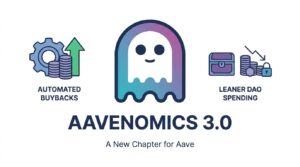
Aave’s governance framework has officially activated Aavenomics 3.0, putting automated AAVE token buybacks into operation while simultaneously trimming DAO operational spending. The milestone completes a governance roadmap the protocol has been assembling since mid-2024, following the passage of the Aavenomics Part One ARFC and subsequent on-chain votes. For a DeFi lending protocol that controls billions in total value locked, the shift signals a deliberate pivot toward capital efficiency and long-term token value accrual.
What the Aavenomics 3.0 Activation Actually Means for Stakeholders
Before unpacking the mechanics, it helps to frame why this matters beyond the protocol’s own community. Aavenomics 3.0 touches token holders, liquidity providers, competing DeFi protocols, and arguably regulators watching how decentralised treasuries manage capital. Here are the key strategic takeaways:
- Automated buybacks create persistent demand-side pressure on AAVE tokens, reducing reliance on speculative trading volume to support price floors.
- DAO operational spending cuts suggest Aave governance is prioritising sustainability over growth-at-all-costs, a posture more common in mature organisations than early-stage protocols.
- The activation validates a multi-phase governance process that began over a year ago, demonstrating that decentralised decision-making can execute complex economic redesigns on schedule.
- Competing lending protocols now face a benchmark: Aave has formalised a value-return mechanism that most DeFi governance tokens still lack
- Token buybacks funded by protocol revenue blur the line between utility tokens and equity-like instruments, a distinction regulators have been slow to enforce in DeFi contexts.
How the Buyback Mechanism Works
At its core, the automated buyback system channels a portion of Aave’s protocol revenue directly into purchasing AAVE tokens from the open market. Unlike discretionary treasury operations that require repeated governance votes, this mechanism runs programmatically. That distinction matters. It removes the friction and political negotiation that typically slow down capital allocation in DAOs.
Aave generates revenue primarily through interest rate spreads on its lending and borrowing markets across multiple chains. By routing a defined share of that revenue into buybacks, the protocol creates a structural feedback loop: higher utilisation leads to more revenue, which leads to more token purchases.
Whether this constitutes a “dividend” or a “burn” equivalent depends on how the purchased tokens are handled. Some buyback models retire tokens permanently; others redirect them to staking rewards or ecosystem reserves. The specific routing in Aavenomics 3.0 follows parameters set through Aave’s on-chain governance process, which token holders voted to approve.
Spending Discipline in a Decentralised Treasury
The other half of this equation deserves equal attention. Reducing DAO operational spending is, in practice, harder than it sounds. Decentralised organisations face constant pressure to fund new initiatives, grants, integrations, and contributor teams. Saying no requires coordination across a dispersed voter base with competing incentives.
Aave’s ability to execute spending reductions alongside a buyback programme suggests its governance participants are thinking in terms of net cash flow rather than gross expenditure. That framing is more sophisticated than what most DAOs demonstrate. Still, the real test comes over the next several quarters: can spending discipline hold when market conditions shift or when a competitor launches an aggressive incentive campaign?
A Comparison of DeFi Governance Token Value Mechanisms
| Protocol | Buyback Mechanism | Revenue Source | Spending Governance |
|---|---|---|---|
| Aave (Aavenomics 3.0) | Automated, on-chain | Lending interest spreads | Reduced operational budget via ARFC vote |
| MakerDAO | Surplus buffer burns | Stability fees, liquidation penalties | Endgame restructuring in progress |
| Uniswap | No active buyback; fee switch debated | Trading fees (not yet distributed) | Grants-focused, no formal spending cuts |
| Compound | None | Interest rate margins | Community grants, limited treasury management |
The contrast is stark. Aave now operates with a formalised capital return mechanism that most peers have only discussed.
Reframing DeFi Governance Through Behavioural Lenses
Beyond the financial engineering, Aavenomics 3.0 offers a case study in how decentralised communities make consequential economic decisions. Applying principles from behavioural decision science and neuro-linguistic programming reveals patterns worth examining.
Governance proposals in DeFi succeed or fail based partly on how they are framed. The Aavenomics roadmap was presented not as a single radical change but as a phased journey, each step building on the last. This incremental framing reduces perceived risk for voters. Psychologically, committing to “Part One” of a plan feels less irreversible than approving a sweeping overhaul, even when the cumulative effect is identical.
There is also an anchoring effect at play. By establishing the mid-2024 proposal as the reference point, subsequent votes were evaluated relative to an already-accepted baseline rather than against the status quo. Voters were not asking “should we do this?” but rather “should we continue what we already started?” That reframe dramatically shifts approval dynamics.
Language choices in governance forums reinforced these patterns. Terms like “optimisation” and “sustainability” carry positive valence without triggering loss aversion the way “cuts” or “reductions” might. Even the branding, Aavenomics 3.0, implies evolution rather than disruption. And while the substance is genuinely significant, the packaging made it easier for a decentralised electorate to process and endorse.
Community engagement data from governance forums also suggests that participation rates held steady or increased through each phase. This contradicts the common assumption that multi-step governance processes suffer from voter fatigue. One possible explanation: each phase provided a sense of progress and completion, triggering what behavioural scientists call the “goal gradient effect,” where motivation increases as a perceived finish line approaches.
Frequently Asked Questions
What triggers the automated AAVE buybacks?
Protocol revenue from lending and borrowing activity across Aave’s deployed chains funds the buybacks. The mechanism operates programmatically based on parameters approved through governance, without requiring repeated manual votes.
Does Aavenomics 3.0 affect staking rewards?
The buyback structure interacts with Aave’s broader tokenomics, but specific impacts on staking yields depend on how purchased tokens are allocated. Governance documentation outlines the routing logic approved by voters.
How does this compare to traditional stock buybacks?
Structurally, there are parallels: protocol revenue replaces corporate earnings, and token purchases replace share repurchases. But DeFi buybacks operate transparently on-chain, with parameters set by token holders rather than a board of directors. The regulatory classification remains an open question in most jurisdictions.
Can the buyback parameters be changed?
Yes. Like all Aave governance decisions, the mechanism’s parameters can be modified through subsequent proposals and on-chain votes. Nothing in the current framework is permanently locked.