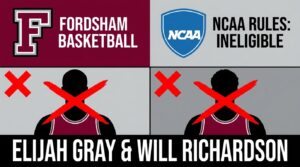
The NCAA has declared former Fordham basketball players Elijah Gray and Will Richardson ineligible, a decision that carries immediate roster implications for the Rams and raises broader questions about transfer portal compliance. The ruling, which affects two players who were expected to contribute meaningful minutes, lands at a particularly inconvenient moment for a program working to rebuild its competitive standing in the Atlantic 10 Conference. Both players had transferred to Fordham with the expectation of gaining eligibility, making this outcome a significant setback for the university’s basketball operations.
What the Ineligibility Ruling Means for Fordham’s Roster
Losing two players to eligibility issues before they ever suit up is more than a scheduling inconvenience. It fundamentally reshapes how the coaching staff approaches depth, rotation planning, and recruiting strategy for the upcoming season. The following points capture the strategic weight of this decision:
- Immediate depth reduction: Fordham loses two backcourt contributors who were factored into preseason planning, forcing adjustments across guard and wing rotations.
- The ruling may deter future transfer portal targets from considering Fordham if the program is perceived as carrying eligibility risk.
- Recruiting timeline pressure: With rosters largely set across Division I, finding replacement-level talent at this stage becomes exponentially harder.
- Conference competitiveness: In a league where margins between middle-of-the-pack and bottom-tier are razor-thin, losing two eligible bodies could shift projected win totals by several games.
- The decision underscores the NCAA’s continued scrutiny of transfer eligibility documentation, a process that remains opaque to many programs (and, arguably, to some compliance offices themselves).
Who Are Elijah Gray and Will Richardson?
Elijah Gray arrived at Fordham University’s basketball program through the transfer portal, carrying expectations built on prior collegiate experience. Will Richardson similarly entered the program as a transfer, with both players expected to slot into rotation roles that would have bolstered Fordham’s backcourt. Their combined experience was viewed internally as a stabilizing force for a team that needed veteran presence.
Yet neither player will take the court for the Rams. The NCAA’s determination that both are ineligible effectively erases months of integration work, from practice reps to team chemistry-building, that cannot be recovered on a recruiting trail this late in the cycle.
The Transfer Portal’s Compliance Minefield
This case sits at the intersection of two forces reshaping college athletics: the explosion of transfer portal activity and the NCAA’s uneven enforcement of eligibility standards. Since the introduction of the one-time transfer exception, the volume of players moving between programs has surged dramatically. But the administrative infrastructure supporting those moves has not always kept pace.
Programs are now managing compliance workflows that involve multiple institutions, varying academic calendars, and eligibility clocks that don’t always align neatly. A misstep in documentation, a credit-hour shortfall, or an unresolved academic hold at a prior institution can derail a player’s eligibility months after they’ve already committed and relocated. What remains less clear is whether Fordham’s situation stemmed from an academic shortfall, a waiver denial, or something else entirely. The NCAA has not publicly detailed the specific grounds for either ruling.
How Programs Can Mitigate Eligibility Risk
Schools recruiting heavily from the portal would benefit from treating compliance verification as a front-loaded process rather than a parallel one. That means:
- Requesting full academic transcripts and eligibility documentation before extending a scholarship offer, not after
- Engaging compliance staff in initial conversations with prospective transfers, rather than looping them in post-commitment
- Building contingency roster plans that account for the possibility of one or more transfers being ruled ineligible
Still, even the most diligent programs occasionally get caught by rulings they didn’t anticipate.
Broader Implications for Mid-Major Programs
Fordham’s situation is not unique, but it hits harder at the mid-major level. Power conference programs can absorb the loss of two players through deeper recruiting pipelines and NIL-driven portal acquisitions. For a program in the Atlantic 10, the margin for error is considerably narrower.
| Factor | Power Conference Impact | Mid-Major Impact |
|---|---|---|
| Roster depth after loss of 2 players | Manageable through existing depth and late portal additions | Potentially season-altering; limited replacement options |
| Recruiting leverage | Brand and NIL resources offset eligibility concerns | Eligibility issues can create lasting reputational drag on recruiting |
| Compliance resources | Dedicated compliance teams with institutional support | Often understaffed, with compliance officers juggling multiple sports and responsibilities simultaneously |
And while the NCAA’s transfer rules were designed to give athletes more freedom, the compliance burden has arguably shifted disproportionately onto the receiving institution. That asymmetry deserves more attention than it currently receives.
What Fordham Does Now
The coaching staff faces a decision tree with no ideal branches. They can attempt to find late additions through the transfer portal, though the talent pool at this stage is thin. They can promote walk-ons or younger players into expanded roles, accepting the developmental cost. Or they can simply play the season short-handed, banking on scheme adjustments to compensate for the personnel gap.
None of these paths fully replaces what Gray and Richardson were expected to bring. The Rams will enter the season lighter than planned, in a conference that doesn’t forgive thin rosters.
Frequently Asked Questions
Why were Elijah Gray and Will Richardson ruled ineligible?
The NCAA has not publicly disclosed the specific reasons behind either player’s ineligibility determination. Possible factors in transfer eligibility cases typically include academic credit shortfalls, unresolved issues at a prior institution, or denied waiver requests.
Can Fordham appeal the NCAA’s decision?
Yes, institutions generally have the right to appeal eligibility rulings through the NCAA’s reinstatement process. Whether Fordham pursues that route, and on what timeline, has not been confirmed publicly.
How does this affect Fordham’s upcoming season?
The loss of two expected rotation players significantly reduces backcourt depth and could impact the team’s competitiveness in Atlantic 10 play. Late-stage roster adjustments are possible but constrained by the current transfer portal timeline.
Is this kind of ruling common in the transfer portal era?
Eligibility complications have become more frequent as transfer volume has increased across Division I. Not every case becomes public, but compliance offices across the country are managing a higher volume of complex eligibility reviews than at any previous point in college athletics.



