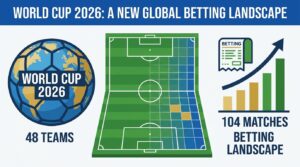
The 2026 FIFA World Cup will be the largest in tournament history, expanding to 48 teams across 104 matches hosted in the United States, Canada, and Mexico. That expansion doesn’t just rewrite the sporting calendar. It fundamentally alters the economics, regulatory complexity, and operational demands facing the global sports betting industry. For operators, affiliates, and regulators alike, the tournament represents both a commercial windfall and a stress test of unprecedented scale.
What the Expanded Format Means for Betting Markets
Before unpacking the strategic implications, it’s worth grounding the numbers. The jump from 32 to 48 teams adds 40 additional matches compared to the 2022 Qatar edition, stretching the tournament window and multiplying the volume of in-play and pre-match markets available to bettors worldwide. Here are the key business takeaways:
- Extended betting window: More matches over a longer schedule means sustained engagement rather than the compressed intensity of previous tournaments, giving operators more days to acquire and retain customers.
- New market depth: Teams from smaller footballing nations entering the group stage introduce unfamiliar matchups, creating pricing challenges for oddsmakers and opportunities for sharp bettors.
- The tri-nation hosting model spans multiple time zones, which could fragment peak betting hours but also broaden the daily window for live wagering across North America, Europe, and Asia.
- Regulatory patchwork: With matches spread across the U.S., Canada, and Mexico, operators must navigate at least three distinct regulatory frameworks (and, within the U.S., a state-by-state licensing mosaic that remains incomplete).
- Sponsorship and media rights: Longer tournaments attract higher cumulative viewership, which in turn inflates the value of betting-adjacent sponsorship deals and data partnerships.
A Regulatory Puzzle with No Single Answer
The United States alone presents a fragmented picture. Since the Supreme Court struck down PASPA in 2018, more than 30 states have legalized some form of sports betting. But legality varies sharply by jurisdiction. Some host cities for 2026 matches sit in states with mature, competitive markets. Others do not. Texas, for instance, has no legal sports betting framework despite hosting matches in the Dallas–Fort Worth area.
Canada’s situation is comparatively straightforward. Ontario launched its regulated iGaming market in April 2022, and single-event sports betting became legal nationwide in August 2021. Mexico, meanwhile, operates under a federal permit system that has drawn criticism for opacity and inconsistent enforcement (a distinction regulators have been slow to address publicly).
What remains less clear is how cross-border data flows, geolocation compliance, and advertising standards will be harmonized, if at all. FIFA’s own integrity protocols add another layer. Operators with ambitions to run World Cup promotions across all three countries face a compliance burden that arguably exceeds anything the industry has encountered at a single sporting event.
Why Operators Are Already Positioning
Major sportsbooks aren’t waiting for kickoff. FanDuel’s sportsbook operations and DraftKings have both signaled increased investment in soccer-specific content and market offerings ahead of 2026. The logic is straightforward: the World Cup is the single most-watched sporting event on the planet, and hosting it in North America collapses the time-zone barrier that historically dampened U.S. engagement with the tournament.
European-heritage operators like bet365 and Betway, already dominant in global football betting, see the expanded format as a chance to deepen their North American footprint. And while U.S.-born brands have traditionally lagged in soccer market sophistication, the two-year runway gives them time to build out prop bet libraries, same-game parlays, and player-level markets that football bettors in Europe and Latin America already expect.
Still, customer acquisition costs during a World Cup spike dramatically. The 2022 tournament saw some operators spend upward of $500 per new depositing customer during peak promotional windows. Scale that to a 104-match tournament in the world’s most competitive advertising market, and the math gets uncomfortable fast.
How the Expanded Calendar Shifts Bettor Behavior
Tournaments compress attention. A 32-team World Cup creates urgency. Every group-stage match carries elimination weight from day one. With 48 teams split into 12 groups, the early rounds risk dilution. Some matches will feature heavy mismatches between established powers and qualifying debutants.
For bettors, that changes the calculus. Lopsided matchups tend to suppress handle on traditional moneyline markets but can boost exotic and derivative bets: correct score, total goals, Asian handicaps, and first-half results. Operators who adapt their market presentation to reflect this shift will capture more of the recreational bettor’s attention. Those who simply replicate their standard football template may find engagement plateauing after the novelty of opening week fades.
There’s also the question of in-play betting infrastructure. With matches potentially running simultaneously across venues in three countries, latency and data integrity become operational priorities. The demand for real-time, accurate data feeds will test even the most established providers.
Integrity and the Stakes Beyond Revenue
A larger tournament surface means a larger integrity surface. More matches involving teams from federations with less robust oversight infrastructure increases the statistical probability of irregular betting patterns. FIFA’s Early Warning System, operated in partnership with Sportradar, will face its most demanding deployment yet.
Regulators in all three host nations have signaled awareness of this risk. But awareness and preparedness are different things entirely. The U.S. has no single federal sports betting regulator. Canada’s provincial model creates coordination gaps. Mexico’s oversight capacity remains a question mark.
Frequently Asked Questions
How many matches will the 2026 World Cup feature?
The expanded 48-team format brings the total to 104 matches, up from 64 in the previous 32-team structure.
Will sports betting be legal in all U.S. host cities?
Not necessarily. While many host states have legalized sports betting, some venues are located in states where legislation has not yet passed. The regulatory landscape continues to evolve ahead of the tournament.
Why does the tri-nation format complicate betting operations?
Operators must comply with three national regulatory regimes and, within the U.S., potentially dozens of state-level frameworks. Advertising rules, licensing requirements, geolocation mandates, and data-sharing protocols differ across all jurisdictions. It’s a compliance challenge without modern precedent in sports betting.
What types of bets are expected to see the most growth?
In-play wagering, same-game parlays, and player prop markets are expected to see significant growth, particularly as operators invest in soccer-specific product development ahead of 2026. Derivative markets like Asian handicaps may also gain traction given the likelihood of lopsided group-stage matchups.



