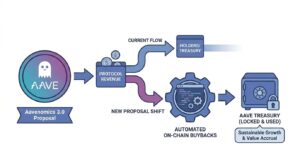
Aave founder Stani Kulechov unveiled a sweeping tokenomics redesign on Thursday, announcing Aavenomics 3.0 through a post on X. The proposal would dismantle the protocol’s current discretionary buyback program and replace it with a fully automated, non-discretionary on-chain mechanism. All protocol and GHO stablecoin revenue would funnel directly into this new system. If adopted, the shift could redefine how one of DeFi’s largest lending protocols distributes value to its token holders.
What Aavenomics 3.0 Signals for AAVE Holders and DeFi Governance
The move from discretionary to automated buybacks carries implications that stretch well beyond Aave’s own ecosystem. Discretionary programs, by nature, leave timing, scale, and execution to governance participants or core teams. That introduces uncertainty. Automated mechanisms, by contrast, remove human judgment from the equation, at least on paper. Here’s what matters most:
- Revenue alignment: By channeling all protocol and GHO revenue into buybacks, Aavenomics 3.0 ties token value directly to protocol performance rather than governance mood
- Reduced governance overhead: Eliminating discretionary decisions around buyback timing and size could streamline governance processes that have historically consumed significant community bandwidth
- The shift signals growing maturity in DeFi tokenomics design, where protocols increasingly seek to minimize trust assumptions even in treasury management
- Precedent risk: If Aave succeeds with this model, pressure mounts on competing lending protocols to adopt similar non-discretionary value distribution frameworks
- GHO’s role expands: Tying GHO revenue to the buyback engine gives Aave’s native stablecoin a more structural purpose within the protocol’s economic loop
Why Automated Buybacks Matter More Than They Seem
Discretionary buyback programs in DeFi have drawn criticism for years. The core problem: they often function as signaling tools rather than consistent value-return mechanisms. A governance vote to execute a buyback can take weeks. Market conditions shift. And the eventual execution may not reflect the original intent behind the proposal.
Aavenomics 3.0 attempts to solve this by encoding the buyback logic on-chain, removing the lag between revenue generation and token repurchase. That’s a meaningful architectural change. It transforms buybacks from a governance action into a protocol-level function, something closer to how traditional companies treat share repurchase programs under board-approved frameworks (a distinction regulators have been slow to enforce in crypto markets).
Still, questions linger. How will the mechanism handle periods of extreme volatility? What safeguards prevent front-running by actors who can predict buyback flows? Kulechov’s preview did not address these specifics in detail.
GHO Revenue as a Structural Pillar
One of the more consequential elements of the proposal is the inclusion of GHO stablecoin revenue in the buyback funding stream. Aave’s GHO stablecoin, launched in 2023, has been growing its circulating supply and integration across DeFi. But its role within Aave’s own economic model has remained somewhat peripheral until now.
Routing GHO revenue into an automated buyback engine changes that calculus. It creates a direct feedback loop: as GHO adoption grows, more revenue flows into AAVE buybacks, which arguably strengthens the token’s value proposition, which in turn reinforces confidence in the protocol backing GHO. Whether this virtuous cycle holds under stress conditions is another matter entirely.
The Broader DeFi Tokenomics Landscape
Aave is not operating in a vacuum. Across DeFi, protocols have been experimenting with fee switches, revenue sharing, and buyback-and-burn models. MakerDAO’s rebranding to Sky and its own tokenomics restructuring earlier this year set a tone. Uniswap’s prolonged fee switch debate highlighted how contentious value distribution remains.
What distinguishes Aavenomics 3.0 is the non-discretionary framing. Most protocols still rely on governance votes to activate or modify revenue distribution. By hardcoding the mechanism, Aave positions itself closer to what some in the industry call “credibly neutral” economic design. The protocol earns, the protocol buys. No committee, no vote, no delay.
Yet this rigidity cuts both ways. Governance flexibility has value during black swan events. Locking all revenue into a single mechanism leaves less room for emergency reallocation.
How Framing Shapes Market Perception
Beyond the technical mechanics, the way Aavenomics 3.0 has been presented carries its own weight. Kulechov’s choice to frame this as an “overhaul” rather than an incremental update signals ambition. In behavioral terms, anchoring the narrative around automation and non-discretion taps into a deep preference within the crypto community for trustless systems. The language itself does work: “automated” and “on-chain” carry connotations of transparency and reliability that resonate with DeFi-native audiences. This framing positions the proposal not merely as a tokenomics tweak but as a philosophical commitment to protocol-level neutrality. For governance participants evaluating the proposal, the psychological anchoring around removing human discretion may prove as persuasive as the economic modeling itself. Perception, in markets built on coordination and belief, often precedes and shapes the fundamentals it claims to reflect. How the community internalizes this framing will likely determine adoption speed as much as any technical audit.
Frequently Asked Questions
What is Aavenomics 3.0?
Aavenomics 3.0 is a proposed tokenomics overhaul for the Aave protocol that replaces its existing discretionary buyback program with an automated, non-discretionary on-chain mechanism funded by all protocol and GHO revenue.
How does this differ from the current buyback system?
The current system relies on governance decisions to initiate and size buybacks, introducing delays and subjectivity. Aavenomics 3.0 would encode buyback logic directly on-chain, executing automatically as revenue accrues. That’s a fundamental shift in how value flows back to token holders.
Will this affect GHO’s role in the Aave ecosystem?
Significantly. By including GHO revenue in the buyback funding stream, the proposal gives Aave’s stablecoin a more structural economic function within the protocol, tying its growth directly to AAVE token dynamics.
Has the proposal been formally voted on?
Not yet. Kulechov previewed the concept on X, and formal governance proceedings through Aave’s on-chain governance framework would need to follow before any implementation.