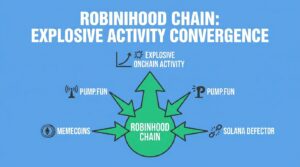
Robinhood Chain, barely a week old, experienced a dramatic surge in onchain activity this week as a memecoin frenzy, a fresh Pump.fun integration, and a defecting Solana-based application all converged on the nascent network. Yet the single largest inflow recorded wasn’t tied to speculative meme trading at all — it was a stablecoin deposit. Cumulative addresses on the chain have climbed rapidly, signaling that the network is attracting both retail speculators and more deliberate capital allocators in parallel.
What’s Driving the Surge on Robinhood’s New Chain
Before unpacking the numbers, it’s worth framing what makes this moment unusual. A brand-new Layer 1 or Layer 2 chain typically takes weeks, sometimes months, to generate meaningful traction. Robinhood Chain compressed that timeline into days, propelled by three distinct catalysts arriving almost simultaneously.
- A memecoin frenzy drew speculative retail users to the chain, mirroring patterns previously seen on Solana and Base during their early growth phases
- Pump.fun, the memecoin launchpad that became synonymous with Solana’s token creation boom, integrated with Robinhood Chain — instantly importing an established user base and launch infrastructure
- At least one notable Solana-native application migrated to the new chain, a move that carries both symbolic weight and practical liquidity implications
- The largest single capital inflow was a stablecoin deposit, suggesting institutional or whale-level participants are positioning on the network beyond the meme trade
- Cumulative wallet addresses have grown at a pace that, if sustained, would place Robinhood Chain among the fastest-growing networks in recent DeFi history
Pump.fun’s Role: Infrastructure Follows Attention
Pump.fun’s decision to integrate with Robinhood’s blockchain infrastructure is arguably the most consequential of the three catalysts. The platform has become the dominant memecoin launchpad in crypto, responsible for hundreds of thousands of token deployments on Solana alone. Its presence on a new chain doesn’t just bring volume. It brings a playbook — one that includes token creation tooling, liquidity bootstrapping, and a community of degens who follow the platform wherever it deploys.
That said, Pump.fun integrations haven’t always translated into durable ecosystems. Previous expansions to other chains generated initial spikes in activity that faded once the novelty wore off (a distinction worth watching closely over the next 30 days). Whether Robinhood Chain can retain these users depends less on the memecoin cycle and more on what else the network offers once the frenzy cools.
A Solana App Defects — And That Matters More Than It Sounds
One Solana-native application choosing to migrate or expand to Robinhood Chain might seem like a footnote. It isn’t.
Solana has spent the past 18 months building a reputation as the default chain for high-throughput consumer applications, particularly in the memecoin and payments verticals. When an established app on that network looks elsewhere, it signals something about either the competitive dynamics on Solana — congestion, fee pressure, attention fragmentation — or the incentive structures Robinhood is offering. Possibly both. The identity of the defecting app and the terms of its migration remain details worth tracking, because they’ll reveal whether this is an isolated move or the beginning of a broader pattern.
Stablecoin Inflows Tell a Different Story
Strip away the memecoin noise and the headline that arguably deserves more scrutiny is the stablecoin deposit. Large stablecoin inflows into a new chain typically indicate one of three things: market-making preparation, protocol-level liquidity provisioning, or a whale positioning for yield farming opportunities before they become crowded. None of these are casual retail behaviors.
The fact that this deposit represents the single largest inflow on Robinhood Chain suggests that sophisticated capital is already treating the network as more than a meme playground. What remains less clear is whether Robinhood itself facilitated or incentivized this deposit through grants, partnerships, or liquidity mining programs — mechanisms that most new chains deploy but rarely disclose in full detail.
How Robinhood Chain Compares to Early-Stage Network Launches
| Metric | Robinhood Chain (Week 1) | Base (Week 1, Aug 2023) | Blast (Week 1, Mar 2024) |
|---|---|---|---|
| Primary growth driver | Memecoins + Pump.fun | Friend.tech social app | Points-based yield farming |
| Largest single inflow type | Stablecoin deposit | ETH bridging | ETH/stETH deposits |
| Key infrastructure partner | Pump.fun | Coinbase ecosystem | Blur/Paradigm-backed |
| Retention risk | High — memecoin cycles are short | Moderate — social app had stickiness | High — points farming is mercenary capital by nature |
Reframing Early Traction: What NLP Principles Reveal About Market Narratives
There’s a pattern in how crypto markets process new chain launches that mirrors core principles of neuro-linguistic programming — specifically, the way framing and anchoring shape collective behavior. When a network launches and its first major narrative is memecoins, market participants anchor their perception of that chain to speculation. Every subsequent data point gets filtered through that initial frame. Robinhood Chain is experiencing this in real time: the memecoin frenzy dominates the conversation, while the stablecoin inflow — potentially more significant for long-term viability — receives secondary attention.
NLP’s concept of representational systems also applies here. Visual thinkers in the market respond to charts showing address growth curves. Kinesthetic participants respond to the feeling of being early, of deploying capital before the crowd. And auditory processors latch onto the narrative itself — “Robinhood has its own chain now” — without necessarily examining the underlying mechanics. Effective chain launches, whether by design or accident, tend to activate all three systems simultaneously. Robinhood’s combination of a recognizable brand name (auditory/narrative), rapid address growth (visual), and the visceral urgency of a memecoin frenzy (kinesthetic) hits all three channels.
Still, anchoring cuts both ways. If the chain’s first week becomes defined by rug pulls or failed meme tokens, that negative anchor could prove difficult to overwrite — regardless of how strong the underlying infrastructure turns out to be. The meta-model in NLP would push observers to challenge generalizations: one week of data, however dramatic, is not a trajectory. It’s a snapshot.
Frequently Asked Questions
What is Robinhood Chain?
Robinhood Chain is a newly launched blockchain network associated with the Robinhood brand, designed to support onchain trading and decentralized application deployment. It went live in late May 2025.
Why did Pump.fun integrate with Robinhood Chain?
Pump.fun follows user attention and volume. Robinhood’s brand recognition and early traction made it a logical expansion target for the memecoin launchpad, which has historically moved quickly to capitalize on new chain launches.
Is the memecoin activity sustainable?
Historically, memecoin-driven surges on new chains tend to be short-lived unless the network develops additional use cases. The stablecoin inflows suggest some participants are betting on longer-term utility, but the retention question remains open.
Which Solana app moved to Robinhood Chain?
Specific details about the defecting application have not been fully disclosed. The migration itself, however, signals competitive pressure within the Solana ecosystem and potential incentive structures on Robinhood’s side.